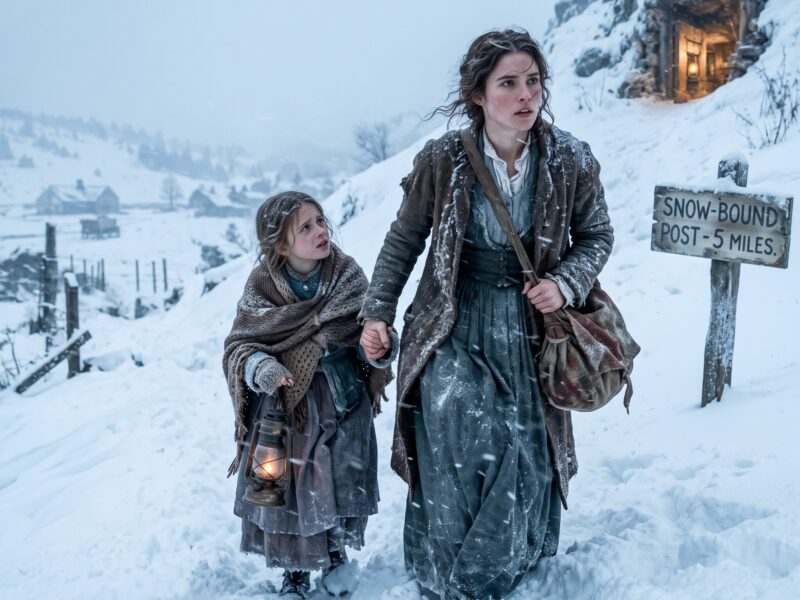
Thrown Into the Snow With Her Daughter—She Led Them to the Secret Her Husband Left Behind
Thrown Into the Snow With Her Daughter—She Led The…
The cold came early to Coldstone Creek in the autumn of 1886. It arrived earlier than the old-timers sitting on the porch of the general store could remember, and it came with a particular, creeping meanness that had nothing to do with the drop in temperature.
Owen Vane had known how to read it. He had a way of pressing his two fingers against the morning air, exactly the way a doctor presses against a patient’s wrist, feeling for a pulse the eye couldn’t catch.
“The sky turns a certain green before a bad one,” he told Cordelia once, during the last autumn they had together. “Not the green of leaves, Delia. The green of old copper.”
She hadn’t truly understood what he meant until the morning of November 8th. Cordelia stepped out of the heavy timber back door of Harlon Puit’s flour mill to shake the white dust from her heavy canvas apron. She looked up and found the entire eastern ridge wearing that exact color. It was a sick, mineral light that sat heavy over the jagged mountains, waiting like a held breath.
Owen had been dead for six weeks.
Cordelia Vane was thirty-four years old, and she had learned in those six agonizing weeks that grief was not the soft, slow, weeping thing people described at funerals. Grief was administrative. It was the brutal, unyielding weight of a hundred-pound flour sack that no longer had another set of strong hands to lift the opposite end.
It was the sound of her seven-year-old daughter, May, breathing in the dark corner behind the mill’s drafty plank wall—steady and trusting in a way that made Cordelia’s chest ache with a terror she had no name for. It was the mental inventory she kept running in her head every night before sleep finally claimed her: What they had. What they owed. What the week ahead required.
Owen had died in September. He was crushed under a survey team’s heavy equipment cart when the axle snapped on the treacherous switchback above Coldstone Creek’s upper canyon. The world had not paused for a single hour to allow her to mourn him properly.
There was a winter coming. There was May.
The arrangement with Harlon Puit had been understood from the start to be temporary. Harlon ran the only flour mill in the valley, a long, groaning timber building that smelled perpetually of dry grain and greased iron gears. He had offered Cordelia the work in a tone that made it explicitly clear he considered it charity, extended only within the bounds of strict reason.
She swept the suffocating grist dust from the milling floor each morning before the massive stone wheel started turning. She mended the rough burlap sacks that split along their seams, pushing a curved iron needle through layers of stiff material until her fingers bled and went numb. She kept the storage ledger with the careful, elegant handwriting Owen had always praised, noting each sack’s weight, position, and condition in columns so mathematically precise that Harlon had twice asked where a woman had learned to keep books.
She answered honestly: her father had kept accounts for a dry goods merchant in Santa Fe before the business failed. The answer seemed to satisfy Harlon without quite warming him.
Their home was a corner behind a plank wall in the back of the mill. It had a single iron lamp hook and a space just wide enough for a bedroll and a small wooden trunk. May slept well there, curled under the thick wool blanket Cordelia had packed on pure, panicked instinct the morning Owen’s crew boss had come to her door with his hat in his hands.
May was seven, with her father’s dark, serious brows and a habit of holding objects with both hands, as if she feared they might otherwise escape. She had cried for Owen for the first three nights. After that, the tears stopped. Instead, she started watching Cordelia, tracking her mother’s relentless movements around the mill the way a barn cat tracks a sound it cannot quite place.
The levadura had been Cordelia’s father’s before it was hers.
He had kept the sourdough mother culture alive for eleven years in a heavy clay jar sealed with breathable cloth. He fed it each week the way some men feed a fire they cannot let die, coaxing its fermentation through brutal, freezing winters and a summer drought that had cracked the adobe walls of his Santa Fe kitchen. When his business finally failed, he had given it to Cordelia on the day of her wedding. He pressed it into her hands without ceremony, as though handing over a working tool rather than a living heirloom he had tended for more than a decade.
Owen had understood its value immediately. He had built her a small, sturdy wooden shelf for the jar in every kitchen they’d ever occupied—always on the south-facing wall, always where the morning light could find it.
After he died, Cordelia moved the jar into the dusty mill corner with them. Every three days, she fed it a pinch of flour and a spoonful of water, watching the small, living bubbles form on the surface with the particular, quiet attention she could not afford to give to much else.
May had claimed the jar as her own responsibility sometime in October. Cordelia had not assigned the chore. One morning, the child had simply begun picking it up each day, checking the cloth seal, and setting it back in its place with both hands wrapped around the cool clay, treating it like a wounded bird that might not survive careless handling.
Cordelia watched her do it on the morning of November 8th, peering through a gap in the plank wall, flour dust still whitening the air around her. She crossed the floor, put her hand on May’s small shoulder for a moment—feeling the fragile bird-bones under the fabric, the profound steadiness of her—and then walked back to her broom.
Some things did not need to be named to be real.
Related Articles

They Mocked the Widow’s Dirt Cellar—Then the Freeze Left Every Cabin Cold but Hers Warm
They Mocked the Widow’s Dirt Cellar—Then the Freeze Left Every Cabin Cold but Hers Warm…

A Homeless Veteran and His German Shepherd Inherited a Ridge No One Wanted — 35 Feet In, They Found
Chapter 1 / 7 A Homeless Veteran and His German Shepherd Inherit… A Homeless Veteran…

Neighbors Laughed When He Built A Cabin Inside An Old Barn—Until It Kept His Home 35 Degrees Warmer
Chapter 1 / 8 Neighbors Laughed When He Built A Cabin Inside An… Neighbors Laughed…

His Sod House Had No Woodpile in January – Until the Trains Stopped and the Town Came Begging
Chapter 1 / 10 His Sod House Had No Woodpile in January – Until t……

She Built Her Cabin Over the Woodshed and Never Burned Wet Wood Again
Chapter 1 / 8 She Built Her Cabin Over the Woodshed and Never Bu… She…

The Duke Abandoned Her on Their Wedding Day—Years Later, He Discovered What He Had Lost
Chapter 1 / 7 The Duke Abandoned Her on Their Wedding Day—Years… The Duke Abandoned…

He Wedged a Tiny A Frame Into a Crevice Before Winter and His Family Slept at 75°F While Town Hit
Chapter 1 / 7 He Wedged a Tiny A Frame Into a Crevice Before Win……

He Was Too Old to Ride—So He Bought the Ruined Ranch and Found the Room Behind the Fireplac
Chapter 1 / 5 He Was Too Old to Ride—So He Bought the Ruined Ran……

Settlers Laughed at His Underground Heat Recovery Duct — Until It Kept His Cabin 71°F Warmer
Chapter 1 / 9 Settlers Laughed at His Underground Heat Recovery… Settlers Laughed at His…

A Navy SEAL Built a Home Inside a Mountain—Then His Dog Warned Him Before the Storm
Chapter 1 / 5 A Navy SEAL Built a Home Inside a Mountain—Then Hi… A…