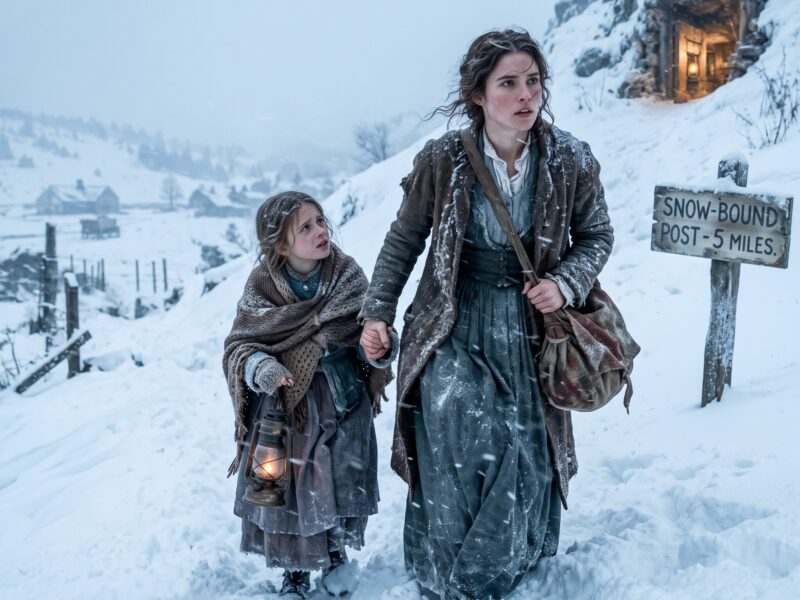
Thrown Into the Snow With Her Daughter—She Led Them to the Secret Her Husband Left Behind
The Listening Stone
May had fallen asleep before the fire was an hour old. She was curled on the bedroll with Flint pressed heavily against her back, acting as a living furnace. Owen’s wool coat—the one Cordelia had packed without thinking, the one that still smelled faintly of survey chalk, sweat, and boot oil—was folded under her head in place of a pillow.
Cordelia had not put the coat in the bedroll. She didn’t know when May had taken it. She sat beside the fire, feeding it small, precise sticks, and looked at her daughter. She did not try to work out the exact moment it had happened. Some things revealed themselves by being already done rather than by being witnessed.
She did not sleep immediately. She went through the inventory in her head, the way she did every night at the mill. What they had. What the week required. What could be extended. But the calculation felt profoundly different in Iron Hollow than it had in the dusty corner of Harlon Puit’s property.
In the mill corner, she’d been calculating survival strictly within Harlon’s tolerance for her presence. Here, the calculation was purely between her and the ground she was standing on.
She thought about the sketch in her coat pocket. Owen’s name written in Elias’s messy hand beside two words that had been waiting patiently in a survey chart’s margin for eleven months. Owen had asked Elias about Iron Hollow in August. Which meant he had been thinking about it as a contingency.
He had been the kind of man who made contingencies without speaking them aloud. Who prepared for the worst version of events he desperately hoped would not occur. Who understood that the difference between surviving a bad winter and dying in one was often a tiny piece of information filed away in September that you needed in November.
She pressed her face briefly into the rough wool collar of her own coat. Not to cry. She was absolutely not going to cry tonight; there was too much engineering to think about. She did it because the coarse texture of the fabric was a data point, a specific sensory location in time that told her where she was in relation to where she had been.
Then she sat up, stoked the fire, and began planning the morning.
On the third day, she found the inner chamber.
The passage beyond the main shelter narrowed for twenty feet, the smooth stone pressing in from both sides until she had to turn sideways, scraping her shoulders to move through it. Then, it opened into a second space. It was smaller than the first, with a lower ceiling. The walls curved inward at the top in the way limestone curved when water had shaped it over centuries, with more patience than any human project could afford.
The floor was significantly drier than the outer chamber, almost powdery in the corners. More importantly, a crack in the ceiling—a clean, deliberate-seeming line where the rock had separated along ancient fault lines—admitted a brilliant blade of sunlight.
It tracked across the floor for several hours each day, moving from the northeast corner to the center as the winter sun arced low over the canyon rim.
Cordelia stood in that chamber for a long time, watching the dust motes dance in the light.
The warmth under her boots was more pronounced here than in the outer chamber. Not dramatically so—she was not standing on heated coals, nothing was theatrical about it—but when she knelt and pressed her bare palm to the floor, she felt what she’d felt on the slope above the hollow on the first day.
It was residual, persistent heat, behaving as though it had somewhere to be rather than something to lose. The geological survey notation had said possible geothermal influence.
She was no longer treating that as a possibility. It was a fact.
She came back to the outer chamber and looked at the levadura jar resting safely on its new rock shelf. Then she looked at Owen’s leather seed pouch sitting on the trunk lid. Then she looked back at the inner chamber entrance.
She told May that afternoon while they were splitting dried meat from the first snare she’d successfully set along the Artemisia thicket. She’d used Flint’s nose and the compressed grass signs of regular rabbit passage to find the game trail.
“We are going to grow things here,” Cordelia said, her voice echoing slightly off the sandstone.
May looked at the leather seed pouch. She looked at the dark inner chamber entrance. She looked back at her mother. Her young expression did not suggest doubt. It suggested calculation.









