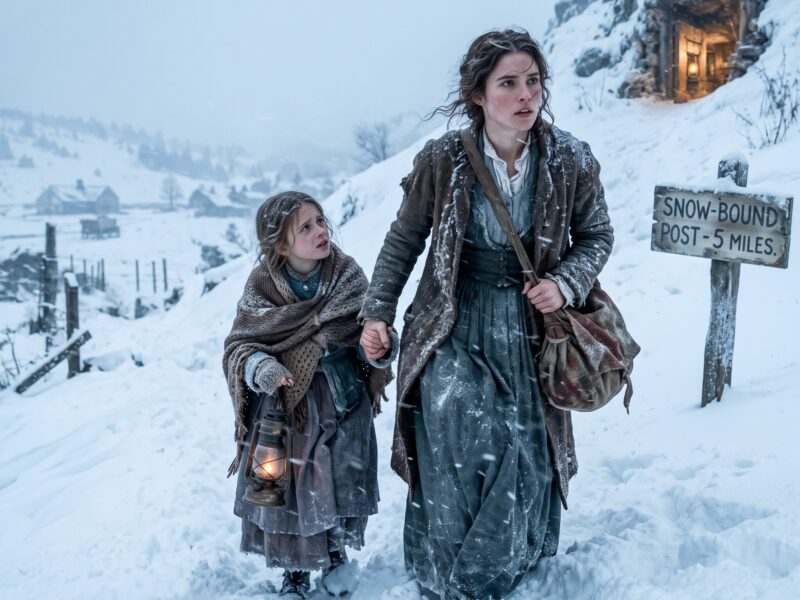
Thrown Into the Snow With Her Daughter—She Led Them to the Secret Her Husband Left Behind
The Liar's Surface
The track narrowed violently as it climbed, shedding width the way a river sheds volume in a drought. Soon, it was barely wide enough for the mule and a walking person side by side.
On their left, the valley fell away in staggering stages. The lower meadows were already painted gray-white with frost. Coldstone Creek itself was a dark, winding thread between banks thickening with jagged ice at the edges. On their right, the sheer canyon wall rose in massive sandstone layers. Each stratum was a different shade of rust-red and cream—the exact colors Owen had spent hours studying with the survey charts.
He’d had a name for each layer. She remembered him tapping a dark band of limestone. “The listening stone, Delia,” he had said. “It holds heat from the day until well after midnight. Warm enough to put your bare hand against at two in the morning in late October and feel something the air has already forgotten.”
May walked without a single complaint. This was not because the eight-year-old was unaware of the freezing death creeping toward them, but because she had decided that complaining was not useful. It was Owen’s qualities showing through. He had named things, noted them, set them aside, and moved to what could be done.
A heavy pine bough somewhere high above collapsed under an ice load. The sharp crack arrived first, echoing like a rifle shot, followed by the sound of wood smashing against stone.
Flint’s ears pinned forward. He assessed the ridgeline, found nothing requiring immediate violence, and continued walking. Cinder exhaled once, registered the hostile world as it was, and continued walking. Cordelia put a bare hand briefly on the mule’s neck as they passed the spot, confirming the warm, muscular solidity of the animal rather than comforting it. The mule was not afraid. The mule was simply present.
The storm found them at the upper switchback, exactly where Cordelia had calculated it would if they moved at Cinder’s stubborn pace.
The wind arrived first. It was channeled between the sheer canyon walls until it gathered a specific, directional violence, stripping away the ambient hostility of open-country weather and replacing it with a focused, screaming assault. Snow came sideways, stinging their faces, then found a downward angle once the canyon turned east.
May pulled her collar up without being told, burying her chin in the wool. Cinder lowered her massive head two degrees and pushed forward. Flint moved closer to Cordelia’s left leg—not seeking comfort, but reducing the distance he’d have to cover if the pack leader required a response.
Cinder slipped on ice hidden under the new, powdery snow. It wasn’t a dramatic fall—just one knee buckling, a snort of surprise, and a controlled, desperate recovery. Both woman and mule were up again before the motion fully registered in Cordelia’s panicked brain.
The ice was the real killer here. Owen had called this kind a liar’s surface. It looked like soft snow, but it moved like greased glass. It was formed during the false warm two days ago, when temperatures lifted just enough to melt the surface before dropping hard in the night. He’d made Cordelia practice walking on ice every January, starting from their first winter together, insisting on it the same way he’d insisted on other practical knowledges he considered non-negotiable.
She was using all of it now.
She pulled out Elias’s sketch at the fork. The pencil line showed a branching she would have completely missed—a narrow gap in the canyon wall disguised by a massive limestone overhang that threw a pitch-black shadow across the entrance regardless of the time of day.
She turned Cinder toward it. The mule assessed the impossible angle briefly, found it acceptable, and followed. Flint had already gone through. The passage was so narrow that Cinder’s saddlebags scraped the stone on both sides. Cordelia watched the leather carefully, holding her breath.
Within ten steps, the screaming wind dropped.
It didn’t disappear entirely, but it was structured, broken into smaller, harmless currents by the towering stone walls running thirty feet above on either side. The snow falling here was lighter, drifting rather than driving. The floor of the canyon showed ground in patches—dark earth between the white, scattered along the length of the hollow as far as she could see in the failing, gray light.
The passage turned once, sharply, and then the canyon opened.
A massive sandstone overhang projected from the east wall, covering a substantial portion of the floor in a natural shelter. It extended deep into a recessed section of the cliff face—three sides of solid stone and a roof that nature had already provided.
The floor beneath the overhang was almost entirely bare of snow. It wasn’t damp. It was dry with the particular, dusty dryness of a surface rarely reached by precipitation, maintaining its own environment independent of what the apocalyptic sky was doing.
Cordelia crouched down and removed her glove. She pressed her bare palm flat against the dirt floor.
It was cold—the biting cold of November in the New Mexico territory, there was no question of that. But it was not congealed. The earth broke apart under her fingers rather than ringing against them like iron, the way frozen ground did. It yielded an inch down. Then two.
She stayed crouched longer than the information required. She was waiting. The way Owen had taught her. Never rush from observation to conclusion, Delia. Always wait until the thing being observed has finished showing itself.
She stood up. She looked at the overhang, the recessed wall, the dry floor, and the canyon passage that had miraculously reduced the blizzard to a fraction of its open-country force. She looked at May, who was standing with the levadura jar held tightly against her coat, waiting with the patient stillness that was either her own quality or Owen’s. Cordelia could no longer cleanly separate them.
She gathered fuel first. Dry wood was limited inside the hollow, but the canyon walls had sheltered fallen branches in their deeper recesses, tucked under rock ledges where the snow hadn’t reached. It was a resource you only found if you spent time actively looking rather than assuming.
She hauled two armloads back under the overhang, stacking them against the sandstone wall. Flint investigated the hollow’s full length while she worked, returning twice to a deeper recess beyond the main shelter area, then to the entrance, then to Cordelia. He wasn’t anxious; he was methodical. The dog was building a mental map of the place the exact same way she was.
When she had enough fuel, she built the fire at the overhang’s edge, not under it, because she needed to see what the smoke did before committing to a fire position she couldn’t safely change. The wood was dry enough to catch without the frustrating, multiple attempts damp wood required.
The smoke rose in a straight column, at first stark white against the darkening canyon walls. Then, as the fire established itself and the smoke volume increased, the column bent.
It didn’t drift toward them. It didn’t hang stagnant in the overhang above, which would have suffocated them. It bent away from the sandstone wall, angled precisely toward the dark passage leading deeper into the canyon, and disappeared.
May watched it go. Cordelia watched it for another full minute, tracking the direction to confirm it was consistent, not a temporary artifact of the wind’s current angle outside.
The direction held.
There was a natural draft moving through the hollow, pulling air from the entrance toward the deeper canyon, which meant the air had somewhere to exit. The smoke bent toward the dark.
The cave was breathing.









