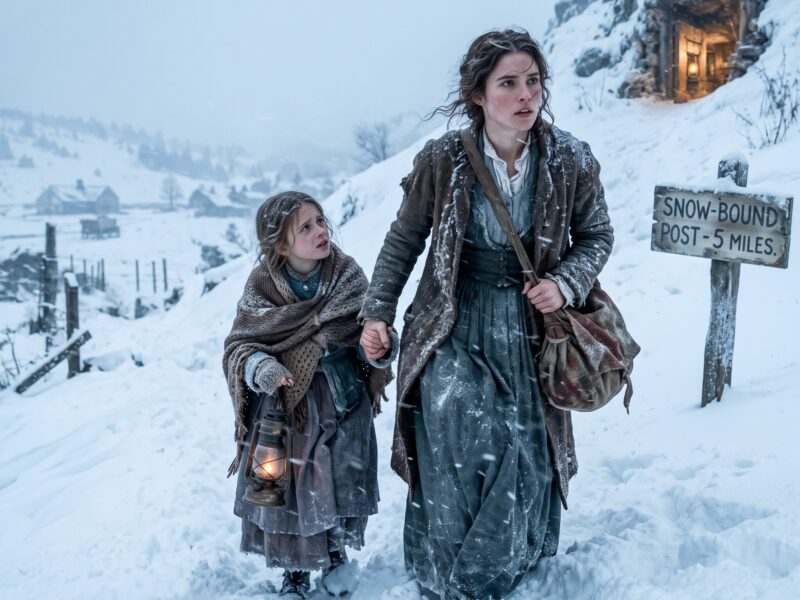
Thrown Into the Snow With Her Daughter—She Led Them to the Secret Her Husband Left Behind
The Leaking Roof
She had noticed the east storage roof in early October.
The problem was not dramatic. A section of heavy timber above the third row of flour sacks showed weathering along the joint where two boards overlapped. It was a soft, gray spongy rot that meant water had been finding its way through during the autumn rains. It would hold through a dry spell. It would not hold through a heavy snow load followed by a melt. The sacks underneath were positioned so that if moisture ran down the interior wall and pooled on the floor, the lowest layer of the town’s winter reserve would be directly in its path.
Cordelia had mentioned it to Harlon on a Wednesday. She stood in the storage bay with the ledger open to the exact page where she’d noted the affected inventory. She kept her voice neutral and factual—the exact way Owen had always said you had to speak to proud men who didn’t like being taught things by people they hadn’t hired for that purpose.
Harlon had looked at the roof, looked at the ledger, looked at Cordelia, and stated that it would be “seen to” before the first snow.
Reverend Silas Drum happened to be in the mill that morning, collecting his monthly tithe allotment of flour. He offered that the Lord had provided adequate roofing thus far, and he expected the Lord would continue to do so.
Harlon laughed. It was not an unkind laugh, but it was the laugh of a man who had just been given divine permission to let someone else’s concern become someone else’s problem.
The roof stayed exactly as it was.
The soft, gray rot at the joint spread another two inches by the end of October. Cordelia kept noting it in the ledger under a column she’d labeled simply Condition, because writing things down in ink was sometimes the only form of being heard available to her.
She was inside the mill, feeding the levadura its morning portion on November 8th, when the quality of light filtering through the gap in the planks changed. She remembered the copper-green sky. She set the jar back on its shelf and went to find her heavy leather boots.
Flint was already waiting at the mill’s back door when she came through it.
He wasn’t barking. He wasn’t moving. He was just oriented toward the eastern ridge with both ears pinned forward, his weight shifted to his front legs. The dog was broad-chested, a mix of wolfhound and mastiff. His fur was the dark, turbulent gray of storm clouds, thick enough that snow never reached his skin.
Owen had traded a surveying compass for him three years ago from a French-Canadian trapper passing through. Flint had chosen Cordelia as his primary concern within the first week, following her from room to room with the patient, unblinking attention of someone assigned to a task they took deadly seriously. His posture this morning was not alarm. It was the posture of a body that had received terrifying information and was waiting to see what the humans would do about it.
Cinder was stabled in the small, drafty shed attached to the mill’s north wall. The gray mule was old—Cordelia estimated fourteen years, though Owen had bought her secondhand without documentation. Cinder had a highly reliable way of communicating displeasure through a single, long exhale through her nostrils that conveyed more nuanced, withering judgment than most people managed with full sentences.
She made the sound twice before Cordelia even reached the shed. Cordelia checked the mule’s water trough and her hooves, finding nothing wrong with either. Which meant the mule’s complaint was about the air itself.
Elias Foot was loading thick leather saddlebags in front of the post house at the far end of the main dirt track when Cordelia came out to confirm the weather. Elias was forty-three, a lean, sinewy man with the weather-worn, leathery look of someone who spent more days sleeping outside than in a bed. He carried the valley’s mail and repaired saddle leather for anyone who needed it, and he asked no more of a conversation than it was willing to give.
He had never said anything particularly kind to Cordelia. He had also never said anything particularly unkind, which, in Coldstone Creek that winter, put him in a much smaller, better category of men than it should have.
When Elias saw her looking up at the copper-green ridge, he looked at it, too. He didn’t call out across the freezing distance between them. He just looked at the exact same sky she was looking at, which was its own kind of grim acknowledgment.









