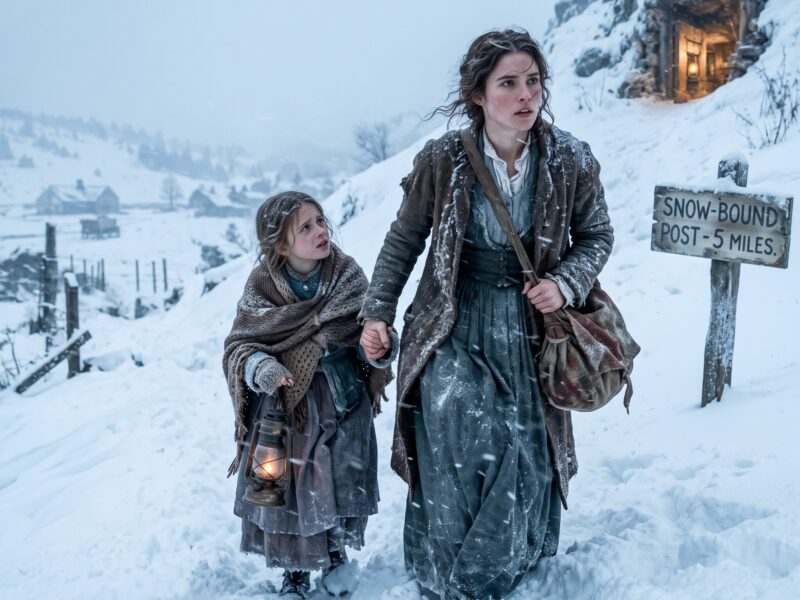
Thrown Into the Snow With Her Daughter—She Led Them to the Secret Her Husband Left Behind
The Eviction
Back inside, Harlon Puit came through the front doors of the mill at half-past seven. He was not alone.
Reverend Drum was behind him, along with two men from the upper end of the valley whose names Cordelia knew from the ledger, but whose faces she associated with the particular, hard expression of people who have decided something terrible before they’ve even entered the room.
Harlon moved to his usual position beside the storage bay entrance, resting one hand on the doorframe the way a man rests a hand on his own property. He looked at Cordelia the way he might look at a column of red figures in a ledger that had come out inconveniently.
“The storm is coming, Mrs. Vane,” Harlon said. “The flour stores are lower than anticipated after the autumn’s poor milling season.”
He paused, adjusting his collar. “There is not enough for arrangements that have been extended beyond what they were ever meant to sustain.”
He said it with the careful, sterile language of a man who prided himself on being reasonable, as though the reasonableness of the vocabulary could mask the brutality of the decision itself.
Reverend Drum stepped forward, clearing his throat. “Difficult winters require difficult choices, Sister. The community’s first obligation must be to those with established, permanent claims on its resources.” He said this in the specific, booming tone he reserved for things he’d already decided were righteous.
The two men from the upper valley said absolutely nothing. They were there as muscle. As witnesses. Not participants.
Cordelia absorbed the verdict. She stood beside the massive milling stone, white flour dusting her hands, the clay levadura jar resting on the shelf behind her. She did not look at the east storage roof, though she was painfully aware of exactly where the rot was.
She asked only one thing.
“How many hours before the storm reaches the valley floor?”
The question caught Harlon without words. He blinked, clearly expecting tears, or begging, or hysterics. He looked at Reverend Drum. Drum looked uncomfortably at the ceiling.
“Six hours, perhaps eight,” one of the upper valley men finally offered, shifting his weight. “Maybe less.”
Cordelia nodded. She turned around, took the levadura jar from the shelf, and walked through the plank wall.
May was already awake, sitting on the folded bedroll with the wool blanket wrapped tightly around her small shoulders. She was watching the gap in the wall with the expression she had developed back in October—the one that meant she had heard something terrifying and was still working out how to hold it.
Cordelia didn’t ask for permission to survive. They were packed and standing out in front of the mill within forty minutes.
The things Cordelia brought were not sentimental. The levadura. Owen’s oiled leather seed pouch, which he’d kept in the inside breast pocket of his work coat. It contained winter-hardy varieties a survey crew botanist had gifted him the previous spring: cold-frame rye, turnip, Detroit beet, and a Russian kale the man had called ‘iron weather’ because nothing else seemed to adequately describe it.
She packed a heavy coil of wire she’d been using to repair the mill’s equipment, deciding not to return it because there was always another task. The wool blanket. A small hand-axe Owen had ground to a razor edge she’d never been able to improve on. Thirty feet of hemp rope.
And the leather-bound mill ledger.
She took it because she’d paid for it with six weeks of her own bloody labor, and no one had ever given her a receipt.
She saddled Cinder methodically, not rushing, exactly the way Owen had taught her. If you rush the saddle, Delia, you’ll spend the whole ride paying for it. Harlon stood in the mill doorway, watching without speaking. Reverend Drum was already gone.
She passed Elias Foot on her way out of town. He was still at the post house, a second leather saddlebag now open on his hitching rail. He looked up from the buckle he was adjusting when Cordelia came level with him. He took in the loaded mule, the bedroll, May holding the levadura jar against her coat, and Flint moving ahead on the track.
Something shifted in Elias’s face. It was not quite pity, and not quite respect, but it occupied a complicated, heavily guarded territory between them.
He left the saddlebag, walked four steps to the edge of the dirt track, and stood there. He didn’t say anything because there was nothing practical to say to a woman walking into a blizzard. Instead, he reached into his heavy coat pocket, took out a folded piece of parchment, and held it out.
Cordelia took it. It was a rough sketch, hand-drawn with the heavy, unartistic lines of a man who worked with his hands rather than a draftsman. It showed the track north, the upper switchback where Owen had died, and a hidden fork she’d never taken. It was marked in pencil with two words: Iron Hollow.
Below the words, Elias had written one sentence: Owen asked me about this place in August.
She looked at Elias. He looked back with the grim expression of a man who had been carrying a heavy package and realized he should have delivered it much sooner.
She folded the paper, put it in her coat pocket beside Owen’s seed pouch, and turned north.









