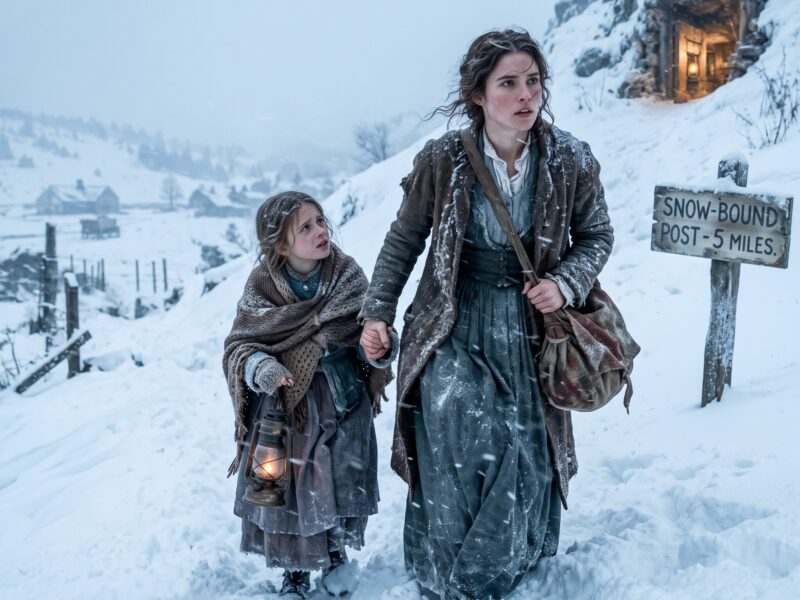
Thrown Into the Snow With Her Daughter—She Led Them to the Secret Her Husband Left Behind
The Cortavientos
Then, in the second week of December, the wind changed the rules.
Cordelia woke to Cinder’s sound from the outer hollow. Not the long, judgmental exhale, but a short, percussive breath twice in rapid succession. It was the sound the mule made when something unnatural had disturbed the physical space around her.
Flint was already at the overhang’s edge when Cordelia reached it, his weight shifted forward, looking straight up at the canyon rim.
What came was not the standard, freezing channel wind that moved through Iron Hollow’s length each evening. It was a violent mountain downdraft, falling directly over the rim like an anvil rather than running along it. It hit the canyon walls and shattered into competing, swirling currents that didn’t know which way they’d been asked to go.
The cortavientos—the stone windbreak wall she had painstakingly built—took the first impact badly. She’d built it for the channel wind, the one that came from the south. This wind came from above, finding the wall’s edge at an angle it wasn’t designed to resist.
A section near the north end gave way. It wasn’t catastrophic, but it was decisive, the internal pressures having found a joint mortared with frozen clay that had never fully cured.
The consequence was immediate and terrifying. The draft through the outer chamber instantly reversed, sending the toxic fire smoke blasting back toward the sleeping platform rather than toward the deep passage.
She spent the rest of that night working blindly by firelight, coughing on the bitter smoke. She pulled the compromised section of the wall down deliberately rather than letting it continue to fail on its own terms. She rebuilt the north end with the heavier boulders she’d been saving, setting them lower and wider.
At two in the morning, she lit a test fire near the oven and watched the smoke. It rose, hovered aimlessly, then drifted weakly toward the deep passage. She moved the fire six inches. Watched again.
The crushing answer came at four in the morning, and it arrived as humiliation rather than discovery.
She sat on the floor, her lungs burning, and ran back through every single change she’d made since the wall came down. She checked each masonry decision the way she checked a column of figures, looking for the step where the fatal error had been introduced.
The original cortavientos had a flaw. A gap in its lower course, a small, irregular space between two stones she’d left unfilled weeks ago because the stones hadn’t fit cleanly and she’d been exhausted. She had filled it tonight while rebuilding, fitting it with a perfect stone she’d been quite pleased with at the time.
That gap had been the draft’s route. The hollow breathed through that accidental gap. It was a crucial part of the circuit that moved air from the entrance, through the chamber, toward the deep passage chimney. She had built a better, stronger wall, and she had broken the hollow’s lungs doing it.
The flaw wasn’t the storm. It was the “fix” she’d engineered herself.
She grabbed the axe and violently smashed the perfect stone out of the wall.
The suffocating haze in the chamber began to clear within minutes. The smoke from the test fire bent sharply toward the passage and disappeared.
She sat back against the cold stone floor, wiping soot from her forehead, and let herself feel the specific exhaustion of working against something she had done to herself. External failure had causes you could point a finger at. This kind, you had to trace back to a decision you’d made with your own hands, thinking you were being smart.
She left the gap open forever. Her job was to fit herself into what already worked, rather than replace it with something she’d designed from the outside.









