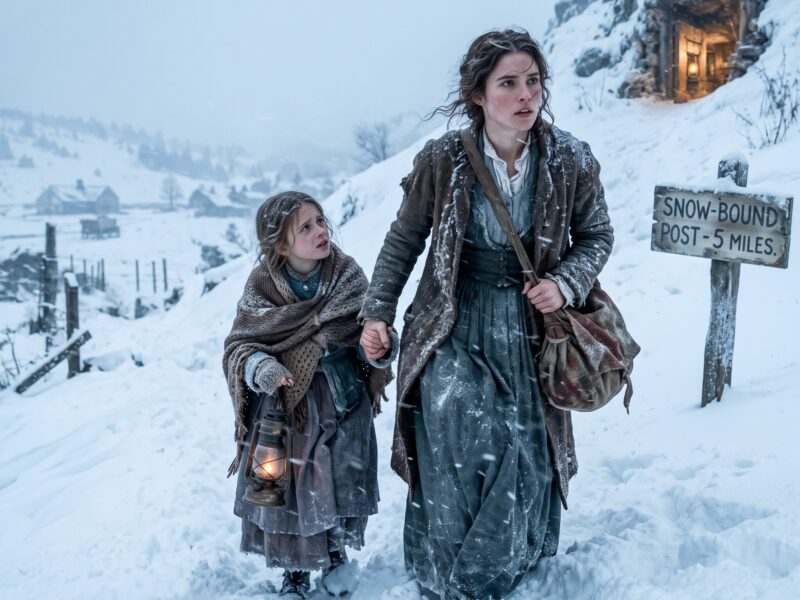
Thrown Into the Snow With Her Daughter—She Led Them to the Secret Her Husband Left Behind
The Vane Loaves
The deliveries began without announcement. Elias returned four days later with a saddlebag that had room in it going back down the mountain, and Cordelia loaded it with two more loaves and a cloth sack of kale, cut from the outer leaves of three plants, leaving the centers to continue producing.
She handed him the updated ledger page—quantities, names, the order she preferred for distribution based on what he’d told her about which households were most pressed. He folded the page into his coat pocket without reading it again. He did not ask if she was certain about feeding the household that had endorsed Harlon’s cruelty. She had not expected him to.
The valley received the bread without knowing its origin. The sacks were plain burlap, no markings, no notes. Elias distributed them in the dead of night as part of the regular motion of his work.
The stories that assembled themselves in Coldstone Creek bore no resemblance to the truth. A dead trapper’s cache discovered and shared? A wealthy ranch family sending provisions south? Rumors built themselves from the absence of information.
By January, the rye—the iron-weather rye—sent up pale green lines under the light blade that were impossible to look at without feeling a profound, overwhelming ache. Green in January in a canyon in the New Mexico territory. She had not made it miraculous. She had made it possible, which in her experience was far more durable.
Elias’s visits settled into a rhythm of every four to six days. He brought news, and sometimes, letters. Two letters were from women she’d worked alongside in the mill, who had apparently found things to say now that they were not saying them in front of Harlon. She read both letters twice and filed them in the ledger between pages.
Elias brought small supplies when he could manage them without it appearing in his store accounts as a line item that required explanation: nails, a handful of cornmeal from his own stores, a tin of salt that he presented without comment, and that she accepted the same way.
On a clear morning in the second week of March, Elias stopped at Iron Hollow with the news that the valley’s flour situation had finally stabilized. A merchant train from the south had reached Coldstone Creek two days prior with provisions sufficient to carry the settlement through to the spring harvest. The deliveries from Iron Hollow were no longer necessary.
He said this with factual neutrality. Then he said something he had not said before.
“People in Coldstone Creek are calling the bread by a name,” Elias said quietly. “Not officially. Just in the way things acquire names when the anonymous description becomes insufficient.”
He looked at the glowing stone oven. “They are calling them Vane Loaves.”
Cordelia was quiet for a long moment. She looked at the ledger open beside her.
“I would prefer they call them bread,” she said softly.
Elias nodded. He took the final saddlebag delivery, said he would be back in four days, and went through the passage.









