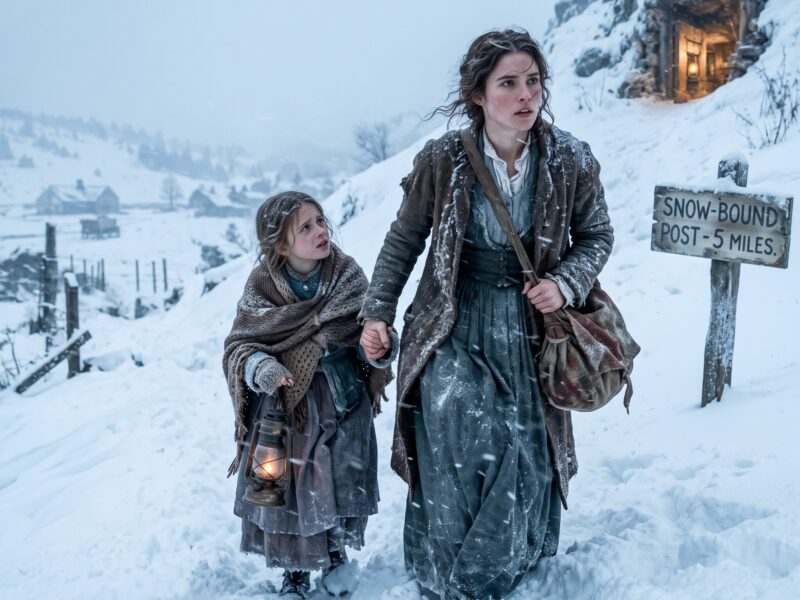
Thrown Into the Snow With Her Daughter—She Led Them to the Secret Her Husband Left Behind
The Reckoning of Stone
They came up the mountain on a Thursday.
Cordelia knew they were coming only because Elias had sent a note tucked into his last delivery sack: Some of them will want to see it.
She heard them before she saw them. The narrow passage between the canyon walls amplified and directed the sound of deliberate footsteps on stone. Harlon Puit came through the gap first, not because he led the group, but because his bulk moved most efficiently through the limestone gap.
Vernon Galt, the town’s master carpenter, followed. Then Reverend Drum, holding his hat in both hands. Then six or seven others, including the woman from the dry goods store window, and a younger woman carrying an infant.
They moved into the outer chamber and stopped dead.
The hollow looked different with people in it. The systems she’d built were starkly visible with human bodies providing scale. The cortavientos rising to chest height. The food storage hanging securely from the ceiling. The massive stone oven against the east wall with its thick sandstone backing and its narrowed mouth. The ledger opened on the flat stone to a page of delivery records, written in the same hand she’d used for Harlon’s inventory.
Vernon Galt walked straight to the oven. He leaned forward, reading the construction. He traced the joint between the clay and the stone. He looked at the mouth, the channel cut for the stone plug. He reached out and lifted the plug, turned it over, and set it back.
“Draft stays consistent,” Vernon said, his voice hushed with professional awe.
Cordelia confirmed it. He asked how. She explained the gap in the cortavientos—the space she’d nearly closed, the function she’d almost eliminated without understanding it. She described the downdraft event, the hours of frantic reconstruction, the realization that the hollow breathed through an opening she created by accident.
Vernon listened the way a builder listens. He did not offer corrections. For Vernon Galt, this was the most complete form of acknowledgment available.
Harlon Puit moved through the outer chamber much more slowly, stopping at intervals to assess rather than observe. He looked at the food storage system, noting the elevation and the air circulation. He checked the wall surfaces for moisture indicators.
Then he stood near the oven, looking at the warm storage zone beside it. He stood there for a time that was longer than the area required.
Cordelia knew what he was looking at. He was looking at the east storage roof in Coldstone Creek. He was looking at the conversation in the mill bay when she’d had the ledger open, and he’d laughed it off. He was looking at his own hubris, measured against a widow’s survival.
He turned from the storage area and moved toward Cordelia, stopping at a respectful distance. He looked at the space between them rather than directly at her.
“How did you keep the moisture out of the storage?” Harlon asked. His voice carried none of the mill doorway register. It was the defeated voice of a man who needed a specific piece of information, asking the only person who had it.
She told him. Elevation first. Air circulation on all sides. Reading the wall faces before assigning storage positions. Checking the roof joints in October rather than January.
She said the last part without particular emphasis. It was simply part of the answer.
Harlon listened. He nodded once—a single, downward motion that was not an apology, but the nod of a man updating his working knowledge. He moved away.
Reverend Drum spent most of his time in the inner chamber. Cordelia found him there, standing at the chamber center, looking at the lush, green garden strip. The kale in its second growth. The beet leaves. The rye pushing toward the ceiling crack. Life arranged in rows in January, in a canyon the valley had considered a death sentence.
He did not begin a sermon. He did not speak at all. Whatever he had prepared to say about providence or necessary sacrifices had not survived contact with a room where the argument had been made in kale and rye, and no one had asked for his divine endorsement.
The younger woman with the infant came to Cordelia near the oven. She stood closer than strangers usually stood. She looked down at the infant, then back up. The look said: This child ate your bread, and it lived. I watched you leave, and I said nothing.
Cordelia held her eyes for a moment. Then she looked at the child, who was watching the fire with absolute, wide-eyed attention. Cordelia reached out and touched the infant’s warm cheek with one flour-dusted finger. The child turned its face toward her hand—the instinctive turning of something very young toward warmth.
There was nothing to say that the gesture had not already said.
The group left before the afternoon light shifted. Harlon went through the passage first. Vernon stopped at the oven once more, pressed his flat palm against the sandstone backing, and made a small sound of profound respect in his throat. Reverend Drum went last, putting his hat back on, his head bowed.
The hollow was quiet again.
May came through the inner chamber entrance with soil on her knees. She looked at the empty hollow, at the space where a dozen people had recently stood. Then she looked at Cordelia.
“Are we going back?” May asked.
Cordelia looked at the oven. She looked at the ledger. She looked at the inner chamber, where the rye reached toward the light. She thought about the question, because it was a real question that deserved a real answer.
“Not yet,” Cordelia said softly.
May absorbed this with perfect equanimity. She went to wash her hands at the water jar. She dried her hands on the cloth, looked at the fire, and then looked back at her mother.
“Is there bread today?” May asked.
“Tomorrow.”
May nodded. This was satisfactory. She went to sit near Flint, leaning against the massive dog’s side, and Flint shifted to accommodate her with practiced tolerance.
Cordelia crossed the outer chamber to the oven and began preparing the fire that would bring the sandstone to temperature for the afternoon bake. The wood was dry. It caught on the first strike. She sat on the flat stone beside the oven and waited for the temperature to build, the way you wait for all things that operate on their own schedule.
Bread. Stone. The rye under the light blade. The season, turning in its time.
She was still here. And she would be here when the spring finally came.









