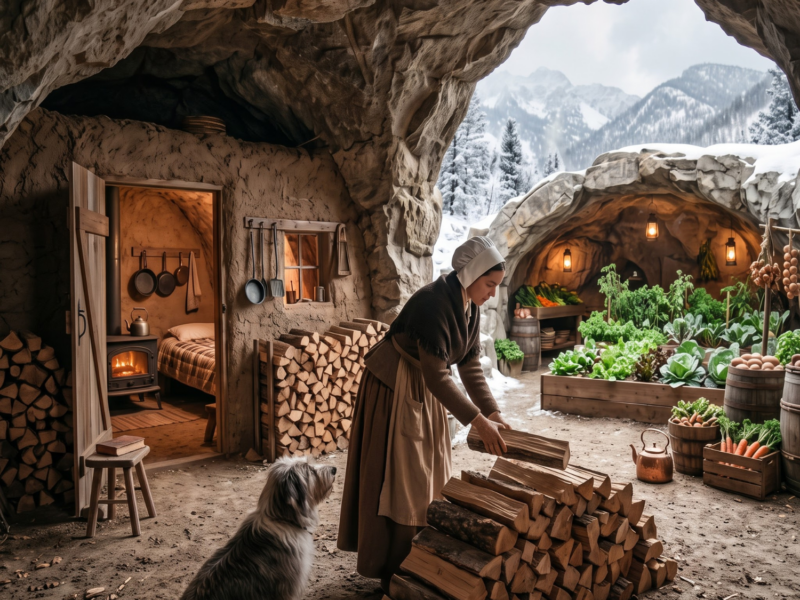
Thrown Out at 16, She Built a $10 Dirt Cellar Inside a Cave — Her Firewood Stayed Dry All Winter
The Roots
The people of Oak Haven had various things to say about Eliza Vance in the months and years that followed.
Some said she was remarkable. Some said she was incredibly lucky. Some said it was a hard thing what had happened to Edmund, and it was good the law had sorted it out properly in the end.
Old Silas Whitmore, when anyone asked him about it—which people did more often than he was comfortable with—would think for a long moment before answering. He would look down at his hands, usually the way a man looks at something that reminds him of a difficult accounting he has made with himself.
Then he would say, “She knew things other people did not know. And she went to the only place those things were worth anything.”
He would leave it exactly there. He was not a man who improved on a sufficient answer.
Reverend Holt said less. He had revised his Sunday sermons in ways that his congregation found somewhat unexpected. There was a new, fierce emphasis on the difference between law as a rigid structure, and justice as a moral action. Between the letter of an obligation, and its spirit. Some of his parishioners found the change deeply uncomfortable. He did not apologize for it.
Ruth Whitmore, who turned ten that spring and had the clear, unfiltered memory of a child who pays attention to everything, would later tell people that what she remembered most was not the dramatic arrest, or the trial, or the reading of the guilty verdict in the county courthouse in Boise.
What she remembered was Eliza Vance coming back to the cabin the following summer. With dark dirt on her knees from the massive garden she was establishing on the eastern bottomland. And the way she talked about the soil quality, and the water table, and the timber yield, with the exact same straightforward confidence Edmund Vance had used to talk about everything he understood. As if the mountain had always been hers. As if there had never been any serious question about it.
There is a particular kind of man who believes that cold and darkness can do his dirty work for him. Who looks at a person alone in the wilderness and sees the problem resolving itself through exposure.
Calvin Pendleton had been exactly that kind of man. And he had understood the mountain the way most cruel people understood it: as a brutal force that moved against human life. A force that took the unprepared, the unlucky, and the isolated, and reduced them to the kind of evidence that winter eventually conceals.
What he had not understood—what men of his particular, arrogant calculation rarely understand—is that the earth is not neutral.
It does not favor those who try to use it as a weapon. It simply holds what is placed in it. Warmth, and cold, and seed, and root, in the compressed weight of years. And it offers what it holds to whoever is willing to go low enough to find it.
Edmund Vance had understood this profound truth. He had spent twelve years building a life on that understanding.
His daughter had spent one terrifying winter proving it.
She had not defeated winter. She had done something far more durable than that. She had learned to read it. To work inside its logic rather than fighting blindly against it. To find the warmth that the earth kept, even in the coldest months, for anyone who was willing to dig down far enough to reach it.
The entrenching tool stayed hidden in the shelter through that summer. And the summer after.
On the third year, when Eliza began expanding the massive root cellar on the north side of the cabin to store her harvest, she went back to the ridge for it.
The blade had gone further to rust in the damp earth, and one of the hinge pins had worked loose, requiring attention before it was usable again. She gave it that attention, cleaning it, oiling it, filing the edge. She was not sentimental about tools. She was, as Edmund had raised her to be, practical.
But she never bought another shovel. She did not need to. She already knew exactly what that one could do.
Some years later, after the valley had filled in with new families who knew the Blackwood Range only as a mountain range, not as the place where a particular story of survival and justice had happened, travelers on the forestry access road would occasionally notice a section of hillside east of the main cedar stands.
They would notice that the ground had an unusual regularity to it. A slight, rectangular depression that seemed too intentional to be natural. They would look at it, shrug, and move on. Because it appeared to be nothing. Just a thickening of the forest floor, a slightly uneven rise where the pine needles were deeper than elsewhere.
But if you knew exactly where to look. If you had reason to stop, and kneel at a certain spot beneath a certain massive western red cedar, you would find the entrance to a small earthen chamber, four feet deep and six feet long.
Its walls long since smoothed by seasons of settling. Its roof of pine branches replaced entirely by the living roots of the cedar above.
And you would know that it had not been left there as a grave, but as a testament. Because winter always came back. It came back every year, reliable, indifferent, and absolute. And every year, there was someone who had not prepared. Someone who stood at the edge of it and felt the full, crushing weight of what was coming, and did not know how to begin.
And the answer was the same as it had always been. The same answer the ground held in its warmth below the frost line. The same answer the cedar held in the shelter of its canopy. The same answer Edmund Vance had given to his daughter on a sunny summer afternoon in a garden, years before she needed it.
You begin by finding the right tool.
And you find a place where the ground will receive you.









