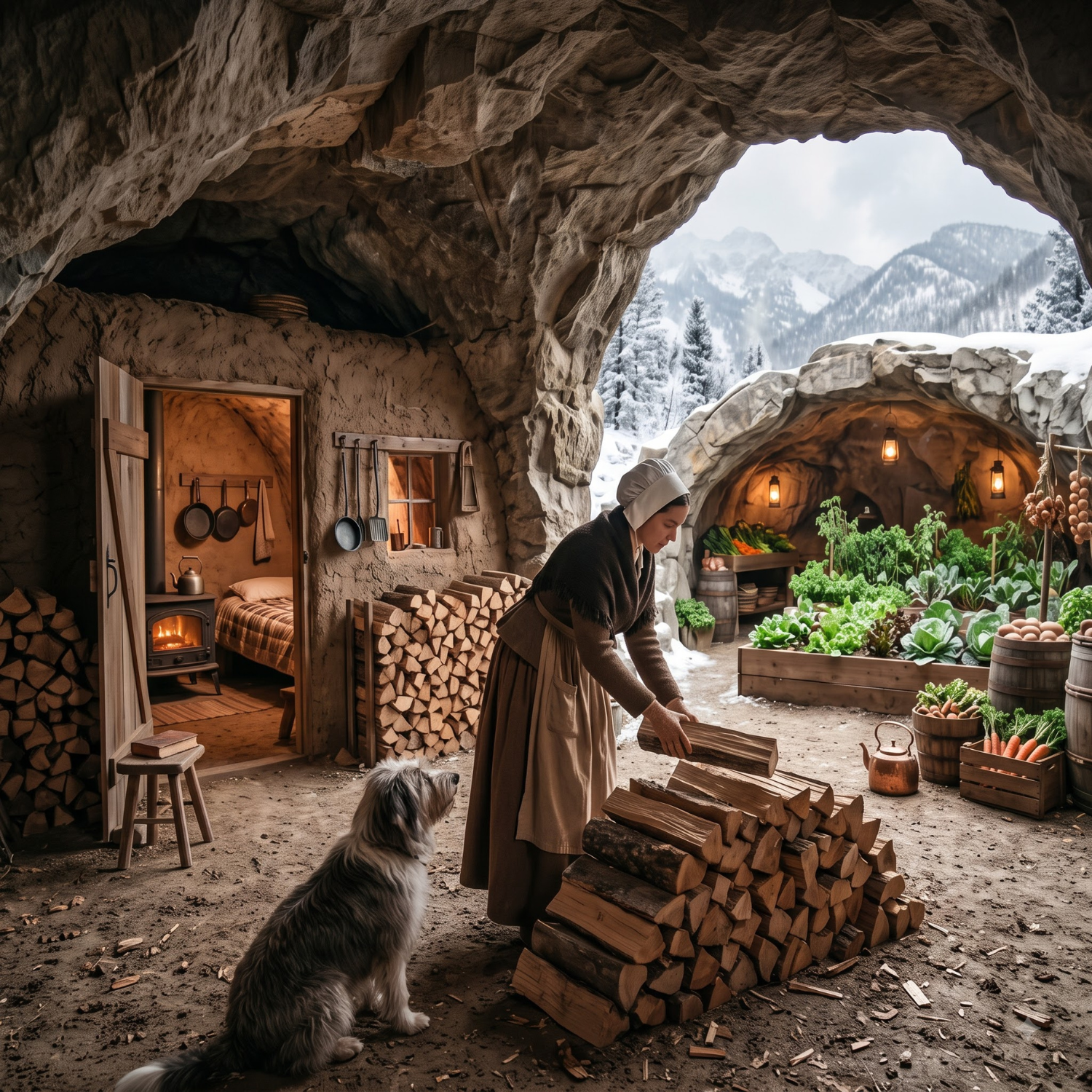
Thrown Out at 16, She Built a $10 Dirt Cellar Inside a Cave — Her Firewood Stayed Dry All Winter
The Usurper
Edmund Vance had spent twelve grueling years building something worth keeping on the rugged slopes of Blackwood Ridge.
He owned two hundred acres of prime Idaho Territory timber and fertile bottomland. He had built a solid, weather-tight cabin, notched by hand from massive western red cedar. He had dug a magnificent root cellar four feet deep, well below the frost line. And, more importantly, he had built a reputation as a man who kept his word, paid his debts on time, and minded his own business.
He had done it all entirely alone after his wife died of a sudden, violent fever when Eliza was just four years old. And he had raised his daughter the exact same way he built everything else: one careful, deliberate piece at a time, with absolutely no shortcuts and no complaints.
Edmund had taught Eliza to read complex topographical maps before she was eight years old. He had showed her how to identify the hidden quality of timber simply by the resonant sound her knuckle made against the bark of a trunk. During the long winter evenings by the stove, he told her stories about the soldiers he had read about—the desperate men who survived the brutal, freezing winters of the Civil War.
“They didn’t survive by fighting the cold out in the open, Eliza,” Edmund had told her, his voice low and serious. “They survived by going underground. They dug into the earth itself, and they let the ground hold them safe until the worst had passed.”
Edmund Vance was not a man who believed in luck. He believed in preparation, in hard-won knowledge, and in the quiet, unassailable dignity of knowing things that other people did not bother to learn.
Calvin Pendleton, Edmund’s older brother, had never built anything in his life.
Calvin had arrived at the cabin six days after Edmund’s funeral. He carried a worn leather saddlebag over one shoulder and a folded set of legal papers in his heavy coat pocket. He smelled of stale tobacco and cheap whiskey.
He told Eliza, standing in the kitchen her father had built, that he was her legal guardian now. He said the county judge had confirmed it, and that she should not worry her pretty head about a single thing. He said it the way a dangerous man says words he does not mean: quickly, flatly, and without ever looking her in the eye.
Within two weeks, Calvin had moved his meager belongings into Edmund’s master bedroom. He sold Edmund’s second, finest horse to a buyer down in Oak Haven, pocketing the cash. He took over the standing account at Whitmore’s General Store, listing himself as the primary cardholder on the Vance property.
He told anyone in town who asked that he was “managing the estate responsibly,” paying down Edmund’s supposed hidden debts, and stabilizing things for the poor, grieving girl.
He was doing absolutely none of those things.
By November, Eliza had learned the hard lessons of living with a predator. She had learned to stay perfectly quiet. She learned to move through her own cabin without disturbing a single one of Calvin’s things. She learned to answer his probing questions with “yes” or “no,” and nothing more.
Most importantly, she had learned to read the sound of his footsteps on the porch. She learned to gauge the heaviness of his tread, the slight stagger in his gait, to know within seconds whether a given evening was safe, or if she needed to disappear into the background.
She kept her father’s leather-bound field journal hidden under a loose floorboard beneath her cot. It was the absolute last thing of Edmund’s that Calvin had not yet found and touched.
On the evening of November 12th, her sixteenth birthday, there was no cake. There was no celebration.
There was only the terrifying sound of a whiskey bottle shattering violently against the living room wall because Calvin had thrown it there, followed by a heavy, suffocating silence.
Eliza had made one critical mistake that day.
Earlier that morning, as Calvin reached across the breakfast table for the salt cellar, the inner pocket of his woolen vest had gaped open. Eliza’s sharp eyes caught the edge of a folded document tucked inside. She instantly recognized the distinctive, embossed letterhead. It was from the Territorial Life Insurance Office in Boise. Her father had taken out a comprehensive policy two years before he died, preparing for the worst. Eliza knew, without ever being formally told, that she was supposed to be the sole beneficiary of that money.
She asked about it that evening. She had chosen her words incredibly carefully, keeping her tone neutral. She asked whether there was any official paperwork she should know about regarding her father’s estate.
Calvin crossed the room in three massive strides.
He grabbed the collar of her flannel shirt, twisting the fabric tight, and pulled her violently upright off the wooden chair. His face, in that terrifying moment, was the dark, mottled color of a brick left baking in the summer sun.
“You think you are entitled to something here?” Calvin hissed. His voice was low and flat, the exact way dangerous men’s voices often are before they strike. “Your father left this family drowning in debt. Everything in this cabin, every single acre of that land outside, belongs to me now. And you? You are sixteen years old today. That means you are legally old enough to go work somewhere else. So get out.”
“Uncle Calvin, please,” Eliza gasped, struggling against his grip. “The cold is pressing through the walls. It is eight degrees below zero outside. Where am I supposed to go?”
“I do not care if it is forty below!” Calvin roared, spittle flying from his lips. “Go to a charity shelter in Boise! Go find the state! But you are not sleeping under my roof tonight!”
He did not let her pack properly. She had exactly ninety seconds before he had the front door wrenched open, the freezing, howling air pouring into the room, his arm extended toward the pitch-black dark.
Eliza scrambled, her mind moving with icy clarity despite the panic. She grabbed what she could reach in the main room. The heavy wool blanket from her cot. The brass oil lantern from the hook by the door. The tin box of waterproof matches from the kitchen shelf. Two extra pairs of thick wool socks. And her father’s oversized canvas work coat, the one that still hung by the door and carried the faint, comforting smell of sawdust and pine resin.
Finally, she reached for the framed photograph on the wooden mantle above the fireplace. It was a picture of her and Edmund taken the summer she was twelve, both of them squinting happily into the bright July sunlight.
Calvin kicked the front door fully open. The wind hit her like a physical wall.
“Out,” he said.
The door shut behind her. The heavy iron lock turned with a fatal click.
Eliza stood alone in the dark driveway. The gravel crunched under her boots. The lethal cold reached for her immediately, biting through her jeans. She pressed her hand into her pocket and felt the gold coin there. Ten dollars. The absolute last thing her father had ever given her.
She looked up at the frosted cabin window. Calvin’s dark shadow moved behind the glass, settling back into Edmund’s favorite armchair, reaching for a new bottle of whiskey from the shelf Edmund had built with his own hands.
Eliza pulled the heavy canvas coat around her shivering shoulders and turned her back on the light, facing the total darkness of the mountain.
She understood her options, and she understood them coldly, entirely without panic. She thought through the problem the way her father had taught her, before raw emotion could muddy the waters.
The Oak Haven Sheriff’s office was four miles down the treacherous logging road. But Sheriff Dunbar had been Calvin’s drinking companion every Friday evening for as long as Eliza could remember. Walking into that office tonight was exactly the same as walking back onto Calvin’s front porch and saving him the trouble of coming after her.
From Dunbar, she would be shipped to the grim juvenile holding facility in the county seat. From there, she would be handed over to some state assignment she could not predict or control. Every day she spent locked in that bureaucratic system was a day Calvin spent legally consolidating his permanent hold on two hundred acres of prime Vance land.
She was absolutely not going to let that happen.
The settlement of Oak Haven sat seven miles down the mountain on the main road. It had no homeless shelter, and no telegraph office that welcomed strangers at midnight.
What it did have was Whitmore’s General Store. Old Silas Whitmore sometimes stayed late doing inventory. And the clearance bins at the very back of his store occasionally held the kinds of practical, unglamorous tools that a person in a truly desperate situation might actually need to stay alive.
She pulled her collar up and began the long walk down.