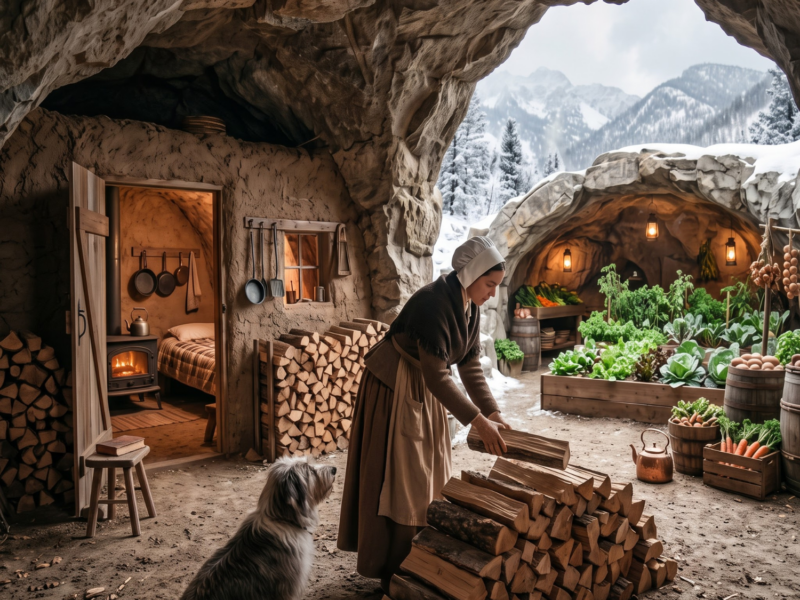
Thrown Out at 16, She Built a $10 Dirt Cellar Inside a Cave — Her Firewood Stayed Dry All Winter
The Warm Wall
The first major blizzard of the season arrived on November 28th.
It brought three days of white, silent, heavy snow. The accumulation buried the first mark she had carved on the cedar tree outside. Then it buried the second.
She stayed sealed inside her earthen chamber, conserving heat and movement, surviving entirely on snowmelt and the very last scraps of the pemmican.
When the blizzard finally broke on the morning of December 1st, she crawled out to find two feet of fresh, pristine snow across the ravine, and a silence so complete and profound it was almost a physical sound in itself.
She was freezing. She crawled back inside to start a small, controlled fire.
She reached to the bottom of her carefully stacked woodpile, where the logs pressed tightly against the back wall of the earthen shelter, and pulled a thick branch free.
She stopped.
The wood in her hand was not cold.
It was not frozen solid, as she had fully expected it to be after three days of the worst storm of the season.
It was warm.
It was not the gentle, radiating warmth of sunlight on a summer afternoon. It was warm the way the stones around a fireplace stayed warm hours after the fire has gone out.
She held the log with both hands and stared at it in the dim interior light filtering through the entrance. Copper raised his head from the corner, his nostrils working, sniffing the air.
Eliza set the log down. She pressed her bare, blistered palm directly against the dirt of the back wall of the shelter. The wall she had dug directly into the hillside.
The earth there was dry. It was not damp with winter moisture the way the side walls were. It was dry, almost powdery, and it was radiating a slow, steady, unmistakable heat.
She had been sleeping with her back against a warm wall for three weeks and had not noticed until now.
She picked up the entrenching tool. She pressed the flat of the steel blade against the earth and tapped it once with her knuckle.
The sound that came back was not the flat, dead thud of soil against soil.
It was hollow. Metallic.
It sounded as if something enormous on the other side of that dirt wall had heard her knock, and answered.
The metallic sound did not echo the way a stone would echo against another stone. It rang clean and sharp, and entirely wrong for the inside of a mountain. It was the sound a massive, closed bell makes when you strike it once and then listen to the vibration happen to the silence afterward.
Eliza held the entrenching tool exactly where it was, her palm still pressed against the vibrating wood of the handle, and did not move for a long, terrifying count of ten.
Copper was already on his feet. The dog stood in the cramped space with his front legs braced, his nose working in rapid, shallow pulls. He was pointed directly at the back wall of the shelter with the focused, predatory stillness of an animal that has identified something dangerous it cannot yet categorize. His ears were fully upright. He made absolutely no sound, but the hackles had risen sharply along the ridge of his spine.
That told Eliza more than any growl he might have made.
She pulled the entrenching tool back, flipped it to the spade side, and began to dig into the back wall.
The earth along the back wall came away differently than it had during the original excavation. It was bone-dry and loose, almost granular. It moved with her hands as easily as beach sand. She dug with the steel blade first to clear the outer layer, then switched to her bare hands when she needed to feel exactly what she was uncovering. Her blistered palms protested every scraping motion. She ignored them.
The first thing she uncovered was a massive plate of riveted iron. It was dark with age and surface rust, set perfectly flush against the surrounding soil, as though it had been placed there deliberately rather than discovered naturally.
She swept the dirt away from its edges with her fingers, moving outward, tracing the shape of it. It was large. Far larger than she had expected.
She worked frantically for twenty minutes, clearing soil methodically from the center outward. And when she finally sat back on her heels, striking a match and holding the oil lantern close, she understood exactly what she was looking at.
It was a wheel.
It was made of heavy cast iron, about eighteen inches across, mounted on a thick spindle that connected straight through the face of a massive steel door.
It was the kind of heavy, industrial door she had seen illustrated in her father’s engineering books. The kind built for deep, underground mining applications in the 1860s and 1870s.
A bulkhead.
The lock mechanism was a simple pressure seal, operated by rotating the wheel to disengage a series of heavy internal pins. It was the same basic safety principle the old copper and silver mines had used throughout the entire Blackwood Range before the federal closure orders came down in 1869, shutting the boomtowns down. The mines had been sealed. The state had documented the sealing. There were official records in Boise.
But this door was warm.
It was not warm from geothermal activity. It was not warm from the passive heat of deep earth. The warmth coming through this thick steel was directed, aggressive, and concentrated. It was the specific, undeniable heat signature of something burning continuously on the other side.
Whatever was behind this heavy steel door had been burning for a very, very long time.
Eliza gripped the rusted wheel with both gloved hands. She braced her boots against the earthen wall on either side of the heavy frame, taking a breath, and pulled.
The wheel did not move a millimeter.
She adjusted her grip, wiped the sweat from her brow, and tried again. This time, she drove the effort through her legs rather than her arms, using the larger muscles the way Edmund had taught her to use them when leverage mattered more than raw strength.
The rust and the decades of compressed soil held it fast. She felt the painful resistance in her wrists and elbows, the strain traveling up into her shoulders like fire.
She let go, breathed heavily, and looked at the wheel. Copper paced nervously behind her in the narrow space—three steps left, three steps right.
Eliza found the longest, most solid piece of pine branch from her wood stack. She slid it deeply through two of the wheel’s spokes, creating a lever arm nearly four feet long. She repositioned herself below the wheel, planting the lever end pressing against the earthen floor for counter-resistance, and applied steady, brutal downward pressure with her entire body weight.
Something gave.
Not much. A fraction of a degree of rotation. But something gave.
She bore down harder, gritting her teeth. The muscles across her back flared with hot pain. She set her jaw and kept going.
The wheel moved another fraction. Then another. Then the rust binding the spindle began to crack at the joint. Fine, orange powder fell from the housing, and the resistance changed from solid rock to grinding metal.
And then, with a sound that seemed impossibly, terrifyingly loud in the confined space of the dirt shelter—a shriek of old metal forced past its long resistance—the wheel turned.
One full rotation. Two. Three.
The heavy locking pins disengaged with a massive internal clunk she felt more than heard.
Eliza grabbed the door handle and pulled backward.
The pressure seal broke.
A rush of air hit her in the face. It was hot, bone-dry, and carried with it a smell unlike anything she had encountered on that mountain, or anywhere near it. It smelled of burning coal, hot iron, sulfur, stone dust, and something sharp underneath it all—a harsh chemical smell she had no name for. Something industrial. Something ancient and awake.
The temperature difference was immediate and staggering. The air pouring through the open door was not body heat, or lantern heat, or the modest warmth of deep earth. It was furnace heat. It was the heat of something burning at tremendous, sustained temperature, and it poured out of the darkness in a steady, aggressive current that dried the moisture from her cracked lips in seconds.
Beyond the door, a narrow, corrugated steel tunnel sloped downward at a gentle angle, disappearing into the dark. The metal walls of the tunnel were warm to the touch.
She could hear something now. It was not the imagined sound she might have heard before. It was real, present, and growing louder as she listened.
A low, mechanical roar. The deep, sustained, rhythmic breathing of something very large, and very deliberate.
Copper refused to go in. The dog sat at the threshold, his legs locked, his muzzle pointed downward into the tunnel, and would not be moved.
Eliza removed her heavy canvas coat because the air temperature past the threshold made it entirely unnecessary. She left it neatly folded on the dirt floor of her shelter. She took the brass oil lantern, checked the fuel level, struck a match to light it, and stepped over the threshold into the tunnel.









