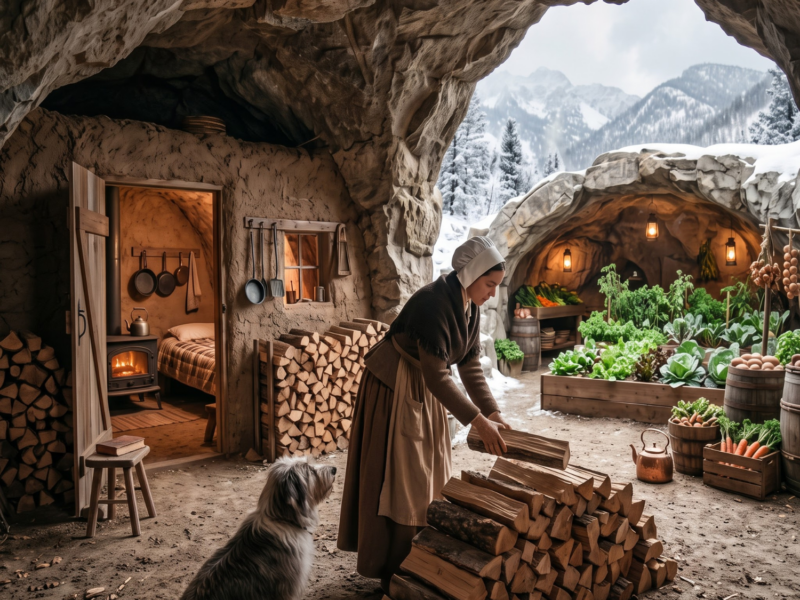
Thrown Out at 16, She Built a $10 Dirt Cellar Inside a Cave — Her Firewood Stayed Dry All Winter
The Midnight Timber
Eliza spent the daylight hours of that afternoon in a state of absolute stillness she had not managed in weeks.
She went through her meager supplies methodically. She drank the last of her melted snow water and did not replace it yet, not wanting the extra weight for the brutal journey ahead. She checked the condition of her boots and retied the frozen laces as tightly as her numb fingers would allow.
Copper was not in the shelter.
She had not heard the dog leave. She had not even noticed the absence until she reached for him in the late afternoon for warmth, and found only the depression he had left in the dirt where he had been sleeping.
She crawled to the entrance and looked out. His paw tracks led north along the base of the hillside, heading toward the game trail that connected eventually to the main ridge road. And then, the tracks became uncertain on a section of exposed, wind-scoured stone, and she lost them entirely.
She waited forty minutes, which was forty minutes more than she could afford. Copper did not come back.
She made herself finish preparing. She could not go looking for him in the woods. Not with the sun already dropping behind the peaks, and twelve miles of impossibly rough terrain standing between her and the only place on earth that mattered. She was not going to risk Edmund’s journal, and the justice it represented, for a dog. Not even this dog.
She told herself that, over and over, until she believed it.
She crawled out of the earthen shelter for the very last time as the sky was transitioning from flat gray to the particular, deep dark that came just before full night—the brief interval when the shapes of things were still visible, but all details had vanished.
She shouldered her canvas bag. She looked once back at the hillside, at the invisible line in the earth that marked the location of the bulkhead door beneath. She looked at the ancient cedar tree, and at the shelter entrance with its cover of pine boughs, looking from the outside like nothing more than a natural thickening of the forest floor.
She turned toward the south, and she began to walk.
She had gone perhaps three hundred yards, moving silently through a section of heavy timber where the snow was thinner under the thick canopy, when Copper suddenly appeared from the shadows ahead of her.
He was not alone.
The dog stopped dead on the trail in front of her. He turned his head back to look at something approaching behind him.
And then, out of the dark, came the steady, rhythmic clop of a mule’s hooves on frozen ground. A lantern appeared, held low to the earth.
And behind the lantern came Silas Whitmore, riding on the back of his old gray mule, breathing hard from the brutal climb. Beside him on foot, with his hands jammed deep in his coat pockets and his breath coming in short, white bursts, walked Reverend Thomas Holt.
Eliza stood frozen in the path and looked at the dog. Copper’s tail moved once, slowly, with the measured satisfaction of an animal that has successfully completed a task it set for itself.
She looked at Silas Whitmore. The old man had stopped the mule and was now sitting very still in the saddle, looking down at her with an expression she could not immediately read in the harsh lantern light.
Then she looked at Reverend Thomas Holt. His face in the lantern light was ten years older than she remembered, and it carried something heavy in it that had not been there three weeks ago in the doorway of the rectory.
She opened her cracked mouth to speak.
And then she saw the direction Copper’s head had suddenly snapped toward.
He was not looking at the two men. He was looking back the way she had come, toward the hillside. His ears were pinned up. His body was completely rigid.
Somewhere in the dark timber to the west, where the slope dropped away toward the eastern access trail, a branch broke sharply under the heavy weight of a boot.
One clean break. Then total silence.
Then, much more carefully, another footstep.
It was someone who had heard the murmur of voices, had stopped, and was now moving again with much greater tactical care, paralleling the trail, keeping hidden in the trees.
Silas reached down without a word and cupped his thick hand entirely over the lantern glass, smothering the flame.
The darkness that followed was absolute and suffocating.
Eliza did not move. She did not breathe. She stood in the lightless, freezing cold of a December midnight on Blackwood Ridge, with her dead father’s journal pressed against her ribs. And she listened to the careful, deliberate, hunting footsteps of Deputy Amos Crew, working his way through the timber forty yards to her left. Getting closer. Not knowing yet exactly where she was, but knowing she was somewhere very near.
Nobody breathed.
The four of them stood in the lightless cold of the timber—Eliza, Silas, Holt, and the mule. The dark around them was total and without feature. The footsteps in the trees to the west had gone very quiet, which meant whoever was making them had also stopped to listen.
Copper had not moved a muscle. He stood with his head angled sharply toward the timber, tracking something the humans could not see in the pitch black. The rigidity of his posture communicated what none of them dared to say aloud.
Crew had stopped because he heard the mule stop. He was waiting for them to make a noise. He was waiting for them to move first.
Eliza understood this dynamic the same way she understood the timber: by feel and pattern, rather than explicit knowledge. She had grown up hunting on this mountain with Edmund. She knew how sound traveled through freezing air and still timber, how it carried, and where it bent around the rocks. She knew that Crew, if he was experienced in rough terrain, would know these exact same things.
They were locked in a deadly calculation, both sides waiting for the other to reveal their position.
Eliza reached out blindly in the dark. She found the mule’s leather bridle by memory, her hand landing two inches above where she first touched the animal’s neck. She expertly worked the buckle of the bit ring free and pressed the leather loose against the mule’s jaw, eliminating the small, metallic clinking sounds the hardware made when the animal naturally moved its head.
She felt Silas’s massive hand find her shoulder in the dark. It was a question.
She pressed his hand twice, firmly. She hoped he understood it to mean: Stay still and trust me.
She did not know if he would. She had no history with Silas Whitmore that included trusting each other in the dark with an armed deputy sheriff thirty yards away.
He stayed still.
She waited two minutes. Three. The cold worked agonizingly at her exposed face and hands. Copper remained locked on the timber to the west like a statue.
Then, from somewhere further down the western slope, came a different sound. The harsh crack and skid of a heavy boot losing its purchase on a hidden, icy shelf of rock, followed immediately by the muffled, heavy impact of a body catching itself violently against a tree trunk. Followed by a sharp, pained intake of breath that traveled clearly through the frigid air.
Crew had moved. He had attempted to move laterally, trying to circle around them to cut off the trail, and the treacherous terrain had not cooperated.
Eliza turned and put her lips agonizingly close to Silas’s ear.
“East,” she whispered, her breath barely moving the air. “The creek bed. Now. Quietly.”
She heard him relay the direction to Holt in a breath so controlled it barely qualified as sound.
She took the mule’s bridle and led it forward. Not on the hard-packed trail, but off it, plunging into the untracked, deep snow along the eastern edge of the timber, where the ground was softer, and the mule’s hooves made significantly less noise.
She moved entirely by feel, and by the faint, shifting variation in the darkness that told her where the massive tree trunks were. Copper fell in right beside her, stepping precisely and silently in the tracks she had already made.
Behind them, on the western slope, she heard Crew’s footsteps again. He was moving much faster now. No longer trying to be stealthy. He was moving aggressively in the direction where they had been standing. He reached the trail. She heard him stop. The silence from that direction had a frantic, searching quality to it.
She kept moving. Steady and unhurried. Because haste on uncertain, icy ground in full darkness was exactly how people twisted ankles. And a twisted ankle on this mountain, tonight, was a death sentence.
Thirty yards. Fifty.
The heavy tree cover thinned above the frozen creek bed, and a thin, weak spread of starlight came through. It was enough to see vague shapes by. Enough to keep her footing on the ice.
She heard Crew call out once from the trail behind them. Not her name. Just a sound. A short, hard note of pure frustration from a man who has lost the thing he was tracking, and knows it.
She did not answer. She kept walking.









