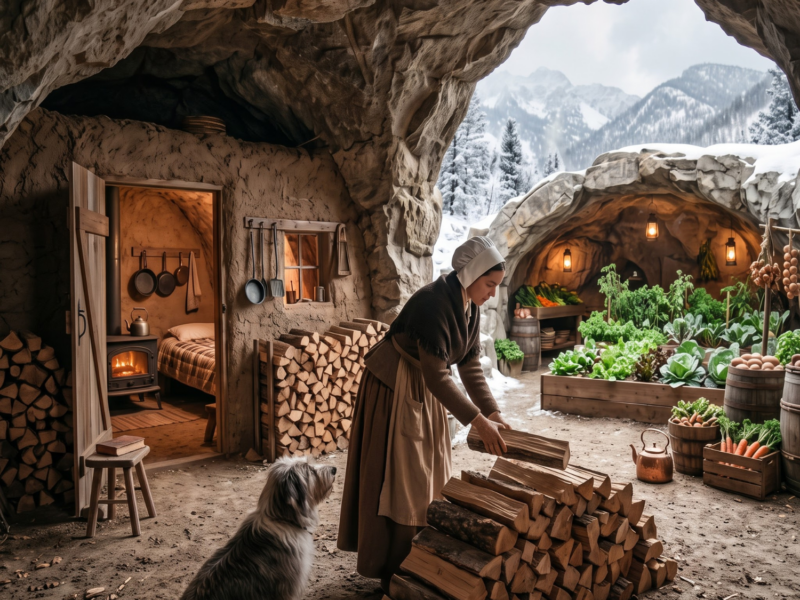
Thrown Out at 16, She Built a $10 Dirt Cellar Inside a Cave — Her Firewood Stayed Dry All Winter
The Ledger of Silence
She walked the seven miles in just under two grueling hours.
By the time she reached the back alley entrance of the general store, her fingers and toes had gone from screamingly painful to completely numb. She knew enough about the cold to know that the numbness was not an improvement; it was a severe warning.
She slipped through the heavy wooden back door just as Silas Whitmore was carrying a heavy wooden crate of canned goods from the stock room. Silas was seventy years old, or thereabouts. He was broad in the chest, with a thick white beard and the kind of massive, scarred hands that came from decades of hauling heavy inventory and mending wire fences.
He had known Edmund Vance since before Eliza was born. The two men had played chess every Wednesday evening for nearly a decade in the dusty back room of this very store, hunched over a pot of terrible, bitter coffee that neither of them had ever complained about.
“We are closing up,” Silas grunted, setting the crate down heavily, not looking at her.
Eliza moved quickly, ignoring him. She went straight to the clearance bins near the hardware section. She had spent the seven-mile walk deciding exactly what she needed. She didn’t want comfortable camping gear. She didn’t want anything designed for recreation. She needed tools for the specific, immediate problem of surviving at high altitude, in sub-zero conditions, with no existing shelter.
The first thing she pulled from the bin was a military surplus folding entrenching tool from the war. Its metal blade was slightly pitted with rust, but the edge was solid steel, and the folding hinge mechanism was still functional. The faded price tag read $4.50.
The second item was a heavy oilcloth tarp, olive drab, about six feet by eight feet, with a slight tear near one brass corner grommet. It was marked $2.75.
She carried both items to the glass counter and set them down with a thud. She reached into her pocket and slid the heavy ten-dollar gold coin across the glass.
Silas Whitmore finally looked up.
He looked at her for a long, silent moment. He took in her cracked, bleeding lips. He saw her windburned, pale cheeks. He saw the oversized canvas coat that had belonged to a man he had sat across a chessboard from for ten years. He looked down at the entrenching tool and the tarp.
Something shifted in the old man’s expression. It was something older and deeper than surprise.
“Getting pretty cold to be out in the woods, Eliza,” Silas said softly, his voice a low rumble.
“I am not playing, Mr. Whitmore,” she replied, her voice completely devoid of emotion.
Silas stared at her eyes. Then, he rang up the items without another word. The total came to $7.25. He made her exact change from the till without being asked. Then, he turned and walked into the back stock room.
He emerged a moment later carrying a bundle of dense, chemical fire-starter bricks wrapped in wax paper, and a heavy cloth bag. Inside the bag was a dense block of pemmican—dried beef pressed heavily with rendered fat and wild berries. It was the kind of unappetizing but incredibly calorie-dense preserved food that had kept mountain men alive for generations.
He set both items on the counter next to her change.
“Inventory error,” Silas muttered, looking somewhere past her left shoulder, refusing to meet her gaze.
Eliza gathered everything into her canvas bag, packing it efficiently. She was almost at the back door, her hand on the brass knob, when Silas spoke again. His voice was so low she might have missed it if the store had not been dead quiet.
“Girl,” Silas paused, swallowing hard. “If you find anything strange up on that East Ridge… do not touch it alone.”
Eliza stopped. She turned slowly and looked at him.
His face gave absolutely nothing away. But his massive hands were gripping the edge of the glass counter so tightly his knuckles were white. That grip told her that the rest of his body was working incredibly hard to keep still.
She waited for him to say more. He did not.
She turned the knob, walked out into the freezing alley, and the bell above the back door rang once and went silent.
Behind her, Silas Whitmore stood at his counter for a long time without moving.
He had known something was terribly wrong on the East Ridge for weeks. Edmund Vance had told him as much, sitting right there in the back room, just two weeks before Edmund died. And Silas had said nothing to the sheriff. He had said nothing to the marshals. He had told himself he had his young grand-niece, Ruth, to think about. He had the store to protect. Calvin Pendleton had dangerous friends in the sheriff’s office.
It had been so incredibly easy for Silas to tell himself that silence was not the same thing as choosing a side.
Standing in the empty store, he was finally beginning to understand that silence was exactly the same thing.
In the small, cramped cot behind the back counter, nine-year-old Ruth Whitmore lay perfectly still with her eyes wide open, watching through a gap in the stock room curtain. She had heard every single word of the exchange.
Ruth was small for her age, but she had learned early in life that the adults around her always said the most important, dangerous things in the quietest voices. She did not know what the “East Ridge” meant. But she knew that her great-uncle’s hands had not shaken like that since the morning they got word that her parents had died in a wagon accident.
She stayed very still, said absolutely nothing, and filed away what she had heard in the dark part of her mind where she kept the things that mattered.









