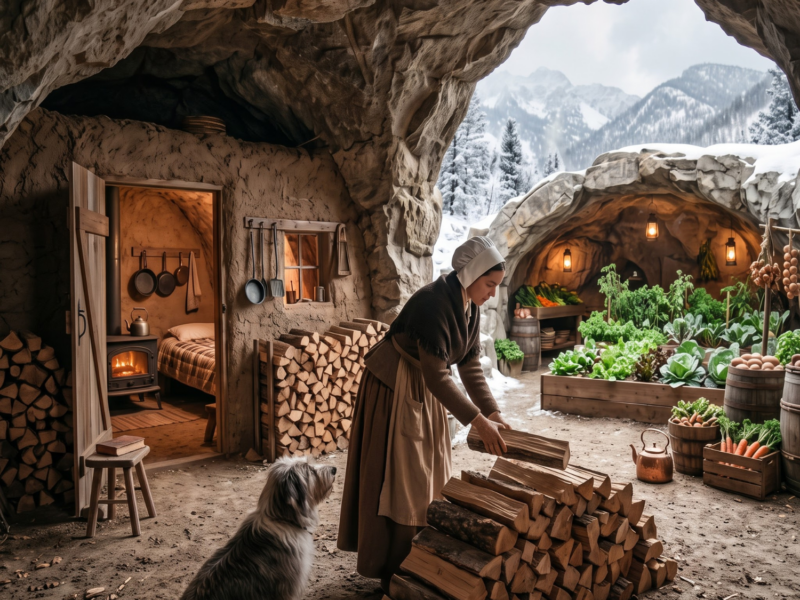
Thrown Out at 16, She Built a $10 Dirt Cellar Inside a Cave — Her Firewood Stayed Dry All Winter
The Devil's Forge
The tunnel opened into a cavern that had been built, not naturally discovered.
Eliza stood on a narrow, grated wooden catwalk bolted securely to the rock wall, ten feet above the cavern floor. She held the lantern out in front of her, letting her eyes adjust to the gloom, and instantly understood that what she was looking at was not an abandoned mine.
Not anymore.
The original excavation was still visible in the vaulted, jagged stone ceiling and the rough-cut walls. But every single surface below had been heavily modified, reinforced, and equipped with modern machinery. Heavy timber supports had been installed along both sides. The floor had been meticulously leveled and packed hard.
Two massive brick smelting furnaces occupied the far wall. Each one was the size of a small cabin. Their fireboxes were roaring, glowing a demonic orange through heavy iron grates. Their toxic exhaust was piped upward through a complex system of metal shafts that disappeared into the rock above, engineered at angles specifically designed to disperse the heat and smoke before it emerged at the surface, rendering the operation invisible from the sky.
The furnaces were burning hard. Both of them. The coal boxes were full, the draft mechanisms propped open wide.
Stacked along the near wall, directly below her, were dozens of wooden crates and iron-bound chests. Some were pried open. Inside one, she could see massive chunks of raw ore. Silver-bearing quartz. Judging from the color, the texture, and the sheer volume of it, this was not the small sampling amounts an amateur prospector might collect. These were massive, industrial quantities. Extraction quantities.
She slowly descended the wooden stairs to the cavern floor. The heat at this level was physically oppressive. Sweat broke across her back and shoulders within a minute of reaching the bottom.
She moved silently between the stacked crates, holding her lantern close, reading shipping labels where there were labels. Equipment shipping invoices were addressed to a phantom freight depot in Boise. Expensive ventilation component orders were placed through a dummy supply company in Nevada. All of it was routed through complex intermediaries. Nothing was addressed directly to Oak Haven, or to any name she recognized.
But at the far end of the cavern, set apart from the deafening industrial equipment, was a rough, makeshift working space.
It consisted of a table made from two sawhorses and a wide pine plank. There was a single chair, a locked iron strongbox, and a glass ashtray holding the dead, chewed ends of several expensive cigars.
And beneath the ashtray, partially hidden by a ledger, was a book.
It was not an accounting ledger. It was not a logbook.
It was a field journal. Its brown leather cover was worn incredibly smooth at the corners from years of handling. The binding had been repaired with a distinctive strip of rawhide cord at some point in the past.
Eliza knew that book before her trembling hands even reached for it.
She had watched Edmund Vance carry it in his breast pocket every day of her life. He had used it to log weather patterns, timber measurements, and equipment maintenance schedules. And sometimes, in the quiet evenings when the work was done, he had sat at the table by the cabin window and written things in it in his careful, compressed, beautiful handwriting. She had fallen asleep more nights than she could count, watching the rhythmic movement of his pen across the page.
She lifted the ashtray and picked up the journal. The leather was warm from the ambient heat of the cavern.
She opened it to the middle, and then turned forward, scanning the dates until she found the final entries. Her father’s voice spoke to her from the page.
October 12th, 1883 Found evidence of unauthorized extraction activity on the East Slope. Fresh, heavy wagon ruts on the forestry access road, not consistent with any legitimate logging claim in this area. Found chunks of silver-bearing ore near the entrance of Shaft 3, the one the state officially sealed in 1869. Someone has been working that shaft in the dark.
October 15th Calvin is involved. Saw his wagon at the ravine access road last night past 11:00 PM. He is secretly operating a massive smelting operation under the old mine. The ore is not from this property. He is taking it from federal claims on the Western Ridge—three separate parcels. Deputy Amos Crew is his partner in this. I saw them together at the shaft entrance two nights ago.
October 18th Confronted Calvin directly. He did not deny it. He laughed. He told me his financial arrangement with the Territorial Mining Inspector’s office in Boise means the discrepancies will never be formally investigated. He told me that if I go to the federal authorities, he has enough forged documentation prepared to implicate ME as the primary operator. I am going to the U.S. Marshals at Fort Blackwood tomorrow morning. I will bring this journal as proof. I have to protect Eliza.
The entry was dated October 18th, 1883.
Edmund Vance had died on the morning of October 20th. Two days later. Found crushed alone in the timber section under a felled pine, in what Sheriff Dunbar had classified—in under forty-eight hours—as a tragic, unavoidable accident.
Eliza stood perfectly still in the sweltering heat of the cavern and read the final entry twice.
Then she closed the journal and held it tightly against her chest with both hands.
She had understood, intellectually, since the terrifying night Calvin threw her out into the snow, that her father’s death was not what they said it was. She had held that horrible understanding at a safe distance from her feelings, because she could not afford the emotional weight of it. Not while she was still just trying to stay alive in a hole in the ground.
But holding this journal, standing in this cavern with the undeniable evidence of what Calvin had built all around her, seeing Edmund’s handwriting on the page she had just read… the distance collapsed.
She stood perfectly still for a moment, and let the crushing grief and realization wash completely over her.
Then, she pushed it down. All the way down to the dark, cold place where she kept the things she would deal with only when she was safe. She pushed the journal deep into the waistband of her jeans and pulled her flannel shirt tight over it.
She was turning toward the staircase when she heard the sound from the far end of the cavern.
It was a loud grinding of massive gears. The mechanical complaint of a large, counterbalanced steel door being raised on greased tracks.
It was a different entrance. One she had not known existed.
Pale, cold daylight spilled in from the far end of the cavern. The rumble of heavy wooden wheels on gravel immediately followed it. A wagon had just entered the mine.
She looked frantically at the staircase. The catwalk above and the tunnel entrance where she had come in were fully visible from the main floor. Anyone walking in from the far entrance would see her the absolute moment she moved for the stairs.
She was already moving toward the rough worktable.
She went to her knees and slid smoothly under it, pulling the loose canvas tarpaulin that had been draped over the table edge down to the floor on the open side, creating a makeshift curtain. She pressed herself flat against the back legs of the table and went completely, terrifyingly still.
The heavy wagon stopped somewhere in the middle of the cavern. She heard boots crunching on the stone floor. Two sets.
The first voice was pitched slightly higher than she expected, uneven in its cadence.
“The ore temperature is running hotter than we planned for,” the voice said nervously. “If we push the second furnace any harder before the new draft assembly is installed, we risk cracking the firebox. It’ll blow.”
The second voice she recognized instantly. It settled heavily into her chest like a bucket of ice water.
“Then we manage the temperature, and we keep working,” Calvin Pendleton said. “I am not shutting this operation down for a week because of a faulty draft assembly.”
Calvin was close. Closer than she had expected. His boots were moving directly toward the worktable.
The first voice—the nervous man—continued, lowering his volume now, with the particular quality of a man trying to keep a conversation from being overheard, even in a cavern where there was ostensibly no one to overhear it.
“The Territorial Mining Inspector’s office received a report from the Federal Land Office yesterday,” the man said. “About extraction irregularities on Claims Seven and Nine. They are not just sending a written field report, Calvin. They are sending an actual inspector. A person. On the ground.”
“That inspector will receive a sealed letter from the Boise regional coordinator the moment he arrives,” Calvin said dismissively, “confirming that the activity on those claims has already been assessed and officially cleared.”
“What if he doesn’t believe the letter? What if they follow up directly with the coordinator?”
“Then the coordinator will say exactly what I have paid him five thousand dollars to say,” Calvin snapped. “Keep moving the ore.”
A pause. Boots shifting nervously on stone. The first voice dropped lower still, almost a whisper.
“What about the girl?” the man asked. “Silas Whitmore confirmed to Dunbar she was in his store the night you drove her out. People in town are starting to ask questions, Calvin. If she dies out there this winter, the federal marshals will run a full search of the mountain looking for the body.”
There was a silence then that had a heavy, terrifying quality to it. It was the quality of a man who has already thought completely through an answer, and is merely deciding how much of his sociopathy to share aloud.
“Let them search,” Calvin said. The flatness in his voice was not anger. It was something far past anger. It was something that had processed the situation mathematically and arrived at a cold calculation. “She is a minor who left her legal guardian’s home voluntarily. Children go missing in these mountains every year. The terrain takes them. By the time the spring thaw comes, there will not be enough remaining of her to establish a cause of death. And once she is legally declared absent and presumed dead by a judge, the entirety of Edmund’s life insurance policy transfers directly to me, as the sole surviving guardian on record. It resolves cleanly.”
The first voice said, very quietly, “Edmund was one thing. He was going to the marshals with evidence. We were cornered. But the girl… the girl is not your concern, Amos.”
Amos.
Deputy Amos Crew.
Eliza recognized the voice now. She filled in the face in her mind. The careful, bureaucratic manner of the pen moving quickly across the accident report the afternoon Edmund died. Case closed in 48 hours. Nobody’s fault. These things happen.
The boots were moving again, stepping right up to the worktable.
Eliza pressed herself into the darkest back corner under the table, her knees drawn tightly to her chest. Her breathing was so fiercely controlled it barely qualified as breathing.
The tarpaulin covered the open face of the table, but it did not seal it completely. Through a half-inch gap where the canvas did not quite reach the floor, she could see a sliver of the cavern.
Calvin’s boots stopped less than two feet away from her face.
The heavy, iron-capped toes of them filled the gap in her view. He set something heavy on the table directly above her. The thick pine plank surface flexed under the weight. She heard paper rustling. A ledger page being turned.
“Temperature is holding,” Calvin muttered to himself, more than to Crew. It was the habit of a man accustomed to working alone in the dark. “Draft assembly or not, we run the furnaces through the weekend.”
The boots did not move for what felt like an eternity. Eliza did not allow herself to count seconds. Counting seconds was a way of measuring how frightened you were, and she could not afford to know that number right now.
Then, Calvin straightened. The weight lifted from the table surface. His heavy footsteps moved away, walking toward the roaring furnaces. She heard him speaking to Crew in a lower register that did not carry clearly across the cavern over the noise of the fire.
She waited. She counted to one hundred, very slowly, in her head. And then she counted to one hundred again.
She heard Crew’s footsteps moving in the opposite direction, toward the wagon. She heard the loud sounds of equipment being unloaded—metal clanking on stone, heavy wooden crates being shifted and dragged.
She came out from under the table in the exact same smooth, silent motion a person uses to stand up after being knocked down in a fight: controlled, deliberate, with absolutely no wasted movement.
She stayed low, keeping her body below the line of sight of the tall crates stacked between her and the glowing furnaces. Moving in a low crouch, she kept the equipment blocking her from where she had last heard Crew’s voice by the wagon.
She reached the wooden staircase. She went up it one agonizing step at a time, keeping her weight on the extreme outside edges of the wooden treads where the boards were supported by the frame and least likely to creak. Across the catwalk. Into the corrugated steel tunnel.
She did not run until the tunnel curved and the cavern light was fully blocked behind her.
Then, she ran.
She burst through the bulkhead door and tumbled out onto the cool, earthen floor of her dirt shelter, gasping for air. Rolling onto her back, she grabbed the heavy door by the handle and pulled it shut behind her. She grabbed the rusted wheel and spun it violently. The heavy pins engaged. The seal closed.
She lay flat on the dirt floor, staring up at the pine branch ceiling and the dark oilcloth roof above it. She listened to her own ragged breathing in the dark until it slowed to something manageable.
Copper pushed his wet nose against her jaw, whining softly.
She had gone into that mountain looking for the innocent reason her firewood was warm. She had come out with the motive, the method, and the confession for her father’s murder, in a written record in his own handwriting.
She pressed the leather journal flat against her ribs, held it there with both hands, and thought about what had to happen next.
Fort Blackwood. Twelve miles south across the brutal ridge.
It was the home of the U.S. Marshals. Federal jurisdiction. Outside the corrupt reach of Sheriff Dunbar’s office, and outside the reach of anyone Calvin Pendleton had managed to place on his payroll in the county system.
Edmund had been going exactly there on the morning of October 20th. He had not arrived.
She would arrive.
But not yet. Not in daylight. Not on the main road. Not while Calvin had Deputy Crew watching the mountain paths. And Harlan Soot had already confirmed to Calvin that she was still alive somewhere on this ridge.
She would leave at midnight. The extreme cold would make movement utterly miserable, but the total darkness would make it survivable. She needed the agonizing hours between now and then to rest, to hydrate, and to plan the exact route in her head.
She allowed herself to sleep for exactly three hours, which was an exercise in pure discipline rather than a luxury.
When she woke, she wrapped Edmund’s journal in the last completely dry section of the oilcloth tarp. She bound it tightly with a length of rawhide she had cut from her spare bootlace, creating a waterproof bundle, and tucked it into the deepest part of her canvas school bag.
She did not know, lying there in the dark, working through her route, that Calvin Pendleton had not gone back to his cabin to sleep the previous night.
She did not know that the conversation she had overheard in the cavern had continued long after she was gone, and that it had turned, eventually and fatally, to the question of the old bulkhead door in the southeast corner. The emergency exit shaft from the original mine that had been sealed from the outside in 1869, and supposedly had not been opened since.
She did not know what Deputy Crew had found when he went to casually check it that morning.
Crew had gone to the southeast corner of the cavern as part of his routine inspection of the facility. He made this check every third day—a systematic walk of the perimeter, looking for water seepage, structural shifting, or any sign that their ventilation modifications were affecting the rock stability. He had been doing this for eleven months. He knew every crack and variation in those stone walls.
The heavy steel bulkhead door looked the same as it always did.
But the soil directly in front of it did not.
The ground there had been recently, noticeably disturbed. The compressed, hardened earth of the cavern floor showed the unmistakable marks of fresh excavation, and then the frantic marks of someone attempting to smooth those marks over, imperfectly, in darkness or in haste.
Crew crouched down and examined the wheel mechanism closely. The rust pattern along the spindle housing was broken. There was fresh, bright orange rust dust on the floor directly below it. The mechanism had been rotated recently, and rotated back.
Someone had opened this door from the other side. Someone had been inside this cavern.
Crew stood up. He stood very still for a moment. The furnaces roared behind him, the heat pressed down from above, and he thought about what this meant. He felt the full, terrifying weight of it arrive.
He did not tell his men. He rode directly down the mountain to Calvin’s cabin.
Calvin listened to everything Crew said without interrupting, pouring himself a drink. His face, when Crew finished, showed no readable emotion. He looked out the window of the cabin toward the Eastern Ridge for a long time.
“Who else knows this access point exists?” Calvin asked finally, his voice dead.
“Nobody living,” Crew said nervously. “The shaft was officially sealed before the mine closure. It is not on any of the public survey maps. But someone found it from the other side, Calvin. Someone dug into that hillside from outside, and came through.”
Calvin was quiet for another long moment.
“She has been on this mountain for three weeks,” Calvin said. “She has been living out there in this killing cold for three weeks.”
He said it the way a man says something that has profoundly recalibrated his understanding of an enemy. Not with admiration, but with a deadly seriousness he had not been applying before.
“Calvin,” Crew said, his voice shaking. “If she was in there… she would have found the journal.”
Calvin said nothing.
“She was looking for firewood, or she was exploring the hillside, and she found the heat bleeding through the rock, and she dug in,” Crew panicked.
Calvin turned slowly from the window. “Edmund kept that journal on his person every single day. She would have recognized it the absolute moment she saw it.”
“What do you want to do?”
“I want you to go up that ridge tonight,” Calvin ordered, his eyes blank. “Find her camp. She has to be within a quarter-mile of the shaft entrance. She could not have carried the materials for a winter camp much further than that in one trip. Find it. And find her.”
Crew looked at him for a moment. “And when I find her?”
Calvin met his eyes. “Make absolutely sure she does not get to Fort Blackwood.”









