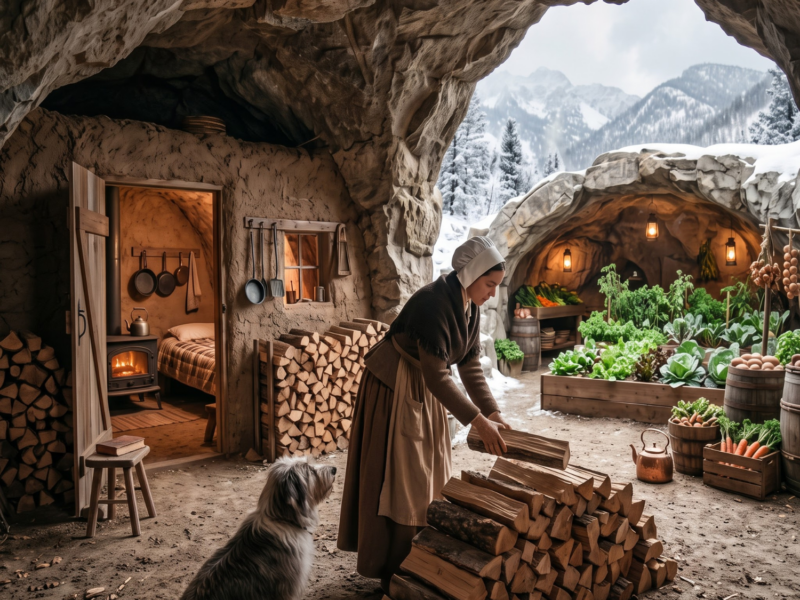
Thrown Out at 16, She Built a $10 Dirt Cellar Inside a Cave — Her Firewood Stayed Dry All Winter
The Chase
Eliza was almost past the very last building on the main dirt road when the heavy wooden doors of the Blackwood Saloon swung violently open. Yellow, smoky lamplight fell across the frozen mud of the street.
A man stepped out. He was heavyset, unsteady on his feet, his breath clouding in the bitter cold. It was Harlan Soot. He was in his mid-forties, a man who had worked at the lumber mill when the mill had work to give, and spent the rest of his time at the saloon running through whatever money he had managed to earn. He and Calvin Pendleton had shared a table in that dark saloon more times than either of them could count.
Harlan looked at Eliza and stopped in his tracks. His alcohol-glazed eyes took a moment to focus in the dark. Then, ugly recognition landed on his face.
“Hey now,” Harlan slurred, his words coming out thicker and slower than they should have. “That is the Vance girl. Calvin has been looking all over for you, kid. You stay right there.”
Eliza did not stay right there.
She was already moving. She cut sharply left, darting between the hardware building and the feed storage shed, plunging into the narrow, trash-filled passage where the saloon’s lamplight did not reach. She scrambled over frozen crates and then she was through, breaking out into the open ground behind the last row of buildings.
And then she was running.
She crossed the open, snow-dusted ground in twenty seconds flat. She reached the first dense line of pines at the base of the mountain and threw herself in.
Behind her, she heard Harlan Soot shout once, a drunken, angry bark. Then, nothing. He was not, it turned out, in any physical condition to chase a terrified sixteen-year-old through the dark woods.
She ran blindly through the trees until the lights of Oak Haven were entirely gone, swallowed by the terrain. She finally slowed to a walk, her chest heaving. She forced herself to breathe entirely through her nose, warming the freezing air before it reached her burning lungs, exactly the way Edmund had taught her to do to prevent frostbite from the inside out.
She did not know that Harlan Soot, once he recovered sufficiently to make the walk, went directly to Calvin Pendleton’s cabin at the base of Blackwood Ridge. She did not know what was said in that cabin, or how long Calvin’s lamp burned before it finally went dark.
But she understood Calvin Pendleton well enough to know one absolute truth: he was not a man who left problems unresolved. And the girl was still alive on his mountain. He had not planned for that complication to last this long.
The East Ridge of Blackwood Ridge was what the Forestry Service designated as “public land.” In practical terms, that meant land that no one managed, no one patrolled, no one visited in winter, and absolutely no one was likely to come looking for a missing person in. The terrain was brutal. It dropped sharply into a series of jagged ravines with treacherous footing, even in dry summer weather. In November, with black ice hidden beneath the snow and no marked trails, it was the kind of place the locals described simply and accurately as a place where people did not come back from.
Eliza went there anyway.
She hiked for an hour past the edge of town, following the eastern logging trail until it petered out into narrow game paths. She followed the game paths until they too became uncertain, vanishing under the snow. Finally, she navigated by following the ravine edge by memory, and by the angle of the biting wind on her cheek.
She knew this terrain intimately. Edmund had walked it with her every summer since she was small enough to ride on his broad shoulders, teaching her to read the shape of the land the way a seasoned sailor reads the swells of the water.
She found her shelter site two miles deep into the ridge.
It was a massive western red cedar, old enough that its trunk was wider than her outstretched arms. Its lower branches swept outward and downward in a broad, dense canopy that had shed most of the fresh snow around its base, creating a dry perimeter. Beneath those heavy branches, the ground was comparatively clear—a natural, bowl-like depression sheltered from the worst of the howling wind.
She spread the olive-drab oilcloth tarp across the frozen ground. She wrapped her shivering body tightly in the wool blanket, then pulled her father’s massive canvas coat over everything else, curling into the absolute smallest shape she could manage in the dirt.
She did not sleep.
Sleeping in this temperature was not safe, and she knew it. Edmund had explained hypothermia to her when she was ten. He had described the way the body’s warning signals went quiet and strange, the way the mind grew sluggish and invited a person to just close their eyes and stop paying attention.
Every single hour, shivering violently, she forced herself to sit up. She flexed her muscles hard, held them tight, and released them, forcing the sluggish blood to keep moving into her legs, feet, and hands.
She lay back down and stared at the dark underside of the cedar canopy. She listened to the wind working through the tops of the pines high above—a sound like breath hissing through a clenched jaw.
She thought about Edmund. She thought about the way he had looked the morning of October 19th, heading out to the timber section alone with his ax over his shoulder, looking no different from any other morning of her life. She thought about the two deputies who came to the cabin that afternoon with their careful, blank faces and their rehearsed, careful words. Logging accident. A widow-maker branch fell. Nobody’s fault. These things happen.
She thought about Calvin Pendleton sleeping in Edmund’s bed, pouring Edmund’s whiskey.
She was thinking about that when she heard the sound.
It came from the north edge of the cedar’s canopy. A rustle. A soft, deliberate crunch of frozen pine needles.
Eliza froze, her hand creeping toward the heavy folded shovel.
Then, a shape pushed through the hanging branches and stood in the small, cleared space beside her.
It was a dog. It was reddish-brown, with fur matted in clumps with burrs and snow. Its ribs were starkly visible along its flanks, and its muzzle had gone gray with age and hardship. One ear stood straight up; the other had been torn in a fight at some point and had healed slightly folded over.
Eliza recognized him before her exhausted mind had fully processed what she was seeing.
Copper. Edmund’s hunting dog.
Calvin had violently driven the dog away into the woods six weeks after the funeral because, as Calvin put it, “the animal cost more in food than it contributed to the property.” She had not seen him since. She had assumed he had starved or been taken by wolves.
The dog walked forward three slow steps. He turned once in the small space beside her, and lay down heavily against her side. His body was warm. It was steadily, reliably warm, and he offered it without asking anything in return.
Eliza put her arm around the dog’s bony ribs and pressed her face into the matted fur at the back of his neck. He smelled like pine resin, cold air, and faintly, underneath everything else, like the inside of Edmund’s barn.
Eliza Vance did not cry often. But she cried then. She wept quietly into the dog’s fur, her shoulders shaking, while the wind moved relentlessly through the pines above them, and the temperature continued to fall toward death.
By the time she stopped crying, she felt something else underneath the crushing grief. She felt something quieter, harder, and infinitely more useful.
She pressed that hard thing down into herself and held it there. She was going to need it.









