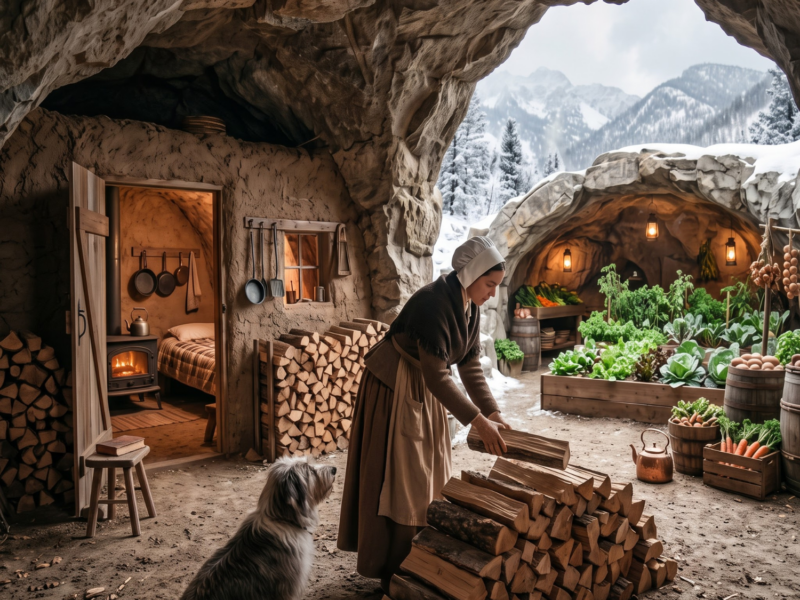
Thrown Out at 16, She Built a $10 Dirt Cellar Inside a Cave — Her Firewood Stayed Dry All Winter
The Dugout
When the pale, gray dawn finally arrived, the light came in thin and colorless through the dense cedar canopy. Eliza dragged herself upright.
Her joints moved the way wet wood moved—reluctantly, and with agonizing resistance. Her lips had cracked further in the night, tasting of copper blood. She stood in the biting cold and assessed her situation exactly the way Edmund had taught her to assess any mechanical problem.
What did she have? What did she need? What was the gap between the two? And what was the most direct, practical path across it?
She had survived one night. She knew, looking at her blue fingernails, that she could not survive many more like it under a tarp.
She remembered a sunny afternoon when she was nine years old. She and Edmund had been turning over the garden beds in preparation for spring planting. She had asked him why the root vegetables survived the brutal winter without freezing solid, why the ground did not freeze all the way down to the center of the earth.
He had stopped digging, leaning on his shovel, and looked at her in the way he always did when she asked a question worth answering properly.
“Below the frost line, Eliza, the earth keeps its own heat,” he had said, wiping his brow. “Doesn’t matter what the air does above it. You get deep enough into that ground, and the temperature stays around fifty degrees, year-round. Has been that way since before any of us were born. Soldiers in the war figured this out. Men who should have frozen to death in the Virginia wind dug themselves into the earth like badgers, and came out alive in the spring.”
He had tapped the steel blade of his spade against the dark soil. “You dig down far enough, kiddo, and winter cannot touch you.”
She had not thought about that casual conversation in years. Now, standing shivering on the ridge, she thought about absolutely nothing else.
She chose her site carefully, finding a spot where the hillside rose sharply and created a natural cutbank—an earthen wall already partially formed by the rugged terrain.
She unbuckled the entrenching tool, locked the blade into its working position with a click, and drove the pickaxe end into the surface of the ground.
The top layer of soil was frozen solid, hard as concrete. The shock of the impact traveled violently up through the wooden handle and rattled her teeth in her jaw. She gasped, pulled the tool free, and drove it down again. And again. And again.
By noon, her hands were covered in broken, weeping blisters. The raw skin stung agonizingly against the cold metal, despite the thick wool gloves she wore beneath her father’s coat.
By mid-afternoon, she had finally broken through the foot-thick frost layer and into the softer, unfrozen earth below. The digging became possible, though it never became easy.
She thought about Calvin, sitting comfortably in Edmund’s armchair in the warm cabin below, drinking his whiskey. And she drove the steel blade in harder.
Copper watched from a few feet away, his head tilted at a slight angle, following each stroke of the shovel with his intelligent eyes.
By the end of the second grueling day, Eliza had carved a rectangular chamber into the hillside. It was four feet deep, six feet long, and three feet wide. It was a grave for a giant, or a home for a survivor.
She built the roof from the heaviest fallen branches she could drag from the surrounding timber. She laid them crosswise over the open trench, creating a sturdy lattice. Then, she spread the olive-drab oilcloth tarp over the branches. Finally, she piled excavated soil, dead leaves, and pine needles over the tarp until the earthen mound was a foot thick and blended seamlessly into the natural contours of the forest floor.
The entrance was barely wide enough for her to crawl through on her stomach. She covered it with her school bag and a thick cross-hatching of pine boughs to block the wind.
On the third evening, completely exhausted, she crawled inside.
The wind stopped.
Not diminished. It stopped completely. The three walls of living earth absorbed the sound and the fury entirely. Her body heat, which had been bleeding rapidly into the open air since the night she left, finally had something to press against.
The temperature inside the tiny chamber was cold, but it was a completely different kind of cold. It was contained and diminishing, rather than aggressively advancing.
She pulled Copper in after her. He turned twice in the cramped space and settled heavily against her legs.
For the first time in three days, safe beneath the frost line, Eliza actually slept.
Over the following week, she established the rigid routines of survival.
She gathered deadwood from the surrounding ravine each morning, dragging birch branches and fallen pine sections back to the shelter and stacking them neatly against the interior back wall. She melted clean snow for drinking water using one of the chemical fire-starter bricks in her tin camp cup. She strictly rationed the pemmican Silas had given her, eating tiny, miserable amounts four times a day rather than larger amounts twice, tricking her stomach.
In the dark hours, she thought about Fort Blackwood, the federal way station twelve miles south across the ridge. It was where the U.S. Marshals maintained a permanent post that answered directly to the federal government in Boise, rather than to any corrupt county sheriff.
She thought about Edmund’s leather field journal, still hidden under the floorboard of her cot in the cabin she could no longer reach.
And she thought about what Silas Whitmore had said, standing there with his knuckles white against the glass counter: If you find anything strange on that East Ridge, do not touch it alone.
She did not know what the old man meant. But she thought about it.









