She Had Nowhere to Go—Then the Abandoned Mine Revealed a Secret Room ⛏️
The Hearth
The Hearth was larger than the journal’s dry measurements had prepared her for. Measurements are merely an abstraction until space becomes a physical experience.
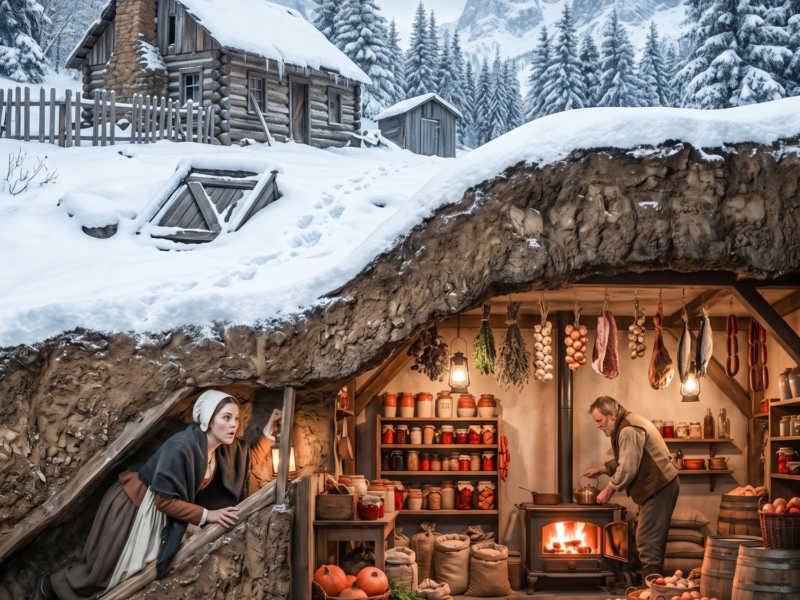
It was thirty feet across at its widest point, the natural stone ceiling vaulting to perhaps fifteen feet at the apex. The walls curved in the organic, flowing way of geological formations that were never meant to be rooms, but had become one through the miraculous intervention of a man who could see what a space could be, rather than only what it currently was.
The floor fissure ran east to west across the dead center of the cavern. It was two feet wide, perhaps six inches deep at the visible edges, and presumably much, much deeper at the dark center.
From this fissure rose a steady, powerful column of air that was visibly, gloriously warmer than the surrounding atmosphere. She could see it distort the lantern flame when she held the light above it—the flame bending wildly away from the upwelling, then recovering in a continuous, gentle, absolutely reliable conversation between the molten earth below and the air above.
August had written that the vent maintained a steady sixty-eight degrees in January, with twenty-below air roaring on the surface. She was there in October, and the vent’s air on her bare forearm felt like standing near a low-burning, comforting stove. Not scorching, not aggressive. Simply present. A living warmth that did not ask permission to exist.
She walked the perimeter of the massive chamber.
The heavy shelves along the north wall were built from rough-milled pine lumber. The wood was perfectly sound, the joints expertly pegged rather than nailed. The whole structure was anchored immovably to the rock wall with iron brackets that August had carried in, piece by heavy piece, through sixty feet of dark tunnel.
On those shelves sat tinned goods in perfect, military rows, the paper labels browned with age but entirely legible. Flour sat in heavy canvas bags completely coated in melted beeswax. The wax had gone slightly brittle at the surface, but the airtight seal remained flawlessly intact. Salt pork rested in heavy, glazed ceramic crocks, the ceramic undamaged, the heavy lids sealed tight with poured paraffin. Lamp oil waited in flat-sided tin cans. A stack of thick wool blankets was folded neatly.
And there were six books.
They sat with their spines facing outward. Five were a mix of dense engineering and geology texts. And one was a worn volume of Henry Wadsworth Longfellow’s poetry.
It seemed at first vastly inconsistent with the rest of the survival gear, until she considered that August Holt had been a man living entirely alone inside a mountain for two years, with only his math and his engineering journals for company. Perhaps he had desperately wanted, sometimes in the crushing dark, to read something that didn’t require calculations.
The cast-iron stove in the southeast corner was small, specifically designed to sit directly over a secondary, smaller fissure, rather than to stand alone. It was a cooking surface heated entirely by the earth.
It was either the most incredibly practical thing Marin had ever seen, or the most profoundly elegant, depending on what you chose to value about it. Both, she decided, running her hand over the cold iron. It was both.
She stood in the middle of The Hearth for a long time. The lantern was burning. The vent breathed steadily beneath her boots.
Somewhere far above her, Ironback Mountain stretched its granite miles in every direction, and the October sky sat on top of it all, turning violently cold in the way that Colorado Octobers do. The killer cold was coming from the northwest with the absolute directness of a decision already made.
But in here, none of that was present as a threat. It was present only as distance—a violent thing happening in a separate, abstract register from where she stood.
The mountain had never been her adversary. It had been this all along.
And everything else—Edmund Graves’s arrogant certainty, Mrs. Hartwell’s cloying pity, the dull, final thud of that iron orphanage gate—had merely been noise imposed on a pure signal she was only now receiving clearly.
You do not conquer a mountain, August had written in his third month on the freezing plateau. You ask it the right questions, and you wait patiently for it to answer. Most people never ask. They assume they already know what the mountain is for.
She sat down on the smooth stone floor of The Hearth. She sat in the radiant warmth that had been here, waiting, for three years without her. Warmth that had been here for geological ages before August was born. Warmth that would be here long after both of them were nothing but names on faded, crumbling documents in county registers nobody looked at anymore.
She sat there for a while without moving, letting the heat seep into her aching bones.
Then, she stood up. Because there was a great deal of work left to do.









