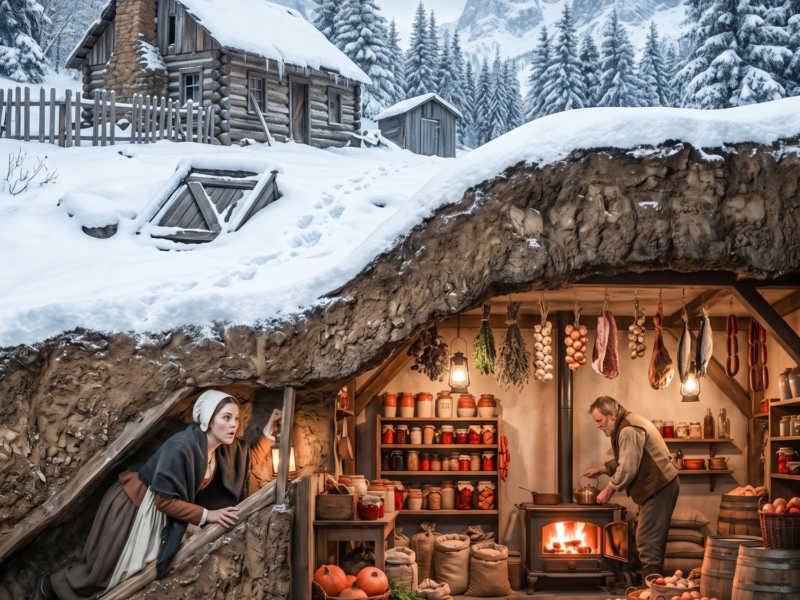
She Had Nowhere to Go—Then the Abandoned Mine Revealed a Secret Room ⛏️
The Dig
The first two weeks were archaeology without any of the patience that archaeology requires.
Every single stone she moved revealed two more stones wedged tightly behind it. And the debris pile, which had looked finite and manageable from the front, revealed itself to have terrifying depth. Not the gentle depth of a mound of dirt, but the compressed, interlocked depth of heavy things that had been falling onto each other for years.
She developed a brutal system.
Small stones first, moved entirely by hand, carried back to the side passage at forty feet that branched left and dead-ended after twenty feet. That dead end would become immensely useful as a dump site. Medium stones were leveraged out of the pile with the heavy iron pry bar, rolled, and moved in stages. The massive ones she chipped at relentlessly with the pickaxe along their visible fracture lines until they miraculously split into manageable sections.
Her hands changed vastly faster than the pile did.
The blisters she had started with broke, wept, dried, reformed over tougher skin, broke again, and built up again. By the end of the first week, her palms had taken on a different character than they had ever possessed before. They were not fully calloused yet, but they were actively reorganizing themselves in that direction. The soft, institutional tissue was resigning its position, handing control over to something much harder and more prepared for the violence of the work.
She ate twice a day. Morning, before entering the freezing shaft. Evening, after crawling out.
She ate beans from the supplies she’d bought from Cormac, cooked over a very small fire built from the driest deadwood she could find on the plateau. It was mostly the stunted limber pines that grew along the rock faces, wind-twisted into agonizing shapes that suggested they had been in a losing argument with the mountain for a century.
The fire was small. She deliberately kept it small. Not because she was rationing fuel, but because large fires on the high plateau were highly visible from the trail in the valley below, especially at night. And she was absolutely not ready to be visible. She was not exactly sure when she had decided this, but she had.
She worked quietly. She covered the mine entrance securely with a heavy canvas tarp when she wasn’t inside it. And she did not go down to Ridgemont after that first, necessary supply run.
Whatever Edmund Graves believed about her situation, she would let him blindly believe it. A woman being observed is a woman being managed. She had lived twenty-one years being aggressively managed by institutions that firmly believed their management was a form of kindness. She was entirely done being managed by anyone.
On the third day of the second week, the ceiling came down.
It was not the section she was actively working under. She had been incredibly careful, methodical, constantly checking the overhead rock with her lantern before she moved anything that might shift the load distribution of the pile.
The section that came down was twelve feet behind her. It was a piece of the left wall that had been standing perfectly solid since she started, a section she had tapped and checked on the very first day that showed absolutely no visible fracture lines.
It came down in a single, terrifying block, approximately the size of a large steamer trunk. And it hit the tunnel floor with a concussive sound that the enclosed rock amplified into something that felt more like a physical pressure wave than a noise. The impact knocked her to her knees.
She was not under it. She had moved past that exact spot four minutes earlier to retrieve the shovel from where she’d left it leaning against the wall.
Four minutes.
The horrifying math of that interval did not leave her mind for the rest of the day.
She sat in the dust of the tunnel with the lantern, her heart hammering against her ribs like a trapped bird, and looked at the massive block of granite for a very long time. It had landed cleanly. There was no secondary collapse. The ceiling above the new, jagged gap showed solid, gray granite, rather than the loose, layered shale she’d been worrying about.
The block itself was not in her way. By any practical, physical measure, nothing had changed. The work could easily continue.
What had changed was entirely interior.
She had been operating, she realized with sickening clarity, with a kind of theoretical, abstract acknowledgment of risk. She knew intellectually that the tunnel could fall on her, the exact same way a person knows they could theoretically be struck by lightning—as a statistical fact without any immediate, visceral reality.
The massive block of stone on the tunnel floor violently converted that theoretical knowledge into something her body now understood at a primal level, far below conscious thought.
Her hands, when she finally picked up the shovel again, were not entirely steady for the first time since she’d started the dig.
She picked up the shovel. She moved forward to the pile.
This was not courage in any grand, heroic form she had expected courage to take. It was not a cinematic surge of adrenaline, not a noble resolution, not the miraculous absence of fear.
It was vastly simpler than that. It was the brutal recognition that she was significantly more afraid of stopping, of going back to the orphanage or Graves’s laundry room, than she was of continuing into the dark. Which was, perhaps, the most honest, unvarnished definition of commitment she had yet encountered in her life.
She did not stop digging.









