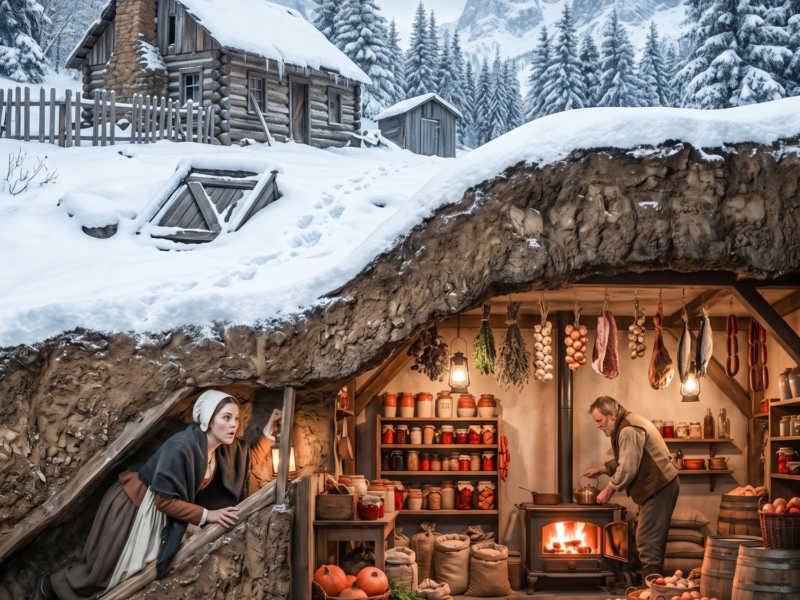
She Had Nowhere to Go—Then the Abandoned Mine Revealed a Secret Room ⛏️
The Revision
Cormac Briggs arrived twenty minutes later.
He was pulling a heavy wooden sled loaded with canvas bags that bumped over the snow’s uneven surface with the particular, relentless stubbornness of a heavy load being moved by a man who had decided it was going to move, regardless of the terrain.
He wore a wool coat she recognized as very old, but extraordinarily well-maintained—the kind of garment that represented a relationship with material, rather than a mere purchase. He had strapped his supply sled to himself at the chest, using the old teamster’s method for steep or uneven terrain, leaving his massive hands free.
He came over the plateau’s edge, saw her standing beside the vapor column source, and took in the scene with the cumulative, sharp attention of a man who had spent sixty-eight years developing the vital skill of reading situations correctly on the very first pass.
His eyes moved from her, to the entrance, to the cut of the vapor plume, to the retreating line of Graves’s snowshoe tracks heading south.
The smile that spread across his face was slow. The kind that does not announce itself loudly, but simply becomes present, the way the sun becomes present on a winter morning—gradually, and then completely.
He crossed the plateau and stopped at the crater’s edge. He looked down at the door with its heat-rimmed frame. He looked at her.
“Two winters,” Cormac said, panting slightly, his breath pluming. “That’s what I gave you.”
Marin smiled.
“In my head,” Cormac continued, leaning on the sled rope. “I said two winters. If she’s got half the grit of what she seems to have. Maybe less, if the mountain decided otherwise.”
He tilted his head toward the vapor column. “I’m revising the estimate.”
Marin felt the warmth of his words in a way that was entirely different from the physical warmth of The Hearth. That warmth was geological, ancient, and impersonal in its absolute constancy.
This was human. It was the warmth of one person revising an estimate in your favor based entirely on hard evidence. Which is the only kind of recognition worth having, because it cannot be given before it has been truly earned.
She brought him down into The Hearth.
She watched his face as he crossed the threshold into the cavern. As the sixty-eight-degree warmth found him—a man who had spent five days freezing in a drafty wooden building above a town that had suffered through the exact same storm that had not touched her.
She watched him press his massive, calloused palm flat against the stone wall. She watched him stand over the vent fissure, feeling the updraft. She watched him look at the stocked shelves, at the glowing lamp, at the cot with its neatly folded blankets, at the volume of Longfellow resting on the table beside the geothermal stove.
He did not speak for a full two minutes.
When he finally did, his voice had something in it she had not heard from him before. A quality beneath the practical. The tone of a man encountering something that has moved completely outside the category of the expected or accessible.
“August Holt,” Cormac said, to no one exactly, or to everyone who was not there. “You extraordinary, foolish, magnificent man.”
By nightfall, the story was spreading like wildfire in Ridgemont.
Cormac had gone back down in the afternoon, after she had fed him hot beans from the stove and shown him the journal, the shelves, and the full accounting of what August had built. He had held the fragile leather journal with the immense care of someone holding primary evidence. He had read the final entry standing up, which was how Marin knew he was vastly more moved than he wanted to show.
He had set it down on the shelf with the same care, exactly where she had found it, and had gone back up the tunnel to retrieve his empty sled from the plateau.
She had not asked him to tell anyone. She had not asked him not to.
Cormac Briggs was sixty-eight years old. He had lived in Colorado through boom and bust, through the particular cruelties of hard winters, and the quieter cruelties of institutional indifference. He had lived through enough instances of the “official version” of things being dead wrong that his default was to trust what he had seen with his own eyes over what he had been told by men in suits.
He had seen The Hearth. He would do with that what he thought was right.
What he thought was right turned out to be sitting at a table at McCree’s saloon. With a glass of rye whiskey he nursed over two hours, using a voice that did not perform or embellish the story, but simply delivered it as fact to whoever was there to receive it.
The storm had taken two people from Ridgemont. Hester Mulligan and Pete Darnell. Both elderly. Both taken by the cold in homes that had not held warmth adequately.
The town was in the early stages of the particular, heavy grief that follows disaster. The accounting phase. The tallying of what had been lost against what had been preserved. The looming question of whether things had to be the way they had been.
Into that grim accounting, Cormac dropped his account.
The woman Edmund Graves had dismissed as a half-wit orphan had eaten hot food every night of the storm, inside a mountain that had not lost one single degree of temperature in five days. She had found a brilliant design for living in hard country that a man named August Holt had completed in 1879. A design that had been dismissed, sealed, and forgotten because the men with authority over it had not been able to see past their own arrogant assumptions about what the mountain was for.
The design worked. Cormac had stood in it. He had felt it.
Ridgemont listened.
The story reached its final, devastating shape not in one night, but over the week following the storm, as the town dug out and assessed its true condition. The caving of the Henderson’s barn roof. The frozen pipe failures that had left three homes without water access. The dwindled firewood supply that had forced desperate families to burn furniture by the fourth day.
Against all of this suffering, the story of The Hearth sharpened into something that was less about wonder than about failure.
Not Marin’s failure. But the town’s failure to know what was sitting right next to them. A failure of imagination that had allowed two people to die in a storm that had not been able to touch a woman living inside the mountain with handmade gear, preserved food, and three years of other people’s dismissed knowledge.
Graves’s powerful position in Ridgemont—which had rested entirely on the certainty he projected rather than on any evidence of its accuracy—could not sustain what the story revealed about his judgment.
This was not a community that forgave incompetence disguised as authority. These were harsh people who depended on accurate assessment of conditions for their survival. And the gap between what Graves had confidently told them about the “worthless” Holt claim for years, and what the claim actually contained, was the kind of gap that reshapes trust permanently.
He did not announce his departure. He was simply, by the second week of December, in the quiet process of it. A hurried sale arranged through correspondence with a Denver investor. The house emptying. The office transferring to a deputy registrar from Salida, who arrived with his family and no particular opinions about the Holt claim whatsoever.
Marin learned of the departure from Cormac, who told her without editorializing, because that was how Cormac handled most things.
She did not feel the smug satisfaction she might have expected. What she felt was something quieter. The recognition that Graves’s departure was not a consequence of what she had done, but of what he had failed to do. Which was entirely his own accounting to settle.
Her life had not been organized around defeating him. It had been organized around surviving. Then around understanding what she had inherited. Then around inhabiting it. Those things remained, regardless of who was sitting in the county land office.









