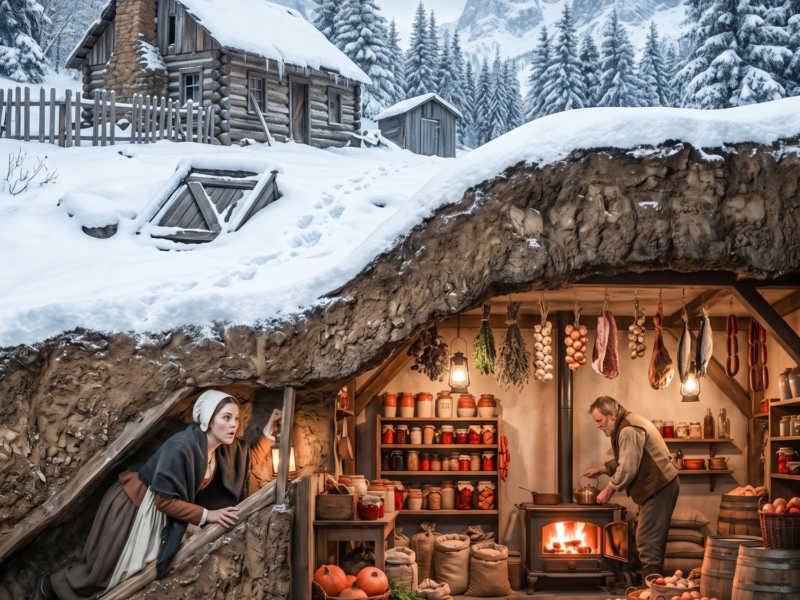
She Had Nowhere to Go—Then the Abandoned Mine Revealed a Secret Room ⛏️
The Appraisal
Edmund Graves appeared at the plateau’s edge.
He was dressed impeccably for the extreme conditions: a heavy wool coat, a fur hat with ear flaps pulled down, and ash-wood snowshoes that looked brand new, or nearly so. He looked exactly like a man who owned the right, expensive equipment for dangerous situations he had not previously chosen to place himself in.
He stopped when he reached the plateau’s open surface.
He looked at the vast, unbroken expanse of white. He looked at the total absence of anything that might indicate a structure, an occupation, a life. His expression at that distance was unreadable, but his posture said something clear. A slight, relaxing drop in the shoulders. The settling of a man receiving the grim confirmation he expected, but had perhaps—in some buried part of himself he was not ready to acknowledge—hoped would not come.
He began moving across the plateau toward the center, heading exactly for where she knew he would have stood to survey the ruins during his previous visit.
She watched him without calling out.
He did not look in her direction yet. He was looking at the flat surface, the absence of any protrusion, the completeness of the white burial.
Then, he stopped dead in his tracks.
She knew exactly what he had seen.
The vapor column above the mine entrance was clearest in the freezing morning cold. The warm, sixty-eight-degree air from the vent fissure, rising through sixty feet of tunnel, emerging from the small gaps around her wooden door, meeting the minus-fifteen-degree air above the snow surface. It condensed immediately into a thin, steady, brilliant white plume that rose six feet straight into the air before dispersing.
From where he stood, it would look like something burning without flame. A white signal rising from nothing, with a consistency that was not windblown, not erratic, and completely inexplicable by anything in his understanding of what dead rock and snow could produce on their own.
He moved cautiously toward it.
She watched him find the edge of the crater she had dug. She watched him look down at the heavy timber door. She watched him look at the visible warmth escaping through the sealed frame.
He stood there for a moment that stretched into eternity.
Then, the door—which she had left unlatched when she came out—swung open from the inside. She had positioned it to swing naturally, pushed by the differential pressure of the warm air meeting the cold. The tunnel breathing out.
Graves’s head snapped up. He looked across the snow surface.
He found her.
The distance between them was perhaps thirty feet across the white plateau. He began moving toward her, his snowshoes leaving the crisp, oval marks of careful progress.
His face was now fully readable at closer range. It was not the arrogant, pitying face she had seen in his office. Nor was it the face she had seen on the plateau in October, when he had ridden up to perform his concern for her benefit.
This was a face that had spent four nights cowering in a house that had not held the cold out adequately. A face that had burned through its winter fuel supply in less than a week. A face that had sat in the specific, terrifying darkness of a room where the temperature was dropping, and the certainty that tomorrow would be fine had been replaced by the immediate, desperate question of whether tonight would be survivable.
He was not a broken man. But he was a man whose internal framework had been stressed far past its capacity to pretend it was still intact.
He stopped six feet from her.
He looked at her. He looked at the shovel. He looked at the heavy coat. He looked at the healthy flush in her face from the morning work.
He looked at the absolute absence of suffering in any form that his cruel calculations had predicted.
His voice, when it came, had shed its professional, booming register entirely. It was quiet.
“You’re alive.”
Marin held his gaze across the blinding snow.
“I have been the entire time.”
The simplicity of the statement seemed to physically cost him something.
He looked past her, at the vapor column still rising steadily from the entrance. He looked at the heavy door she had built. He looked at the cut wood stacked along the rock face to the east—its top buried under snow, but its existence clearly implied by the regular, rectangular shapes visible at the surface.
It was the undeniable evidence of a prepared, deliberate, continuous occupation. None of which had been visible to his careless survey men in September, because she had made it invisible on purpose.
“The ground…” he started, then stopped.
The professional language was failing him. The vocabulary of land assessment, of institutional authority, of a man who measured value entirely by what he could record in a ledger. None of it was adequate to explain the thirty-foot column of warm air rising from the mountain’s face on a morning when the air temperature was cold enough to kill a man from exposure in under three hours.
“Your great-grandfather found it,” Graves whispered.
Marin was quiet for a moment. The wind that had torn the plateau apart for five days had left the air absolutely still now. The way extreme violence always leaves a profound stillness behind it.
“He didn’t find it the way people find things by accident,” Marin said, her voice clear. “He asked the right question. He asked what the mountain had to offer, instead of what he could force it to give up with dynamite. Everything that’s down there… he built it as a gift to whoever came after. Because he understood that knowledge is only useful if it passes forward.”
Graves looked at her for a long time.
The smooth, polished work-surface of his certainty—which had been smoothed by decades of being right in ways that nobody had ever successfully challenged—was visibly uneven now. Not gone. Not demolished. But uneven. Which was worse in its own way. A cracked surface shows you exactly how much was held there by surface tension alone.
She watched him work through something she had seen worked through before, in the faces of people at Mercy Ridge who had built their entire sense of order on an assumption that had suddenly proven spectacularly wrong. The stages were always the same: Resistance. Then the failure of resistance. Then the long, painful moment where nothing was yet rebuilt.
He did not apologize. She had not expected him to. Men like Edmund Graves carried their massive errors privately, paid for them privately, and translated the payment into future behavior entirely without acknowledgment. Because acknowledgment would require them to admit they had been wrong in a way they had said out loud, which was fundamentally different from being wrong in a way they quietly knew.
He would carry this. It would change things. Just not in any form that would ever present itself as an admission.
“I underestimated what was here,” he said, with the agonizing flatness of a man forcing himself to say something true.
“You underestimated August,” Marin corrected him gently. “The land was always exactly what he said it was.”
The distinction was important. He received it.
He nodded once. A minimal gesture, the kind that costs a proud man vastly more than larger gestures do.
Then he turned, adjusted his snowshoes, walked back to the south end of the plateau, and disappeared down the trail without looking back.
She watched the empty place where he’d gone for a moment. Then she turned back to the entrance. The path still needed clearing.









