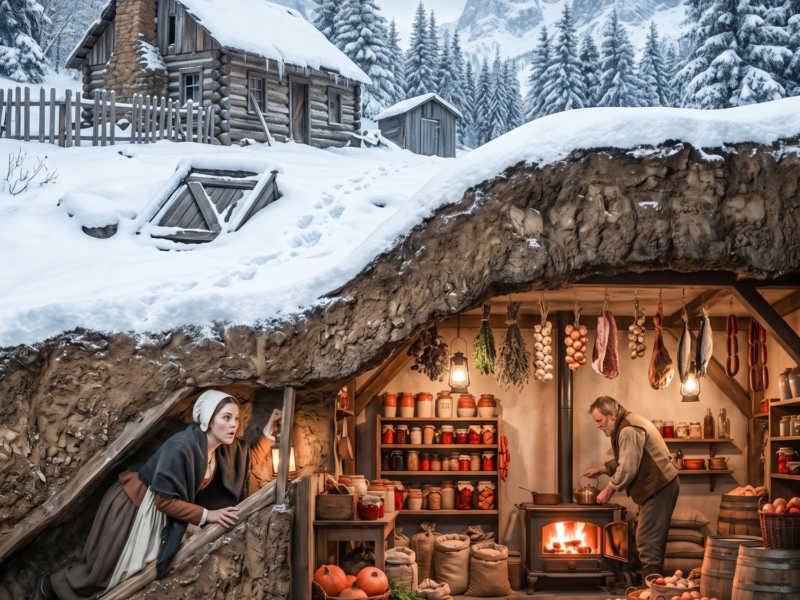
She Had Nowhere to Go—Then the Abandoned Mine Revealed a Secret Room ⛏️
Moving In
Moving her meager life entirely underground took a full week.
Not because the quantities were large—she possessed almost nothing—but because she was incredibly careful. She was deliberate in the way that matters far more than speed when the work is the kind that, if done wrong, cannot be undone.
She built a massive, heavy door for the mine entrance from the ruined cabin’s remaining salvageable timber. It was constructed of three-inch-thick planks bolted onto a sturdy frame. The gaps were chinked tight with a noxious, sticky mix of clay and boiling pine pitch, which she worked out by trial and the kind of error that leaves your hands smelling like a forest fire for three days.
The door hung on the heavy iron hinges she found in the cabin debris, which she reset into proper wooden blocks. She painstakingly cut and chiseled the granite to create a flush door frame. It was absolutely not a beautiful door. But it was a door that would definitively keep the howling wind out and the precious heat in, which was the only thing a door in that location ever needed to be.
She found the fresh water source on the fifth day.
It was a slow seep-spring in the tunnel wall, located two hundred feet back from the main entrance, in a section she had not needed to clear of debris because August had meticulously kept it passable. The water came out of the living rock cold enough to ache against her teeth. It moved along a shallow channel someone had cut into the tunnel floor decades ago, and drained away into a natural, deep sump.
She calculated she could use it directly for drinking and cooking, with absolutely no boiling or treatment required. The mountain was perfectly filtering it through miles of granite for her.
She established a rhythm to her days.
Mornings were for maintenance work. The daily, vital tasks that a space inhabited through a mountain winter would require. She did not know yet what all of them were, but she was rapidly developing the list.
Afternoons were spent on the plateau, while the daylight held, frantically cutting and stacking the twisted limber pine into a massive woodpile against the entrance wall. She would not need much wood. The Hearth’s ambient temperature was entirely self-sustaining. But the iron stove could not cook a meal on geothermal heat alone; it needed occasional supplemental fuel, especially on the days when she used it heavily to bake bread.
She was not going to run out of wood. She was not going to run out of anything.
The bison grass on the plateau went from a vibrant gold to brown, and finally to the flat, compressed, dead tan of late October. The jagged peaks above her were blindingly white with snow from the first week of October, the snowline descending menacingly each week by another hundred feet.
On a clear, freezing night, lying in her cot near the vent fissure, with the Longfellow volume open on her chest and the lantern burning at its lowest useful setting, she could hear the mountain above her.
It was not the wind. It was not any surface sound. It was the deep, agonizing creaking of billions of tons of rock physically contracting as the temperature plummeted toward zero. It was a sound that was far below the range of hearing in any comfortable wooden room in town, but was perfectly audible deep in The Hearth, where she was close enough to the stone for the stone to speak.
She found, surprisingly, that she liked it. The sound was company. Company of a kind she had not expected, but welcomed.
On the third day of November, the sky fundamentally changed.
She had been obsessively watching the weather patterns for weeks, correlating what she saw against August’s meticulous notations in the journal. The man had been a brilliant observer, recording barometric indications even when he had no barometer, using only what he could see with his eyes.
He noted the erratic behavior of the ravens that nested on the mountain’s south face. He noted the way the distant San Juan peaks to the southwest appeared crystal clear or disappeared from view in the haze. He noted the texture of the clouds on the horizon, and whether the wind came from the northwest or swung suddenly to the northeast—which always indicated something entirely different and usually violent.
What she saw on November 3rd was what August had grimly called The Great Stillness.
The wind, which had not stopped blowing for more than a few hours since she arrived in September, simply was not there when she stepped out in the morning. Silence sat heavily on the plateau like a physical, suffocating substance.
The ravens were entirely gone.
The sky to the northwest was a color that was not quite gray. It was metallic. The exact, ominous color of the underside of something very, very large.
She did not need the journal to tell her what came next. The air itself was announcing it.
She brought everything in that could possibly be brought in. She worked frantically through the morning without pausing to eat. She hauled in the remaining cut wood. She brought in the heavy tools she had been leaving near the entrance for convenience. She dragged in the canvas tarp.
She checked the massive door seal. She filled every available container, bucket, and pot with freezing water from the spring. She counted her supplies again, checking them against a mental calendar that ran all the way through April.
Then, she went deep down into The Hearth. She pulled the heavy oak door closed, latched it, sat in the absolute warmth with the Longfellow volume, and waited.









