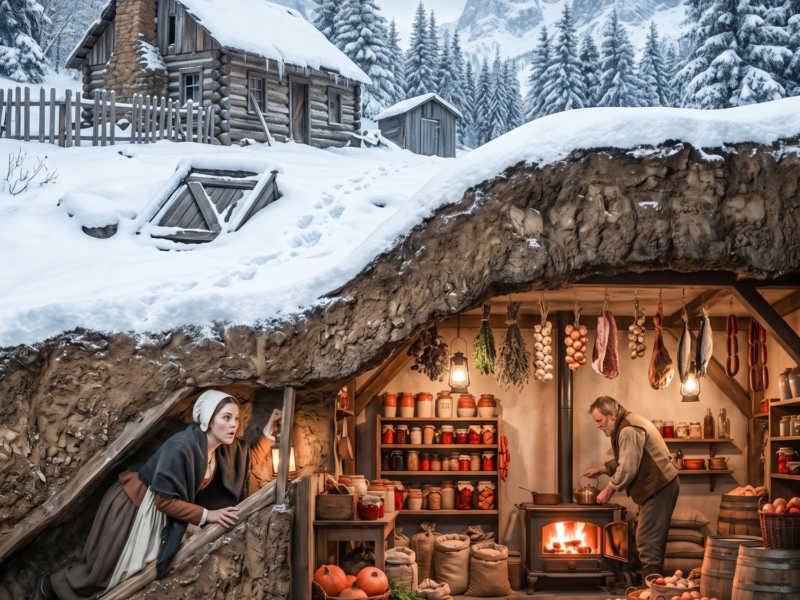
She Had Nowhere to Go—Then the Abandoned Mine Revealed a Secret Room ⛏️
The Sky Drawing a Breath
The path up Ironback Mountain started at the extreme north end of Ridgemont’s main street, where the last building—a blacksmith shop, already closed for the evening—gave way to open, rising ground.
From there, it was recognizable as a proper trail for perhaps a quarter mile, wide enough for a horse cart, roughly graded against the steepest sections. Then it narrowed sharply to a single-file track winding through dense scrub oak and mountain mahogany. Then it narrowed still further, until it was simply the path of least resistance through jagged rock and exposed root—a suggestion more than a road.
Marin climbed for three hours in the long September afternoon. The canvas strap of her satchel cut deeply into her collarbone. Her city shoes, which were sturdy enough for Denver’s paved streets, were dangerously unsuited for uneven granite scree.
The air thinned significantly as she climbed. She noticed it at first as a slight reluctance in her lungs, a mild, confusing surprise at how much physical effort was required for things that hadn’t required any effort an hour ago. By the time she crossed above the treeline, her chest was heaving.
Above the trees, the wind was entirely unmediated. There was no timber to break it, no hillside to redirect it. There was just open, violent sky, and the steady, punishing push of a force that moved through the mountains with the absolute indifference of weather.
The plateau opened before her just as the last of the afternoon light was slanting gold across the rock.
She stopped walking. She dropped her bag. She looked at what was hers.
The cabin was a rotting skeleton. Three walls still miraculously stood, but the mud chinking had crumbled away so completely that the massive gaps between the logs showed sky straight through one side and out the other. The roof had collapsed completely inward, the heavy ridge beam broken like a snapped twig in the center. The timber and cedar shakes lay in a chaotic, rotting heap inside the standing walls.
The heavy stone chimney rose from the wreckage entirely intact, which only made the rest of the destruction look worse by comparison. It stood like a gravestone for the structure it had once served.
The ground around the cabin was sheer rock with agonizingly thin soil. A few low-growing sedges, already bleached white by early frost, clung to life. A thick mat of pale green lichen grew on the north faces of the larger boulders. There were no trees. There was no grass to speak of. The wind moved through everything, unimpeded.
Fifty yards from the ruined cabin, the mine entrance was aggressively boarded over with thick, weathered pine planks, bolted to heavy iron brackets set deep into the living rock face. A metal sign from the Colorado Bureau of Mines—the red paint long since faded to gray on gray—warned: UNSTABLE GROUND. STRUCTURAL HAZARD. UNAUTHORIZED ENTRY PROHIBITED.
The iron bolts were heavy, round-headed. The kind driven into stone to stay forever.
Ironback Mountain rose immediately behind all of this, its sheer granite face catching the last of the light in long, blazing orange stripes between the deepening shadows.
The mountain was not threatening in the way Graves had implied. It was not menacing. It was not actively hostile. It was simply enormous in a particular way. The kind of enormity that predates human memory by geological orders of magnitude. It carried its own variety of indifference, one that was vastly more total, and terrifying, than any active hostility could ever be.
Marin chose the most sheltered corner of the standing log walls, where two sides met and the collapsed roof had fallen away from the angle rather than into it, leaving a small, partial overhead cover of sky. She set down her satchel. She ate the very last heel of the bread she’d carried from Salida.
She did not let herself think about Ridgemont, or Graves, or the fourteen dollars, or anything that could be measured in desperate days or dwindling dollars. She thought about absolutely nothing at all. It was its own kind of brutal discipline.
She slept terribly. The wind found every gap in the ruined walls. The temperature dropped to something that moved past merely uncomfortable and into the range of simply, undeniably factual. This is what cold is. This is what cold does to a body that has nothing between it and the sky.
The second day brought heavy, bruised clouds moving in rapidly from the northwest. They were low and gray-bellied, dragging their terrible weight across the peaks. The wind increased its howling pitch.
Marin spent the entire day huddled in the least cold corner of the ruined cabin, reading her botanical field guide with the intense, focused attention of someone who has decided that learning absolutely anything is better than thinking about starving to death. She identified the lichen on the boulders. Three separate species. One of them was a biological wonder that could survive temperature swings of a hundred degrees and still somehow photosynthesize.
She filed this information away with no particular plan for using it.
On the third day, the wind shifted. It came straight down the mountain’s face like an avalanche of air. The temperature plummeted further.
Marin found herself finally doing the agonizing arithmetic she had been refusing to do. Fourteen dollars. Minus coach fare back to Denver. Minus whatever she would need to eat while she figured out what to do with a worthless piece of rock. Minus the cost of any tools or materials required to make the cabin even marginally habitable.
Minus. Minus. Minus. Until the number at the bottom of the column was something she couldn’t look at directly without weeping.
The room at the Fenwick boarding house down in the valley would be warm. The laundry work would be something to do with her hands. It was absolutely not the life she wanted, but it was a life. And her definition of a life seemed to be rapidly expanding in her panicked mind to include things she had previously, proudly classified as failures.
She hated herself for thinking it. She thought it anyway.
That night, she lay shivering violently under her single wool blanket, with her heavy coat pulled over it, and listened to the wind treat the ruined cabin walls as if they were a wooden instrument it had been waiting all season to play. She was not afraid, exactly. She was something worse than afraid. She was uncertain. Uncertainty is fear without the clarity of a specific threat to focus on. Uncertainty spreads like a stain. It gets into everything.
By the time she finally fell into an exhausted sleep, she had almost decided to walk back down the mountain.
The fourth morning broke entirely differently.
The clouds had cleared overnight without her noticing. She woke to blinding sunlight that came slicing through the gaps in the cabin walls in long, thin, golden blades. It was the kind of September morning in the Colorado high country that seems to be profusely apologizing for the brutal days before it, offering itself with a particular, staggering intensity of light that only exists above eight thousand feet, where there is simply less atmosphere between you and the sun.
The sky was a shade of blue she had no word for that wasn’t woefully inadequate.
She was not yet decided. She was lying perfectly still under her blanket, deciding.
Then, the golden light moved across the ruined hearth.
The heavy stone chimney was still perfectly whole, built of solid granite blocks mortared together by someone who knew exactly what mortar was for. At its base, where the firebox had once roared, the massive hearthstones were still mostly in place, buried under the debris of the collapsed roof.
The light found a jagged crack in the stone at the very base of the firebox.
And in that crack, growing from absolute nothing—from pure, unyielding granite, without a single cup of soil to recommend itself—was a Colorado Columbine.
The state flower. Its delicate purple petals with white inner spurs fully open to the sun. The whole miraculous thing was no larger than Marin’s palm. It was growing from rock, the way things grow from rock in the violent Colorado mountains: without asking permission, without apology, and apparently without any particular interest in whether anyone passing by thought it was physically possible.
Marin looked at the flower for a very long time.
It did not know it was in an impossible place. Or, it knew, and had stubbornly decided to be there anyway, which amounted to the exact same thing. It had not tallied the insurmountable difficulties. It had not consulted Edmund Graves on his ledger. It simply occupied its tiny crack in the granite, turned its face to the available light, and got on with the furious business of existing.
Something deep in Marin’s chest shifted.
It was not dramatically loud. Not the way such things happen in romantic stories with a sudden warmth or a swelling surge of inspiration. It felt more like a bone painfully resetting—a quiet, internal structural correction that hurt slightly, and then was done. And after which, her body was arranged entirely differently than it had been before.
She threw off the blanket. She got up.
She began pulling heavy, rotting debris away from the hearthstones. She was not sure what she was looking for. She was simply looking for something to do that was not lying still and deciding to surrender.
The hearthstones were incredibly heavy. The collapsed roof timbers had to be wrestled aside. Some were gray and punky, soft enough to crumble into dust under pressure; others were still solid and back-breakingly heavy in their cores. She worked furiously for two hours before she reached the actual hearthstone level. Her soft hands were filthy and scraped. Her back ached in the specific, warning way that meant she had been using muscles that had not been used this way before.
It did not feel bad. It felt like vital information her body was delivering about what it was actually capable of.
The large, flat stone at the very back of the firebox—the one that would have reflected heat out into the room—was loose.
Not “collapsed ruin” loose. But deliberately, specifically loose. As if it had been set that way on purpose. As if it had been placed specifically to be moved.
Marin crouched in the ash in front of it. She found a piece of rusted iron strapping in the debris, worked it into the edge of the stone, and applied her weight.
The stone pivoted smoothly outward on a lower edge.
It revealed a dark space cut directly into the rock behind the chimney wall. The recess was perhaps eighteen inches wide, twelve inches high, and eight inches deep. A perfectly square recess that would have been completely invisible with the hearthstone seated in place.
Inside the recess sat a heavy metal box. It was the size of a large book, wrapped tightly in dark oilcloth, and tied with a leather cord that had dried over the years to the consistency of iron wire.
Her hands were not entirely steady when she reached in and lifted it out.
The box was much heavier than it looked. The oilcloth was stiff, but entirely uncompromised by moisture. Whoever had wrapped it had known exactly what they were doing.
She carried it to the best-lit spot in the ruined cabin, sat down with her back against the standing east wall, pulled her knife from her pocket, and sawed through the petrified cord.
Inside the box, resting on a bed of perfectly dried mountain moss, lay two objects.
The first was a gold nugget. It was about the size of her thumb’s first joint. It was irregular, dull-surfaced, but heavy in a way that was instantly, shockingly distinguishable from any other metal she had ever held.
The second object was a thick, leather-bound journal. The cover was worn smooth at the corners. The pages inside were dense with small, highly angular writing in brown ink. The ink had been applied with the pressured deliberateness of someone who was used to writing things down as if the sheer act of writing them made them more real.
August Holt’s name was written on the inside cover.
Below it, a date: July 14th, 1877.
Below that, in smaller, darker letters:
Property of A. Holt, Engineer. If found, read it before you judge it.









