She Had Nowhere to Go—Then the Abandoned Mine Revealed a Secret Room ⛏️
The Engineer's Fire
She read.
August Holt had not been looking for silver.
This startling fact became clear by the fourth page. It became clearer still by the twentieth. And by the fiftieth page, it was so glaringly obvious that Marin had to physically stop reading, close her eyes, and entirely recalibrate everything Edmund Graves had told her, and everything Mrs. Hartwell’s pitying letter had implied, against this radically different evidence.
The leather journal was absolutely not the frantic, disjointed record of an obsessive prospector chasing impossible wealth. It was the meticulous, working document of a highly educated engineer who had taught himself deep-earth geology from textbooks. He had come to Elk County not despite the glaring lack of silver deposits in the granite, but because of it. Because he understood—or passionately believed he understood—something about what the granite of Ironback Mountain contained that was vastly more useful, and far more powerful, than silver.
He had read about geothermal energy in a dense monograph published by a German geologist in 1871, translated into English in 1874, and purchased secondhand at a Denver bookstore for thirty cents.
The radical theory proposed that the violent volcanic and tectonic activity deep beneath the Rocky Mountain range had left massive thermal channels—veins of intense heat running through the granite at various depths, detectable by extremely careful temperature measurement at the surface and in shallow excavations.
August Holt had spent his entire first grueling summer on the plateau doing absolutely nothing but measuring. He drove iron rods deep into the ground at hundreds of different points and meticulously measured the temperature at different depths with a sensitive mercury thermometer. He recorded every single reading in the journal, with a date, a time, and a cross-referenced notation about cloud cover and ambient air temperature.
He mapped. He triangulated. He calculated.
And he found exactly what he was looking for.
Beneath a very specific section of the plateau, the thermal gradient was dramatically, exponentially higher than the surrounding rock. Not by a fraction of a degree. Not ambiguously. But decisively, reproducibly higher.
In the way that hard data crystallizes into unshakeable conviction, August dug. He did not dig randomly, caught in the spiral of desperation that characterized most failed prospecting. He dug with a precise mathematical plan, adjusting his angle as he went, following the warm rock the way a hound follows a scent when it knows exactly what it is looking for.
The mine shaft was not a mine. It was his surgical instrument. The tunnel was his measurement device. He was not trying to extract anything from the mountain. He was trying to listen to it.
By the fall of 1878, he had found the thermal vent.
It was a deep fissure in the granite at depth, from which a steady, powerful upwelling of warm air emerged from the earth’s crust. It was not boiling hot; it was not the scalding, lethal output of an active volcanic geyser. But it was warm in the exact way a living body is warm—consistently, continuously, and infinitely reliably.
He spent the brutal winter of 1878 living in a rough timber camp above the shaft, climbing down daily to measure the vent’s output through the absolute coldest months. It did not vary by a single degree. When the ambient air above the plateau was twenty below zero Fahrenheit for two solid weeks in January, the air rushing out of the vent sixty feet underground was a balmy sixty-eight degrees.
The entire rest of the journal was the construction record.
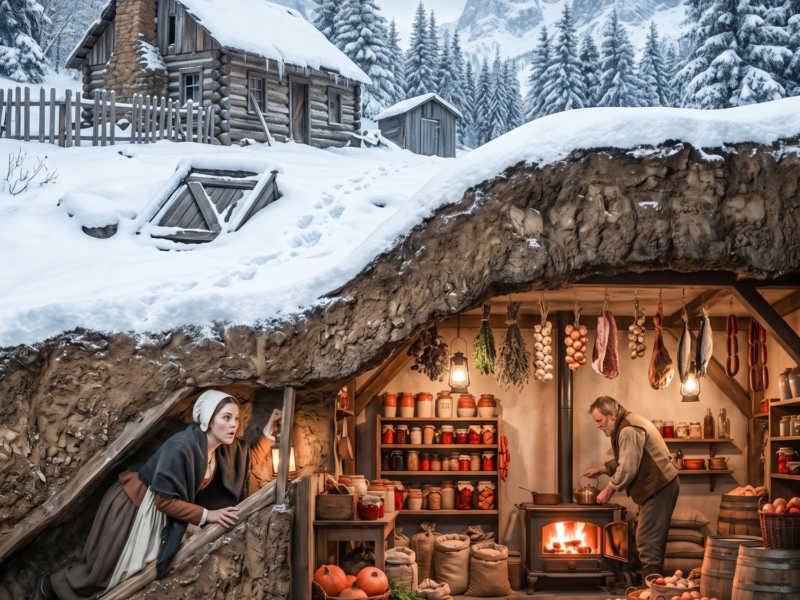
August had designed a subterranean chamber. He had found a natural cavern adjacent to the thermal vent, and he had painstakingly enlarged and shaped it over the following eighteen months using hand tools. He had built heavy wooden shelves. He had hauled down and installed a small cast-iron stove directly over a secondary, smaller fissure, so that it could serve as a cooking surface with absolutely no combustible fuel required. The heat of the earth itself was the fuel.
He had provisioned the massive space.
He had, as Marin read through the final, staggering entries, essentially built himself a permanent, sustainable home deep inside the mountain. A home that would flawlessly maintain a livable temperature through any apocalyptic winter that Colorado could produce, drawing on heat that had been accumulating in the planet’s core since before the Rocky Mountains even existed.
His final entries were dated November of 1879.
The very last one read:
The hearth is complete. Provisions for two winters at minimum are stored and sealed. I am unwell. The lungs have been poor since August. The rock dust has taken its toll. I will winter in Denver, seek medical treatment, and return in October of next year when I am stronger. Everything is ready.
He was not stronger. He had never come back.
He had left a complete, heavily provisioned, perfectly functional winter refuge inside Ironback Mountain. And he had died in a charity ward without telling a single soul it existed, because the only person he had left to tell was a daughter who had died in childbirth before she ever knew what her father had built. And whose daughter was subsequently delivered to a freezing orphanage in Denver with a name pinned to her blanket, and nothing else.
Marin sat for a very long time after she finished reading the final page.
The wind worked tirelessly at the ruined cabin walls around her. The purple Columbine in the hearthstone crack moved slightly with the draft. The golden light had moved completely across the plateau while she read, swinging from morning east to afternoon west. And now the shadows stretching across the snow were long again.
She turned to the very final, folded page of the journal.
It was a map of the mine tunnel, drawn in careful, precise ink. Every single measurement was annotated. Every geological feature was labeled. The main shaft. A branching lateral tunnel at forty feet. A secondary branch at ninety feet. The specific rockfall zones. The heavily timbered sections. The exact point where the granite changed character from the surface formation to the deeper, older intrusive rock.
At the very end of the secondary branch, marked with a small, neat rectangle, were the words: The Hearth.
Below it, a note: Chamber accessed through a false wall of fitted stone. No mortar. Keystone at eye level marked with an ‘H’. Dismantle in sequence as indicated.
The chamber was not on any official county map. The Bureau of Mines had surveyed the shaft in 1880, declared it dangerously unstable, and sealed it. They had not gone far enough in. Either they hadn’t known what to look for, or they had been terrified of the loose shale ceiling. They did not have August’s map.
Marin had August’s map.
She counted backward in her head from the journal’s final entry. November 1879. This was September 1882.
Not fifty years. Not a generation. Less than three years.
The provisions August had meticulously left behind—tinned goods, flour sealed in beeswax cloth, salt-cured meat packed in glazed ceramic, heavy tins of lamp oil—were only three years old. Not fifty.
Three years in a sealed, subterranean mountain chamber with a perfectly stable temperature and absolute zero light exposure was not a death sentence for properly preserved food. It was, in fact, close to ideal storage conditions.
She was not looking at a dead, crazy man’s failed dream. She was looking at a brilliantly completed plan that had simply been waiting for someone to arrive with the key.
The gold nugget caught the late light in her dirty palm. August had found it in the rock during his deep excavation. It was a single piece, probably from a small, isolated pocket in the granite—not indicative of a deposit worth commercially mining. He had kept it merely as a geological record.
She felt its weight. Its incredible density. The way it occupied space vastly more convincingly than other things its size. It was not a fortune that would buy a mansion. But it was something.
The decision arrived without any grand ceremony, which was appropriate, because everything that truly mattered in Marin’s life had always happened that way. Not with a booming announcement, not with the dramatic clarity that dime novels promised, but as the quiet, solid recognition that the path had already been irrevocably chosen, while she was still telling herself she was merely “thinking about it.”
She needed tools.
The heavy planks bolted over the mine entrance would absolutely not come down with a rusty piece of iron strapping and sheer determination. She had tried one bolt already, testing it. The iron bolts were set far deeper than they looked. She needed a proper, heavy steel pry bar, or a sledgehammer, or both. She needed strong rope. She needed lamp oil and a lantern that wouldn’t be extinguished by a sudden subterranean draft. She needed food she could eat while she was doing the grueling physical work. And she needed to be able to do the work for more than a single day without her body failing from sheer starvation.
All of this required walking back down to Ridgemont.
All of this required money, or something equivalent.
She wrapped the priceless journal back tightly in the oilcloth. She tucked it deep into the bottom of her satchel, alongside her clothes. The gold nugget went deep into her coat pocket, where her fingers could constantly feel its weight.
She looked one more time at the Colorado Columbine in the crack of the hearthstone. It was still there. Still brilliantly purple. Completely undisturbed by the terrifying fact that it was September at ten thousand feet, and a lethal cold front was aggressively building in the northwest.
She turned south, toward the steep trail down to Ridgemont.









