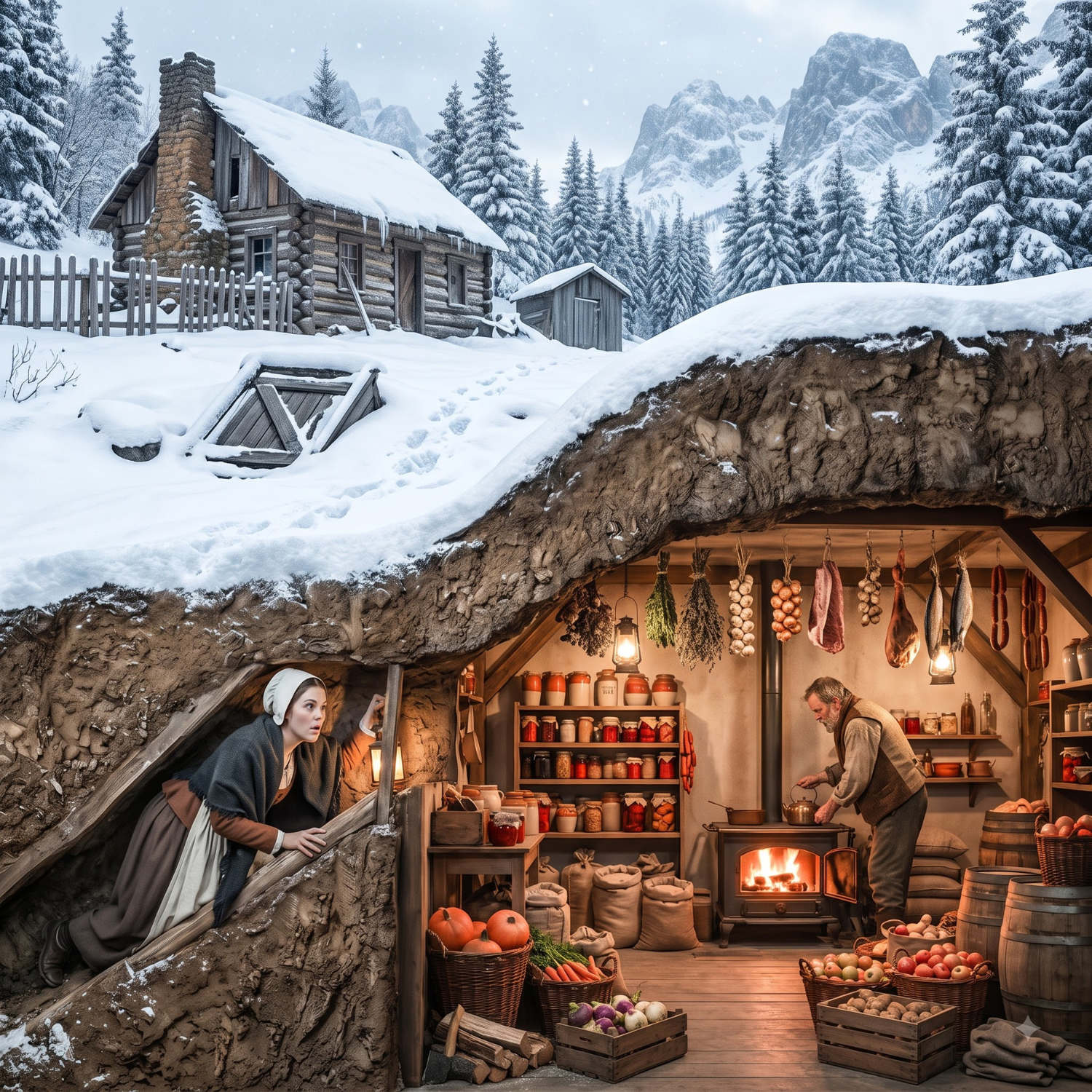
She Had Nowhere to Go—Then the Abandoned Mine Revealed a Secret Room ⛏️
The Arithmetic of Worth
The train south from Denver crossed into the mountains through country that changed so gradually it seemed like the mountains were choosing her, rather than the other way around. The flat, brown plains flattened out behind the train, while the land rose ahead in long, tilted shelves of violent red rock dusted with dark green pine.
By the time the train was laboring up the steep grade through South Park, the air leaking through the window frames had gone cold enough that Marin could see her breath fogging the glass. She pressed her bare fingers against the pane and felt the chill seep deep into her knuckles.
At Poncha Pass, the train groaned through the highest point of the route. Marin looked out at a sky so painfully, sharply blue it seemed almost artificial—the kind of color that belonged in an oil painting of somewhere else entirely. The jagged peaks above the treeline were already capped in brilliant white snow.
“Early for snow,” the man in the seat across from her remarked to no one in particular, rattling his newspaper.
“Bad sign,” said the woman beside him, pulling her shawl tighter.
Marin did not join the conversation. She watched the mountains instead.
She transferred to the mail coach at Salida. It was a cramped, four-passenger wooden box suspended on leather straps that smelled overwhelmingly of wet wool, stale tobacco, and old horse leather. The driver, a man with a face like tanned hide, loaded her single canvas bag without comment.
The two other passengers were a loud mining equipment salesman going only as far as Poncha Springs, and an elderly woman who appeared to be sound asleep before the wooden wheels had even turned to full rotation.
The road climbed violently west out of Salida, crossed the roaring Arkansas River at a wooden bridge that flexed terrifyingly under the horses’ weight, and then began the long, agonizing switchback ascent into Elk County. By the third hour, Marin was the only passenger left. By the fourth hour, she had stopped looking out the window, because every time she did, the dirt road seemed narrower, and the sheer drop beside it seemed infinitely steeper.
She kept her eyes firmly on the deed instead. She read the faded ink over and over, as if sheer repetition might magically reveal some hidden value she’d missed. It didn’t.
The town of Ridgemont appeared around a sharp bend in the road with the abruptness of something that had not been planned, so much as it had simply accumulated. It was a chaotic collection of rough stone and timber buildings gathered defensively at the base of a mountain that rose immediately behind them like a sheer wall someone had suddenly stopped building.
The mountain’s ridgeline—all exposed, jagged gray granite—ran in a long, humped line against the sky. It was the distinct silhouette of some enormous, prehistoric animal lying down to sleep. The locals called it Ironback Mountain. Looking up at it, feeling the shadow of it fall over the town, Marin understood exactly why.
The mail coach lurched to a halt in front of the post office. The driver unceremoniously set her bag on the dusty ground and was back on his seat before she had even finished thanking him. The street was mostly empty in the late afternoon. A man in a dirty apron was sweeping a doorstep. Two tired horses were tied outside a building with a painted sign reading MEATS.
The wind did not stop. It pressed against her from the west with a constant, insinuating, heavy pressure. It was the kind of wind that wasn’t interested in changing direction, and wasn’t apologizing for the chill it carried.
She found the office of the Elk County Land Registration on the main street. It was the only building featuring intact glass in every single window, which glowed in the afternoon light with a self-satisfaction that seemed entirely deliberate.
Edmund Graves was a man whose entire authority lived in his rigid posture.
He sat behind a massive, polished oak desk with the settled permanence of someone who had decided a very long time ago that the desk, the room, and the view from the window were exactly what he deserved, and the world had sensibly agreed with him. He was fifty-two, with distinguished silver at his temples and a mustache trimmed to the exact same precise width on both sides of his mouth.
His hands, folded neatly on the green leather desk blotter when Marin entered, were the soft, pink hands of a man who had not used them for anything rough or dirty in a very long time.
He examined her fragile deed through a small pair of wire-rimmed spectacles, holding the paper at a slight angle as if the primary problem with it might simply be the lighting. He read it. He turned it over. He set it down on the desk with a delicate care that suggested he was being highly professional about something deeply unfortunate.
“August Holt,” Graves said, his voice a smooth, practiced baritone, “had been a very particular type of man. Quite common in the early Colorado boom years. He was intelligent enough to be incredibly dangerous to himself, idealistic enough to be entirely impractical, and stubborn enough to die simply proving a point.”
Graves steepled his fingers. “He came to Elk County in the summer of 1877, armed with a trunk full of engineering books and a wild theory about the mountain. He proceeded to dig into Ironback for two grueling years, while absolutely everyone with an ounce of sense told him he was wasting his life. He found no silver, Miss Holt. He found no gold.”
Graves offered a thin, pitying smile. “He found, as far as anyone in Ridgemont could determine, absolutely nothing at all. Except, perhaps, the particular, fatal satisfaction of a man who believed he was right when the entire world told him he was wrong.”
Graves tapped the deed. “Even as the evidence accumulated overwhelmingly against him, he sealed the mine shaft himself in November of 1879, by which point his physical health had completely collapsed. He died in a charity ward in Denver the following March. The Elk County register showed absolutely no value assigned to the property at any point in its history.”
Graves leaned back in his heavy chair. The leather creaked under his weight in a way that sounded exactly like punctuation.
“The land is stone, plateau, and wind,” he explained patiently. “There was a structure, or what remained of one. The mine shaft was legally sealed under official order from the Colorado Bureau of Mines after a survey in 1880 determined the tunnel was catastrophically unstable. The locals have a name for that plateau, Miss Holt. Nothing poetic. Just a statement of statistical fact about what happens to people who try to winter up there.”
He leaned forward again, adopting the tone of a benevolent uncle.
“What I am offering you is highly reasonable. The township has a vested interest in consolidating these unused, high-elevation claims into the public trust. In exchange for a voluntary transfer of title today, I can arrange a warm room for you at the Fenwick boarding house for a period of sixty days, at absolutely no cost to you. Furthermore, I will provide a personal introduction to Mrs. Fenwick regarding domestic work. It is a highly practical solution to a situation that would otherwise resolve itself very badly. Most likely in the spring. Most likely requiring someone from this office to make a very unpleasant trip up the mountain with a wagon to retrieve… remains.”
His voice carried absolutely no cruelty.
And that was perhaps the most corrosive, infuriating thing about it. The complete absence of malice. It was the tone of a man dispensing practical reality to someone who simply hadn’t earned the luxury of anything else. When the entire tally of her life was reduced to fourteen dollars and a worthless deed, this was exactly what benevolence sounded like from men who held the pen. Paperwork, and domestic work in a room she would owe him eternal gratitude for.
Marin looked down at the deed on the desk. She looked at August Holt’s signature in faded brown ink at the bottom. The handwriting was that of someone who had pressed incredibly hard with the nib of the pen. The letters were angular, deliberate. It was the signature of a man who wrote the exact way he apparently did everything else—with force.
She picked the deed up.
“I’ll keep it.”
The words came out vastly steadier than she felt, which surprised her more than it surprised him.
Graves’s expression did not change by a fraction of a millimeter. He slowly uncapped his fountain pen, made a precise notation in his heavy ledger, and replaced the cap.
“When the tally of a life reduces to sheer stubbornness,” Graves remarked, looking at his ledger, “the mountain has its own, highly efficient way of settling the question. I have seen it before. When the snow comes deep enough that no one can physically reach the plateau, I will know exactly where to ride come spring.”
He looked up at her. “It is the most Christian thing I can offer a person determined to make a bad decision.”
He extended his soft hand for the deed so he could stamp her copy with the official registration mark. She handed it to him. He stamped it with a loud thwack, and handed it back.
Their eyes met briefly. His, filled with a settled, immovable certainty that carried the weight of fifty-two years of being correct. Hers, filled with something she could not yet name, because she had never possessed enough freedom to need to name it before.
She took the deed, turned on her heel, and walked out.
The wind hit her immediately.