She Had Nowhere to Go—Then the Abandoned Mine Revealed a Secret Room ⛏️
The White Burial
The first sound of the storm reached her three hours later.
It was a distant, subsonic register that she felt in her bones more than she heard with her ears. It was a sudden, sharp change in the barometric pressure of the air in the tunnel, a slight, terrifying flexing, as if the mountain itself had taken a massive breath in response to something catastrophic happening outside.
Then, faintly, came the hiss of driven ice crystals sandblasting against the rock face.
Then the storm truly found its voice. And the whisper became something that had no weather word adequate to describe it. It was the apocalyptic sound of a continent’s worth of arctic air moving at terrifying speed through a mountain range that had been in the brutal business of breaking things for sixty-five million years.
And the mountain was not breaking. But everything it was meeting was.
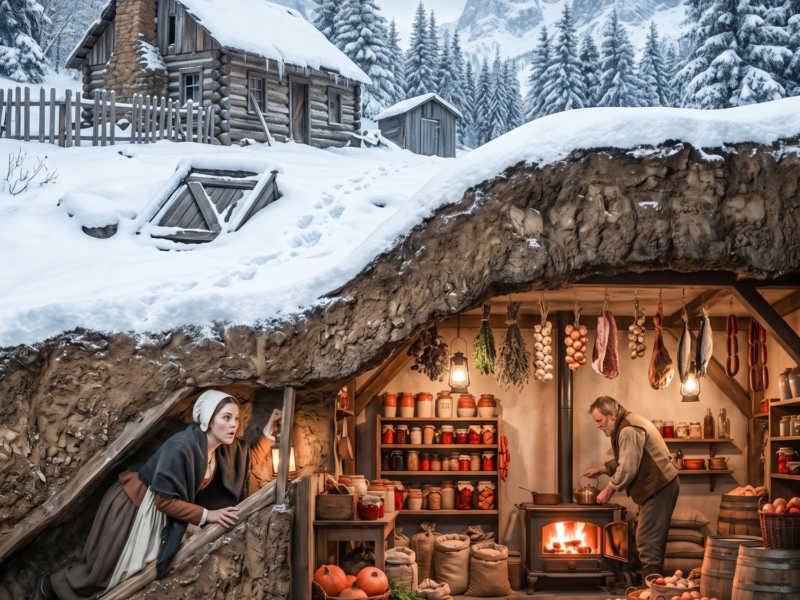
Marin sat in the warmth, sixty feet underground, and listened to the world above her violently rearranging itself. And she was not frightened. She was not even particularly anxious.
She was home.
The storm ran through the first night without a single pause. She slept in three-hour intervals, waking to the changed quality of the sound roaring above her. Sometimes fiercer, sometimes pulling back to something lower, like a massive machine cycling constant pressure without the same dramatic, screaming expression.
By the morning of the second day, the temperature in The Hearth had not varied by a single fraction of a degree.
It was sixty-eight degrees Fahrenheit. Exactly the same as the day she found it. Exactly the same as August had recorded in January of 1879. Exactly the same as it would be long after she was gone.
She ate beans with salt pork cooked flawlessly on the geothermal stove. She read Longfellow. She made meticulous notes in her own new journal about what the psychological experience of the first forty-eight hours of a major blizzard felt like from deep underground.
She didn’t write it for anyone else to read. Not yet. She wrote it because August had modeled for her the profound value of recording what you observe, and she had actively decided to be that kind of person.
Their lives were converging, the old, dead man’s and the young woman’s, through the medium of careful, respectful attention to the exact same rock in the exact same mountain. She had never met him. He had not known she existed. But he had left her something that was not just provisions or engineering plans. He had left her a method. A way of being in a place.
And she was inhabiting it now with the profound gratitude that cannot be spoken to the person who deserves it—which is, perhaps, the most complete and pure form gratitude ever takes.
Outside, the Colorado wind raged. Snow accumulated on the plateau in massive drifts that would cover the heavy mine entrance entirely. Then higher. Then higher still. Until, from above, there would be absolutely nothing visible of any of it. No door, no tarp, no cut wood, no evidence whatsoever of human occupation.
There would be only a smooth, blinding white expanse. And rising from it, in a thin, continuous, miraculous column, the warm breath of the mountain meeting the freezing air. It would form an impossibly steady plume of vapor.
That vapor plume would be the very first thing Edmund Graves saw when he climbed up here on his snowshoes after the storm broke, looking for her frozen corpse.
She did not know that yet. She sat in The Hearth and read poetry, while four feet of snow buried everything she had built, and she did not need anyone in the world to come looking for her.
The storm ended on the morning of the fifth day.
It did not end gradually, with the slow, fading diminishment of a weather system running out of energy. It ended the way certain violent arguments end—completely mid-sentence, leaving behind a silence so total, so absolute, it had its own crushing physical weight.
Marin woke to the silence before she consciously understood what she was waking to. She lay in her cot for a moment, registering the bizarre absence of the roaring sound she had been sleeping inside for four nights. It was the way a person registers the stopping of a grandfather clock they had forgotten was even ticking.
She dressed. She banked the small iron stove—not because it needed it, but because the action was part of the morning’s order. One of the small, necessary rituals she had developed over the past weeks that structured time in a place where day and night were otherwise completely identical.
She ate the last of the previous evening’s beans, cold from the pot. She put on her heavy wool coat, her scarf, her thick gloves—items she had not needed to wear inside The Hearth since October, now suddenly, vitally relevant again.
She climbed the dark tunnel toward the surface.
The heavy wooden door at the top of the shaft was held shut not by the iron latch, but by the massive weight of what had accumulated against it. She felt the immense resistance immediately when she pushed. It was not the resistance of something locked; it was the resistance of something deeply buried. A different quality of pressure, distributed evenly across the whole surface of the wood.
She applied her shoulder and drove her legs. The door gave in inches. Grudgingly at first, then slightly less grudgingly.
As the packed snow on the outside face began to shear away from the door seal, cold air found the gap first. It was a knife of it. The kind of lethal cold that Colorado makes in November at ten thousand feet after five days of sustained blizzard. It was not the cold of weather; it was the cold of an established, undeniable fact about the atmosphere.
She pushed through, fighting the snow wall.
The plateau had been utterly remade.
Every single reference point she had used for two months—the position of the cut wood stack, the line of cleared rock she had dumped to the east, the outline of the ruined cabin’s standing walls—was gone. It was all buried under a continuous, undulating white surface that reflected the morning sun with a ferocity that was nearly painful to her eyes after four nights of soft lamplight.
She stood at the bottom of a deep snow crater, its white walls rising chest-high around her. The sky above it was the blue of something that has been scoured absolutely, violently clean. There was no wind. The air was so incredibly still she could hear her own breath moving in her lungs.
She climbed out of the crater, kicking footholds into the dense snow wall with her boots, hauling herself up by the consolidated surface at the rim.
From the top, standing on snow that was firm enough in the freezing morning cold to easily hold her weight, she looked at a landscape that was utterly, completely silent.
The jagged peaks to the west caught the low sun at an angle that made them luminous rather than merely white. The distant San Juans, which she had been watching on clear days as August had taught her to watch them, were visible with a precise, razor-sharp clarity that comes only after a major atmospheric event has scrubbed the air of everything extraneous.
The world looked brand new. It also looked, in the particular way of high mountain terrain after serious snowfall, like a place that had entirely stopped tolerating the presence of anything fragile.
She retreated back into the tunnel, retrieved the steel shovel from inside the entrance, and began cutting a path outward from the crater’s edge, establishing a navigable, safe surface between her door and the open plateau.
The work was vastly different from tunnel work. It was brighter, colder, the brutal effort producing steam rising from her coat as the exertion generated heat that met the low air temperature. She had been underground for four nights. The sheer openness of the sky above her felt enormous in a way she had to adjust to gradually, like eyes adjusting to intensity of light after darkness.
She was forty minutes into the clearing work when she heard something.
The sound reached her before the source was visible. It was the compressed, rhythmic crunch of snowshoes on a packed surface, coming from the direction of the steep trail. It was deliberate. Unhurried. A single person.
Marin straightened up, gripping the shovel handle in both hands, her back to Ironback Mountain, facing south toward the trail’s emergence onto the plateau.
She waited.









