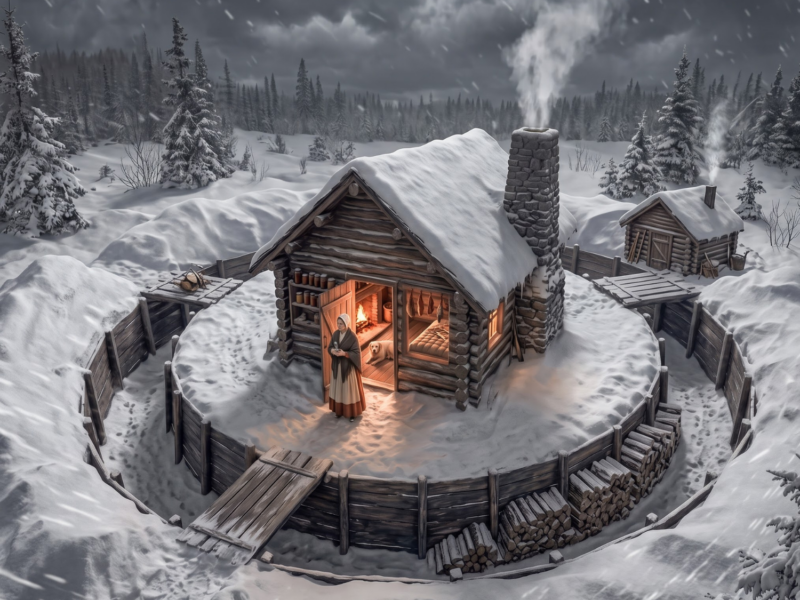
They Said Wind Can’t Be Stopped — She Dug a Trench Around Her Cabin… Then Winter Proved Them Wrong
The White Wall
On the morning of the sixth day, the blizzard relented.
It did not stop so much as withdraw, pulling its white curtain eastward across the valley like a retreating army that has decided the ground is no longer worth holding. The sky cracked open along the western ridge, and a band of hard, brilliant blue light appeared above the mountains, edged with the kind of clarity that only comes after the atmosphere has been violently scoured clean.
Felicity climbed the ladder for the last time as a fugitive and pushed the trap door open. The light that poured through the cabin windows was so white and so absolute that it burned her eyes after five days of dim lantern glow.
Through the frosted glass, she saw the valley completely transformed. The paddock fence had vanished beneath four feet of snow. The tree line was a row of white pillars. The road to town no longer existed. In its place was an unbroken field of white that stretched from her cabin to the base of the eastern ridge without a single mark upon it. The terrible, beautiful silence of a landscape that had erased every trace of human intention.
Then, she heard the shouting.
It came from the north. Faint at first, broken into syllables by the distance and the density of the freezing air. She went to the window and saw three figures laboring through the drifts, moving in a line. A fourth figure led a horse that was staggering with every step, its legs plunging knee-deep into the snow and wrenching free with a motion that spoke of muscles operating on their absolute final reserves.
She recognized Silas Renshaw before she recognized the others.
He was in front, his hat gone, his expensive coat blackened with frost, moving with the dogged, mechanical stride of a man who has passed through exhaustion into the numb territory of shock. Behind him were two of his ranch hands, their faces swollen and discolored by severe frostbite. And behind them, Hosea Hollister, his broad frame diminished by the cold, his hands wrapped in bloody strips of torn fabric.
They reached the porch, and Renshaw hit the door with the flat of his palm. Not knocking. Striking. The sound of a man who had lost the energy for courtesy and retained only the animal need for survival.
Felicity opened the door. The interior warmth met the exterior cold at the threshold, producing a visible cloud of condensation.
Renshaw crossed the threshold and stopped two steps into the room, his chest heaving, his pale eyes moving frantically across the cabin with the inventory of a man looking for ruin. He saw the fire in the hearth—modest, well-maintained. He saw the clean floor. He saw a woman who stood with her weight balanced, her hands still, and her eyes crystal clear.
He had expected devastation. He had expected a cabin as destroyed as his own sprawling ranch, a woman as broken as his own newly obliterated finances. What he found instead was perfect order, and the order enraged him because his mind could not explain it.
“How?” he rasped. The word was not a question. It was a demand.
Hosea entered behind Renshaw, followed by the ranch hands, and Uriah Basset, who had stumbled in last from a different direction. Uriah’s face was raw and entirely expressionless. He had the look of a man who has absorbed a blow so complete that his nerve endings had simply stopped transmitting.
Hosea moved to the center of the room. He was the one who noticed first. Not Renshaw, who was too angry to feel anything beneath his boots. Hosea noticed because he was a man who had spent his life reading the quality of materials through his hands.
He knelt. He pulled off his ragged bandages. He pressed his right, calloused palm flat against the floorboards, his fingers spread wide, and he held that position for several seconds.
The floor was warm. But that was not what stopped him.
There was movement below. Not vibration exactly. Something deeper. A rhythmic displacement of air that transmitted through the packed earth, into the wooden joists, and up into the pine boards as a pulse. Slow, regular, and unmistakably biological.
“The ground is breathing,” Hosea whispered.
He said it the way a man speaks when he has encountered evidence that contradicts everything he has assumed to be true, and the weight of the contradiction has compressed his voice.
Renshaw turned from the hearth. He looked at Hosea on the floor. He looked at Felicity standing by the table. The arithmetic was assembling itself behind his eyes, the variables clicking into place.
“Where are they, Felicity?” Renshaw demanded, using her first name in a tone of utter invasion. “You did not sell them. No one moved horses through that storm. If they died in the timber, the pack would have denned up around the carcasses within a mile of here. But the wolves are gone. Why would wolves leave a valley where three horses are supposed to be dead?”
He stepped toward the center of the room. “You cannot hide a horse,” Renshaw growled. “A horse is a thousand pounds of heat and smell and noise. It breathes twelve times a minute and exhales a plume of warm air that a wolf can track from two miles out. You cannot put a horse in a box and make it disappear!”
“I did not put them in a box,” Felicity said.
She walked to the center of the room. She knelt exactly where Hosea had knelt. Her hand found the iron ring that was set flush with the boards, invisible unless you knew where to look. She gripped it and pulled.
The counterweight system she had rigged—four heavy stone blocks suspended on rope inside the wall cavity—engaged with a deep, groaning tension. A six-foot section of the floor pivoted smoothly upward on its leather hinges and locked in the open position.
The air that rose from the opening was warm, dense, and gloriously alive. It carried the smell of hay, grain, animal sweat, and the particular, unmistakable sweetness of horses that had been well-fed, dry, and calm for weeks. The smell filled the cabin in seconds, displacing the thin, sharp air of the winter morning with something ancient, mammalian, and profoundly reassuring.
Uriah Basset made a choking sound in his throat. Hosea rose to his feet, stepped to the edge of the opening, and looked down. Renshaw took one step backward, as if the hole in the floor had revealed not a stable, but a massive fissure in the logic of his entire existence.
Below them, in the amber light of the lantern, three horses stood on clean sand in a vaulted chamber of smooth clay walls and a ceiling of interlocking stone arches. The buckskin was at the hay pile, chewing contently. The bay mare was standing with her head turned toward the opening, her expression alert but untroubled. The yearling looked up at Felicity and made a low, rumbling sound of recognition.
Hosea was the first to go down. He descended the ladder with slow, careful movements, and when his boots touched the sand floor, he stood still for a long time, turning in a slow circle. He touched the stone walls. He looked up at the perfect arches. He found the mouth of the ventilation flue and held his hand in front of it, feeling the steady, warm current of air moving outward. He followed the flue with his eyes to the point where it entered the back of the hearth above, and he understood in a single, staggering moment of clarity the entire engineering marvel.
The earth warmed the intake air. The animals warmed the vault. The fire drew the exhaust. The chimney scrubbed the scent. The cabin and the stable were not two structures. They were one living organism.
Hosea climbed back up and faced Renshaw. The words he spoke were not dramatic. They were technical, and they were the most devastating thing Silas Renshaw had ever heard.
“It is not a hole in the dirt, Renshaw,” Hosea said, awe bleeding into his voice. “It is a mine. She built a mine for the living.”
The silence that followed was not empty. It was structural. It held the immense weight of a shattered paradigm.
Uriah was the first to break it. He walked to the opening, looked down at the three healthy horses standing in the warm chamber, and then he turned and walked out of the cabin. He walked out into the snow, heading back toward the Basset homestead, where every single animal he owned had frozen to death inside a regulation timber barn. It was the silence of a man who realized that the authority he followed was not only wrong, but destructive.
Hosea stood by the open trap door, looking at Felicity. He had written ‘unlikely to survive the season’ in his ledger six weeks ago. Now, the woman he had written it about was standing in a warm cabin above three living horses, while the men who controlled the valley had arrived at her door with frostbitten hands and a dead-stock count that would bankrupt them. Hosea nodded at Felicity—a single, profound dip of the chin admitting he had been entirely wrong.
Renshaw was the last to react. He stood in the cabin, surrounded by the warmth that his own massive barns had failed to provide, and he said the thing that proved he had always understood more than he let on.
“The creek,” Renshaw said hollowly. “That is why you held this land.”
Felicity met his eyes, her gaze harder than the bedrock beneath her boots. “The creek is why you wanted to take it. The land is why I kept it.”
Renshaw received the words without argument. There was nothing left to argue. His livestock was dead. His barns were collapsed. His leverage over the valley had been obliterated by a woman with a shovel and a miner’s education. He walked out of the cabin without closing the door.
Felicity crossed the room and shut it behind him. She stood with her back against the wood, her hands flat against the grain, and she breathed. Just breathed.
The fire crackled. The horses shifted comfortably below. The world outside was white, silent, and entirely new.
Epilogue: The Treadwell Cell
In late February of 1879, the snow finally began its retreat. Hosea Hollister stood before the town council in the meeting hall and delivered his grim winter report.
The numbers were staggering. Seventy-eight percent of the valley’s barns had suffered structural failure. Sixty-three percent of sheltered livestock had perished. The economic loss was catastrophic.
Then, he turned to a separate page in his ledger and read a second entry.
Treadwell Homestead. Three horses sheltered by subterranean housing method. Duration of shelter: 94 days. Losses: Zero. Survival rate: 100%.
Renshaw, seated at the far end of the council table, objected furiously. He argued that the subterranean method did not meet the existing definition of a registered livestock structure. It was not in the codebook. It set a dangerous precedent.
Hosea listened. He let Renshaw finish. Then he said something he had been composing during the long, freezing weeks of the blizzard.
“Your codebook killed every animal in this valley except hers,” Hosea said, his voice ringing against the wooden walls. “If the codebook says her method is not valid, then the codebook needs a new page.”
The council voted four in favor of recognizing subterranean livestock housing as a legal alternative. One against. Renshaw cast the sole dissent. It was the first vote he had lost in fifteen years, and it would not be the last. The quiet structural authority he had built had been fractured by a blacksmith who had finally decided that procedure without results was suicide.
The story of the vault spread through the valley that spring. Neighbors arrived at Felicity’s cabin with measuring tapes and charcoal pencils. She taught them to read their soil, to calculate thermal stability, and the supreme importance of the friction lock. By the autumn of 1879, seven homesteads had begun excavating what the community forever called “Treadwell Cells.”
Silas Renshaw sold his devastated holdings in the spring of 1880 and moved south, leaving without ceremony. The creek on Felicity’s land continued to flow unfrozen, feeding the wells of every homestead in the settlement.
Felicity Treadwell never remarried. She never left the valley. She expanded her system, creating a network of underground rooms that maintained a constant temperature year-round without fuel. She raised horses, grew vegetables, and consulted on construction projects across the territory. She outlasted the lumber mill, the stagecoach line, and Silas Renshaw, who died in 1903 in a rented room in Pueblo.
When she finally died in the winter of 1918, the cabin was warm, the horses in the vault were fed, and the creek behind her property was running clear beneath a foot of ice.
Decades later, when the cabin was finally dismantled in the mid-twentieth century to make way for a county road, the demolition crew discovered the vault miraculously intact beneath the foundation. The arches had not moved a millimeter. The clay walls were solid. A bronze plaque now marks the spot where the cabin stood, facing west toward the ridge. It does not tell a story of a grieving widow. It records the thermal efficiency, the airflow system, and the date of construction. It presents the work as a statement of absolute method.
If you drive that road on a winter night when the snow is falling, you will pass over that spot without knowing it. You will not see the plaque in the darkness. You will not feel the stones beneath your tires. But they are there. They have always been there, holding the earth in place, long after the people who built them have faded into dust.









