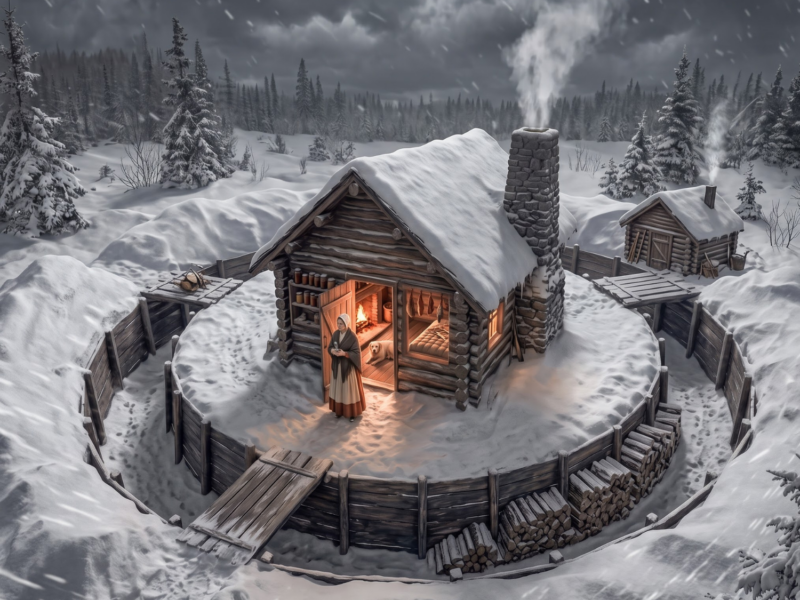
They Said Wind Can’t Be Stopped — She Dug a Trench Around Her Cabin… Then Winter Proved Them Wrong
The Warrant
The sky had changed. The crisp blue of early autumn was gone, replaced by a low, heavy ceiling of cloud that pressed down on the valley with a physical, suffocating weight. The barometric pressure was dropping so fast it made Felicity’s ears pop. The wind had stopped entirely, which was not a sign of calm, but a sign of accumulation—the atmosphere gathering itself before releasing something immense.
Everything from the beginning of this story—Renshaw’s ultimatum, Uriah’s suspicion, the deadline—had been a petty human drama played out on a stage that was about to be swallowed by something far older, and far less interested in property lines.
The real test was not Silas Renshaw. The real test was the winter itself. And it was here.
The blizzard hit like a physical blow. For five days, the world outside the cabin ceased to exist, replaced by a screaming white wall of driving snow and sub-zero temperatures.
Felicity did not sleep in the cabin for five nights. She slept in the vault on the sand floor, wedged tightly between the buckskin and the yearling, with a heavy wool blanket pulled over her shoulders and the sound of three massive heartbeats keeping time in the darkness around her. She went up each morning to tend the roaring fire and check the chimney draft, then descended again before nightfall, when the apex predators of the territory began their desperate circuits across the frozen surface above.
The wolves arrived on the second night of the blizzard.
Felicity heard them from the vault—a distant chorus of high, thin cries that penetrated the layers of earth and stone with a frequency that vibrated in the marrow of the bones rather than the ears.
The horses heard them, too. The buckskin lifted its head from the hay pile and stood rigid, its nostrils flared wide, its breath quickening. The bay mare rose from the sand floor where she had been resting and pressed herself frantically against the far wall, her eyes wide and white-rimmed.
But it was the yearling that terrified Felicity.
The young horse began to pace back and forth across the width of the vault, its hooves making quick, nervous compressions in the sand. Its high head tossed, its breath coming in short, sharp bursts that clouded the air around its muzzle. It could feel the wolves above. Not see them, not smell them, but feel them the way a tuning fork feels the vibration of a piano string in the next room. Some ancient, primal circuit in its blood was firing, telling it that monsters were near, that the correct response was to run, and there was nowhere to run.
Felicity watched the yearling’s agitation build. Each pass across the vault was faster than the last. She could faintly hear the sound of paws on the frozen surface above—a dry, staccato rhythm that moved from north to south, directly over the vault. The pack was crossing her paddock. They were walking on the exact ground beneath which a thousand pounds of living prey stood trembling.
And then, the yearling opened its mouth to scream.
Felicity moved before the sound could form. She crossed the vault in three desperate strides and wrapped both arms around the yearling’s powerful neck, hauling its head down against her chest with all her strength. The animal fought her, its neck muscles bunching and straining, its jaw working violently against the pressure of her forearms.
She held on. She pressed her cheek against the flat plane between its eyes, and she breathed. Slow and deliberate, forcing the calm, rhythmic motion of her own lungs into the space between them.
The yearling’s body shuddered. Its legs locked.
Above them, the wolves paused. Felicity could feel the sensation of movement through the ceiling stop—a sudden absence of vibration that was infinitely worse than the vibration itself, because it meant the pack had stopped to investigate.
She did not breathe. The yearling did not breathe. The bay mare and the buckskin stood frozen in the amber lantern light, their ears pinned flat against their skulls. The vault was absolutely silent.
Four heartbeats. Five. Six.
Then, the vibration resumed, moving south, fading, dissolving into the general white noise of the blizzard above. The wolves had found nothing.
The scent trap held. The raging fire in the hearth above was pulling the stable air through the flue and incinerating every molecule that might have betrayed the presence of three warm bodies in the earth below.
Felicity sank to the sand floor, her arms burning, the yearling’s head still cradled against her. Her hands were shaking violently. The animal lowered itself beside her, folding its long legs beneath its body, and rested its heavy muzzle gently on her thigh.
She sat there for a long time, feeling its breath. And she understood something terrifying. The ventilation system was perfect. The scent trap was functional. The arches were solid. But the system had a fatal biological vulnerability that no amount of engineering could address. The yearling was young and frightened, and fright makes noise, and noise travels through stone and earth in ways that scent does not. The flue could scrub the smell of a horse. It could not scrub the sound of a horse screaming.
From that night forward, Felicity did not leave their side until the storm broke.









