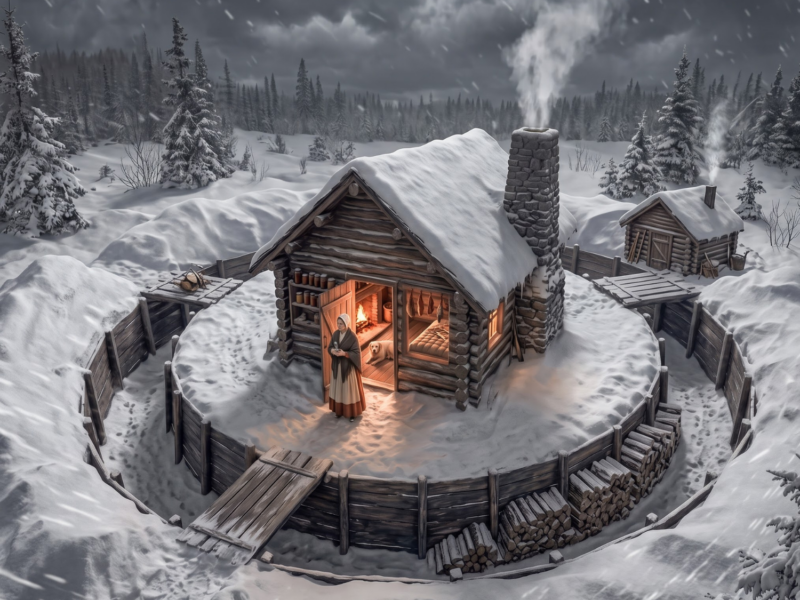
They Said Wind Can’t Be Stopped — She Dug a Trench Around Her Cabin… Then Winter Proved Them Wrong
The Mathematics of Dispossession
She did not go inside immediately. She sat on the top step of the porch and looked at the paddock.
The buckskin was nosing at the fence rail. The bay mare had returned to her hay. The yearling was standing in a patch of sun, its winter coat catching the light in a way that made it look almost golden.
Three horses. Ward’s horses.
Ward Treadwell had been dead for three years, and Felicity still measured time by the things he had left behind. The cabin. The fence posts he had sunk crooked because he never possessed the patience to check the level twice. The three horses he had bought in the spring of 1875 because he believed that spring would last forever.
That was the kind of man Ward was—optimistic in a way that bordered on reckless. He saw the world as a series of grand opportunities that would sort themselves out if you just kept moving forward blindly. He had built the cabin on a slight rise of compacted clay and limestone, thinking only of drainage. Good drainage meant dry floors, and dry floors meant comfort, and comfort meant Felicity would finally stop asking when he planned to reinforce the north wall against the wind.
He never reinforced the north wall. He bought a yearling instead, because the romantic idea of a new horse in the spring excited him far more than the grim reality of a windbreak in the winter.
He died on a frozen road in December, riding too fast toward town to buy her a Christmas gift. The horse slipped. Ward fell. His neck broke on impact. It was not heroic. It was not dramatic. It was the brutal, mathematical consequence of a man who never calculated the risk of ice on a downhill grade. Felicity had loved him fiercely for his warmth, and hated him for his carelessness. Three years later, she had not fully reconciled those two feelings.
“You left me three horses and not a single board to shelter them, Ward,” she whispered aloud to the empty yard.
Her voice was not angry. It was just tired. The deep, bone-aching tiredness of a woman who had been solving another person’s unfinished equations for a thousand days.
She stood, brushed the dust from her skirt, and walked to the edge of the cabin where the ground sloped slightly downward toward the creek. She crouched and pressed her bare palm flat against the earth. It was cool, dense, the color of old rust. She picked up a handful and squeezed it, watching how it held its shape, how the rich moisture content made it pack tight without crumbling.
And that was when her father’s voice came back to her.
Not as a ghost. Not as a sentimental, weeping memory. It came back as engineering.
Ogden Stillwell had been a Cornish copper miner who crossed the Atlantic in 1855 with a wife, a daughter, and a set of subterranean skills that most Americans did not even know existed. He was a man of the earth in the most literal, absolute sense. He understood that the strongest structures were not those built boastfully against the sky, but those integrated humbly into the foundation of the world. He had spent thirty years underground, reading the language of stone and clay and pressure the way other men read the morning newspaper.
When Felicity was twelve years old, he had taken her into the mine where he worked. Not to show her the glittering copper, but to show her the silence.
They had stood together in a chamber sixty feet below the surface, surrounded by walls of compacted clay and limestone. Ogden had put his rough hand on the stone and said something she never forgot. “Listen, Fliss. The silence down here is different from the silence above. Up there, silence is empty. Down here, silence means everything is holding together.”
He taught her to read the veins in the clay, to know which layers bore weight and which held treacherous water. He explained that a mountain does not fall because it understands the distribution of force, and that the most efficient way to stay warm in a hostile world was to let the planet itself provide the insulation. This was not luck or folklore. It was the thermal mass of the soil. The earth, at a depth of eight feet, maintains a constant temperature of roughly fifty-five degrees, regardless of what the freezing atmosphere above is doing. A man who understands that principle can survive a blizzard in his shirtsleeves. A man who ignores it will freeze to death inside a wooden box.
Ogden had died when Felicity was nineteen. A mine collapse. But the detail that shaped the rest of her life was this: The tunnel Ogden had designed never collapsed. Not one stone shifted. Not one beam cracked. He died in a section built by another crew—men who had cut corners to save time and money, men who braced their ceilings with green timber instead of cured stone because it was cheaper, faster, and nobody was going to check.
Ogden had trusted them. He walked into their section on a Tuesday morning in March, and by Tuesday afternoon, he was buried under eight tons of rock that should never have been above his head.
The lesson was simple, and it was absolute: Proper engineering does not betray the person who trusts it. Only carelessness kills.
Felicity carried that lesson the way other women carried lockets. Now, crouching beside her cabin, holding a fistful of clay that her father would have recognized instantly, she began to think in volumes instead of surfaces.
Ward had looked at this land and seen a place to stand. Felicity looked at it and saw a place to hide.
The cabin’s footprint was twenty-four feet by eighteen feet, resting on a perimeter of dry-stack stone. Below that lay a layer of dense, frost-resistant clay that descended eight feet before hitting bedrock. The clay was the perfect consistency. The limestone deposits in the area were abundant and accessible. The bedrock was solid, which meant anything built on top of it would not shift or settle.
She spent that first evening sitting by the hearth, doing calculations by candlelight. To house three horses comfortably, she needed a space twelve feet wide and twenty feet long, with a ceiling height of at least seven feet.
That meant relocating nearly 1,700 cubic feet of soil.
It was an enormous amount of earth to move by hand. It was also the exact kind of work that a Cornish miner’s daughter had been trained in her bones to do.
The decision she made the next morning was the first turning point, determining everything that followed. She did not walk to the yard and begin digging a massive hole where every neighbor, every passerby, and every one of Renshaw’s informants could see.
Instead, she locked her door, moved the heavy oak table and chair, took up a crowbar, and pried up the heavy pine floorboards in the exact center of her living room.
The first bucket of dirt dropped into the darkness below, and the open loop was created. She was not building a barn. She was building a secret.









