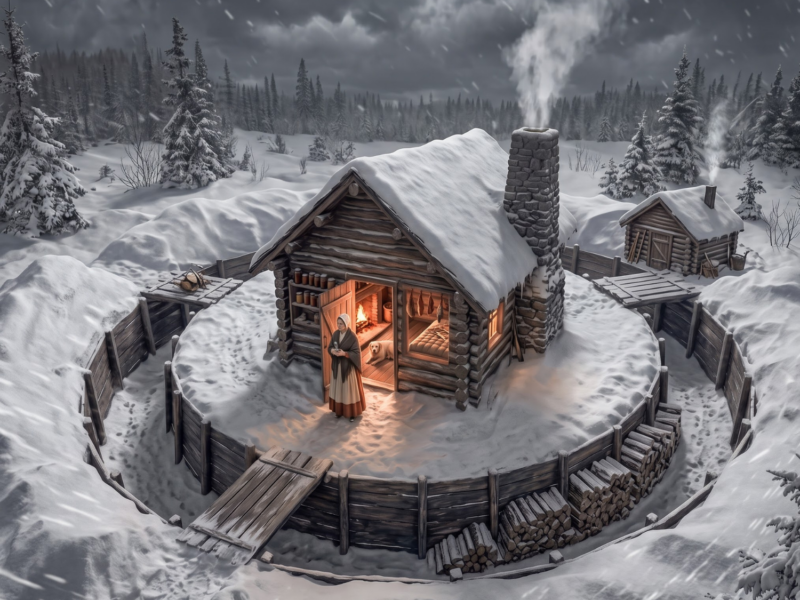
They Said Wind Can’t Be Stopped — She Dug a Trench Around Her Cabin… Then Winter Proved Them Wrong
The Architecture of Secrecy
Five days later, Uriah Basset appeared at the cabin without warning.
He was thirty-eight, a farmer with cruel ambitions that far exceeded his intelligence, and he had attached himself to Silas Renshaw the way a barnacle attaches to a rotting hull. He wanted cheap land leases, and the easiest way to get them was to be highly useful to the man who controlled them. That meant keeping watch. That meant reporting.
Uriah walked the perimeter of the cabin slowly, his eyes scanning the empty paddock, the tree line, the hard ground. The horses were not visible because Felicity had started keeping them tied in a thicket of dense brush a quarter-mile east during the day, risking moving them back to the hidden entrance of the tunnel only under the cover of night.
Uriah asked where they were. Felicity, holding a basket of laundry, told him they were grazing in the eastern valley.
Uriah looked at her the way a hungry dog looks at a closed meat-house gate. Then, he stepped onto the porch, leaned over, and peered brazenly through the cabin window.
The floorboards had been carefully replaced. The furniture was returned to its normal position. But in one corner, near the base of the wall, there was a smear of fresh clay. Dark, reddish-brown against the weathered gray of the pine boards. It was small. It was also unmistakable.
“Why is there mud on your floor, Mrs. Treadwell?” Uriah asked, his eyes narrowing.
“I spilled the wash water,” Felicity said without missing a beat. “It tracked from my boots.”
Uriah held her gaze for a long, uncomfortable moment. He was not smart enough to deduce that she was digging a cavern beneath her house, but he was suspicious enough to know that the math of her life did not currently add up.
Before he left, he delivered Renshaw’s message with the practiced, arrogant flatness of a man repeating words he had memorized to feel important. “Mr. Renshaw will inspect on the twenty-second. No barn, he brings his men to take the horses. If you have hidden them in the hills, that is a federal violation of the ordinance.”
After Uriah’s horse disappeared around the bend, Felicity went inside and stared at the clay smear on the floor. Such a small thing. A thumbprint of evidence that could unravel her life. She got a bucket of boiling water and lye, and scrubbed the spot until the wood was stripped clean and her knuckles bled.
From that night forward, she added a grueling new step to her routine. Every evening before she allowed herself to sleep, she got on her hands and knees with a lantern and inspected every inch of the cabin floor. Every board, every joint, every crack where a microscopic particle of clay might have lodged itself. The race was no longer just against the encroaching winter deadline. It was against the suspicion that was spreading through the valley like frost webbing across a windowpane.
On the night of the fourteenth day, Willard came as he had promised.
He arrived at two in the morning when the moon was hidden behind a thick bank of clouds, carrying nothing but the knowledge in his hands and half a bottle of liquid courage in his coat. They worked by the dimmest lantern light in the cavernous vault below the cabin floor, fitting the inverted limestone arches that would become the ceiling of the stable and the structural foundation of Felicity’s home.
Each stone was cut and placed with the friction lock. The principle was breathtakingly simple, and ancient. The flat face of each stone was turned inward, the rough face outward, and the stones were arranged in a radiating arch pattern where the geometry itself provided the strength. The more weight that was placed on top of the arch, the tighter the stones pressed against each other. Snow, heavy oak furniture, the boots of men walking angrily across the floor—all of it would only compress the structure, making it stronger. Not a single iron nail was used in the load-bearing assembly. The system was held together by gravity, and the fundamental truth that earth, when properly arranged, wants to stay exactly where it is put.
They worked in near silence. Willard’s hands remembered what his alcohol-soaked brain had forgotten. He moved heavy stones with a grace and precision that entirely contradicted the tremor in his fingers, placing each one by feel, testing the fit with his palm before nodding and reaching for the next.
Somewhere around three in the morning, while they were bracing the massive central keystone with their shoulders, Willard spoke again.
“Renshaw does not just want your land, Felicity,” he grunted, straining against the rock. He said it quietly, the way you say something toxic you have been holding in your mouth. “He wants the creek. Your creek.”
Felicity pushed against the stone, listening.
“It is the only water source in this end of the valley that does not freeze solid in the dead of winter,” Willard continued. “The ordinance. The deadline. The horses. All of it is a legal wrapper around one thing. He wants the water.”
Felicity stopped moving. She held the stone in her bruised hands and felt its weight shift as the massive implications of Willard’s words settled into place. The spring-fed creek that ran behind her cabin, pooling in a depression near the tree line before continuing south—she had always thought of it merely as a convenience. A place to wash clothes and water the garden. She had not thought of it as a tactical resource a man like Renshaw would engineer a legal mechanism to steal.
“He has done this before,” Willard said, wedging a shim into the gap. “Three families in this valley lost their land the exact same way. An impossible regulation. A deadline no one can meet. Then Renshaw swoops in and buys the foreclosed claim for pennies from the council. Your father would have seen it immediately. Ogden always knew when the ground was being cut from under him.”
The information changed everything.
Felicity was no longer just saving three horses. She was holding a vital water source that the entire valley secretly depended on, keeping it out of the hands of a tyrant who would weaponize it as leverage against every homestead within ten miles.
Willard finished the last stone just before dawn. He stood in the vault, his hands black with clay and limestone dust, his chest heaving, and looked at the arches above him. They were clean. They were tight. They were geometrically perfect. He nodded once—the exact way Ogden would have nodded—and then he climbed the ladder back into the cabin.
At the door, he paused, pulling his collar up against the biting wind. “I do not know if you will succeed, Felicity. But I know Ogden would want you to try.”
Then he stepped into the fog and was swallowed by the gray.
Felicity stood alone in her cabin as the first morning light pierced the window. She looked down through the open floorboards at the vault below. The arches were complete. The earthen walls were smooth and hard. The space was finally looking like what it was meant to be: A chamber strong enough to hold three draft animals, warm enough to sustain them through a blizzard, and invisible enough to fool every man, every wolf, and every law that said she could not do what she was doing.
The feeling that moved through her veins was not hope. Hope was what Ward had lived on, and it had killed him on an icy road. What she felt was something harder, colder, and infinitely more useful.
It was absolute purpose.









