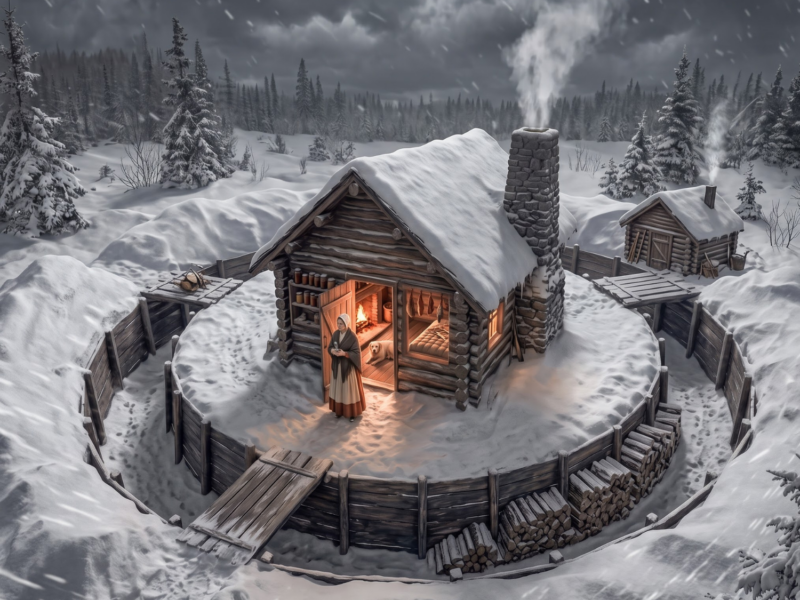
They Said Wind Can’t Be Stopped — She Dug a Trench Around Her Cabin… Then Winter Proved Them Wrong
The Anatomy of a Secret
One week before the deadline, on the fifteenth day, Vashtai Basset rode up to the cabin with a heavy loaf of bread wrapped in cloth and a look on her face that Felicity recognized from the old days.
Vashtai was forty, the nearest neighbor, and she had once been Felicity’s closest friend. They had been two widows together for nearly a year after Vashtai’s first husband died of pneumonia, sharing meager meals, firewood, and the quiet companionship of women who understood what it meant to sleep alone in a cabin surrounded by miles of howling nothing. Then Vashtai had remarried. Uriah Basset had offered her a roof that did not leak, a team of strong oxen, and the protection of a man’s name on a deed. Vashtai had accepted because the alternative was another brutal winter alone, and the last one had nearly killed her.
Felicity did not blame her for the choice. But the friendship had permanently changed. Vashtai now lived safely inside the boundaries of her husband’s world, and her husband’s world was shaped by Silas Renshaw.
Vashtai sat at Felicity’s table and looked around the cabin. Everything appeared normal. But Vashtai was a woman who noticed things that men did not. She noticed that Felicity was gaunt. She noticed the new, brutal calluses on her palms. She noticed the faint, earthy smell of deep clay on Felicity’s clothes—a smell that absolutely did not belong in a cabin with wooden floors.
Vashtai did not ask directly. She set the bread on the table and said, “Uriah tells me you have been moving a great deal of dirt to the creek. More than a root cellar would account for.”
Felicity sipped her chicory coffee and lied flawlessly. She said she was repairing the cabin foundation, which had settled dangerously after the spring rains.
Vashtai looked at her for a long, piercing time. Then she stood, gathered her heavy shawl, and walked to the door. She stopped with her hand on the frame and spoke without turning around.
“I do not want to know what you are doing, Felicity. Because if I know, Uriah will ask. And I do not know how to lie to my husband.”
It was a warning and a boundary drawn in the exact same breath. Vashtai was protecting Felicity by deliberately refusing to learn the truth. But the chain was visible now: If Renshaw pressured Uriah, Uriah would pressure Vashtai, and Vashtai would break. Not because she was weak, but because she had already made her bargain with survival, and that bargain did not include the deadly risk of lying to the man who kept her alive.
Felicity watched Vashtai mount the chestnut mare and ride north, her back straight, her head turned slightly toward the wind. There had been a time when the two of them would have sat at this table until dark, talking about the small, particular concerns of women who live alone at the edge of the world. That time was gone. Ground into dust by the quiet machinery of survival.
On the night of October 20th, Felicity moved the horses.
She did not try to lead them with ropes. She baited them with oats, pouring a thin, fragrant line of grain from the thicket where they had been hidden, down into the gaping mouth of the earthen tunnel.
The big buckskin went first, its heavy head low, nostrils working furiously as it followed the trail of grain into the absolute darkness. The bay mare followed immediately, pressing her nose against the buckskin’s flank for reassurance.
The yearling stopped.
It stood at the mouth of the tunnel with its ears rotating frantically and its front hooves planted rigidly in the dirt, refusing to go forward. Felicity did not pull the halter. She did not push from behind. She had learned from the buckskin that horses respond to patience the way people respond to arguments—slowly, and on their own terms.
She walked halfway down the ramp and sat in the darkness, making herself small and still, and she waited.
Fifteen minutes passed. The yearling’s breathing was audible from where she sat, rapid and shallow. The terrifying sound of a young animal trying to decide whether the unknown darkness ahead was more frightening than the known cold behind.
Felicity began to hum.
It was a haunting melody her father used to sing in the copper mines. Not a lullaby, but a working song. A song miners sang to test the echo in a new chamber, judging by the sound whether the rock walls were solid or hollow. The melody bounced off the packed earth walls of the tunnel, soft and round and resonant.
The yearling tilted its head. One ear swiveled toward her in the dark. Then the other. Then it took a tentative step. Then another. Then it was beside her, its warm, sweet breath puffing on her neck, and she placed her hand gently on its velvet nose and walked it the rest of the way down.
The vault received them the way the earth receives a seed.
The temperature stabilized within the hour, a balmy fifty-five degrees—thirty degrees warmer than the freezing surface. The horses did not whinny in panic. They seemed to sense the massive weight of the earth around them, the unyielding solidity of the stone above their heads, and they settled into the space with a calmness that shocked her. The buckskin began pulling happily from the hay pile in the corner. The bay mare folded her long legs beneath her and lay down comfortably on the sand floor. The yearling stood close to Felicity, its flank pressed tightly against her side, and she felt its erratic heartbeat slow from a rapid flutter to a steady, measured pulse.
She climbed the ladder and engaged the heavy iron pulley system she had rigged to lift the final floorboards back into place. The boards settled with a quiet, final thud, flush with the rest of the floor. She replaced the table and the chair. She swept the area clean of any microscopic trace of sand or clay.
From the outside, the cabin looked exactly as it had for three years. No barn. No fence. No sign of the three massive animals that were the center of her world.
The deadline was forty-eight hours away.









