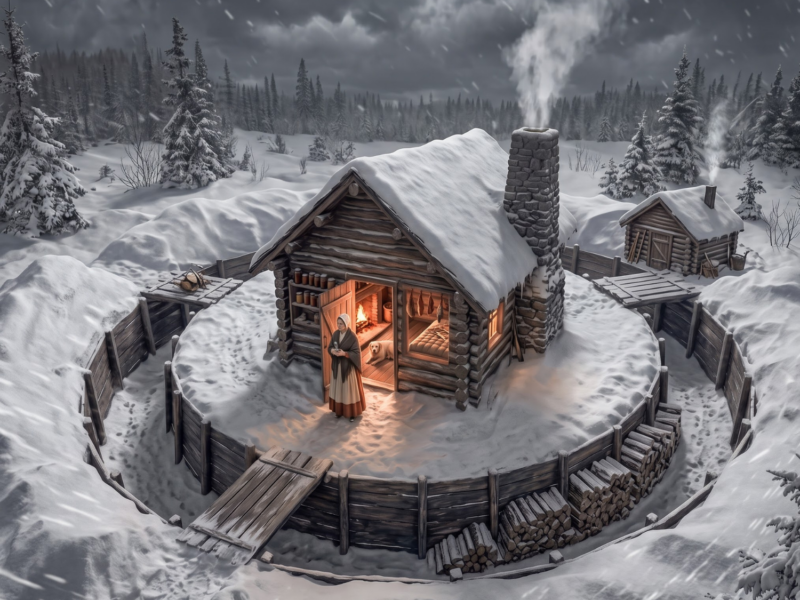
They Said Wind Can’t Be Stopped — She Dug a Trench Around Her Cabin… Then Winter Proved Them Wrong
The Inspection
One week later, on November 2nd, Renshaw came for the second time.
He brought Uriah and a territorial clerk armed with an official inspection warrant. They arrived at mid-morning, and Renshaw did not wait for Felicity to open the door. He pushed it open himself and walked inside as if the cabin were already his rightful property.
This inspection was nothing like the first. Hosea had been respectful and brief. Renshaw was methodical and invasive. He opened every cabinet. He looked under the bed. He pulled the curtains from the window and checked the wall behind them. He knocked on the logs with his hard knuckles, listening for hollow spaces. Uriah went around the back of the cabin, pushing violently through the brush, searching for tracks or hidden structures.
Renshaw moved through the room slowly, his boots heavy on the floorboards, and he stopped dead in the exact center of the cabin.
He was standing directly above the trap door. His massive weight was pressing down on the specific boards that concealed the iron ring, the leather hinges, and the three horses standing in the darkness below.
And then, the yearling moved.
It was a small motion. A shift of weight in the sand. One hoof pressing down and then lifting. The sound it made was barely audible—a soft compression of sand against stone, muffled by eight feet of earth and four inches of pine.
Felicity heard it. Her heart stopped for a full beat, then resumed at twice its normal rate.
Renshaw tilted his head. He looked down at his boots. “The floor is unusually warm,” he said softly.
“I keep the fire burning all day,” Felicity said, her voice a mask of ice. “Winter is coming.”
He looked at her. She looked at him. Below them, the bay mare stood absolutely still, ears upright, listening to the strange, heavy footsteps directly above her head. The yearling was motionless now, as if it, too, understood that silence was survival.
The moment stretched to the breaking point. Renshaw’s eyes moved from Felicity to the floor, and back to Felicity. He was a man who trusted his predatory instincts, and his instincts were screaming that something in this cabin did not add up. The localized warmth of the floor. The quality of the air, which carried a faint, biological richness he could not name. The fact that a widow with no barn, no horses, and no visible means of support looked calm and unbroken when she should have been on her knees in desperation.
But the territorial clerk, a thin man named Pettigrew who had ridden two freezing hours from the county seat and wanted nothing more than to ride two hours back, had already written Compliant on his form. Uriah had found nothing behind the cabin. And the warrant did not authorize them to tear up the nailed floorboards of a private residence based on a hunch. Renshaw had suspicion. He did not have evidence. And suspicion without evidence is just weather—something you feel but cannot hold.
“The property is in compliance, Mr. Renshaw,” Pettigrew sighed with the particular exhaustion of a bureaucrat. “There are no livestock present, and no livestock housing to evaluate. I see no basis for further action.”
Renshaw watched Pettigrew leave the cabin. He did not follow immediately. He stood in the center of Felicity’s cabin for a long moment, his eyes fixed on the hearth where the modified baffles cast shadows he could not interpret. The fact that this outcome was slipping beyond his control produced a visible tension in his jaw. He was grinding his teeth. It was the only sign of frustration he allowed himself, and it was the most human she had ever seen him look.
He walked to the door. He stopped, turned back, and looked at Felicity one final time.
“It will be a long winter, Mrs. Treadwell. I hope you have enough firewood.”
The door closed. The hoofbeats faded. Felicity stood in the center of her cabin and listened until the silence was complete, until there was nothing but the pop of the fire and the muffled, living warmth beneath her feet.
Then, she cried.
She cried for exactly one minute. She counted the seconds in her head because counting was how she maintained control, and control was the only thing standing between her and the vast, freezing uncertainty of the winter ahead. At sixty seconds, she stopped. She wiped her face with the back of her hand. She walked to the hearth and checked the draft of the flue. She climbed down the ladder and inspected the grain supply. She pressed her palm against the clay wall and felt it cool and solid under her touch.
Then she climbed back up, replaced the floorboards, and prepared the cabin for what was coming.









