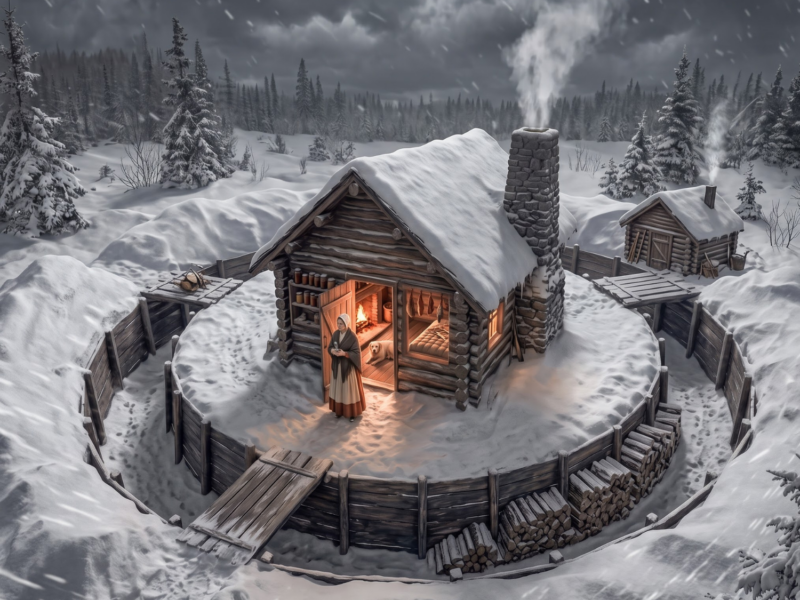
They Said Wind Can’t Be Stopped — She Dug a Trench Around Her Cabin… Then Winter Proved Them Wrong
The Descent
On the morning of October 22nd, Hosea Hollister rode up to the cabin with two other men. One was a nervous clerk from the county seat. The other was Uriah Basset, sitting high in his saddle with the particular, vibrating alertness of a man who expects to find something worth reporting.
Hosea dismounted first. He was a deliberate man, a blacksmith by trade, a Civil War veteran by history, and a man who fundamentally believed that rules were the only thing standing between a frontier community and utter chaos. He did not enjoy enforcing the livestock ordinance. He did not enjoy being pulled into Renshaw’s gravitational orbit. But he believed in procedure, and procedure required this inspection.
He looked around the empty paddock. He scanned the distant tree line. He studied the hard ground near the cabin for tracks, for droppings, for any sign that horses had been present recently.
The ground was pristine. Felicity had raked it two days earlier and let the high wind redistribute the dust perfectly.
“Where are the horses, Mrs. Treadwell?” Hosea asked, his voice stern but lacking malice.
Felicity stood on the porch with a cup of chicory in her hand, her posture relaxed, her voice flat. “They are no longer a concern for the council, Mr. Hollister.”
Hosea frowned deeply. “Hiding them in the woods will not work. The wolves will find them by nightfall, and the law will find you by morning. Renshaw intends to claim this land if you cannot demonstrate the means to secure your livestock. You cannot fight the winter with a shovel.” He added, almost gently, “Where are they?”
“They are where the wolves cannot reach them,” Felicity replied smoothly. “That was the requirement, was it not?”
Hosea did not believe her. He assumed she had sold the horses to a passing trader, or driven them into the high canyons in a fit of desperate, widow’s grief. He opened his leather ledger and wrote in a careful, precise hand: Property void of livestock. In compliance with the letter of the ordinance.
He added a private note at the bottom margin: Owner likely destitute. Unlikely to survive the season.
He walked back to his horse. Beneath his heavy boots, the floorboards of the porch transmitted a faint, microscopic vibration that he did not register. Below him, separated by four inches of pine and eight feet of engineered earth, the yearling was shifting its weight in the sand. Hosea climbed into his saddle and gathered his reins, failing entirely to notice that the smoke rising from Felicity’s chimney carried a faintly different hue—a subtle warmth in the color that came from biological molecules he had no framework to identify.
But Uriah Basset did not leave with Hosea.
He stayed behind, standing in the yard, his eyes moving across the cabin with the slow, predatory sweep of a man who does not know what he is looking for, but is certain it is there. He looked at Felicity, and his voice carried no pretense of neighborly formality.
“I do not know what game you are playing, Felicity. But I will find out.”
He mounted his horse and rode after the clerk, and Felicity watched him go with a statue’s stillness that hid the frantic speed of her pulse. If Uriah came back in the night with a shovel, he would find the brush tunnel entrance within hours. He was not clever, but he was persistent, and persistence with a shovel is all you need to uncover a secret buried in clay.
She needed the winter to arrive before Uriah kept his promise. She needed the snow to seal the ground, to bury the entrance, and make digging impossible. She needed time, and time was the one currency she could not earn.
Three days later, on the night of October 25th, Willard appeared at the cabin for the second time.
He was drunk and deeply frightened, a combination that made him look smaller than his sixty years, and he stood in her doorway with his hat clutched in his hands like a man delivering a murder confession.
Renshaw was talking in the saloon. Willard had been there nursing a whiskey he could not afford, and he had heard Renshaw tell two cattlemen that he knew the Treadwell widow was up to something, and intended to return with an official search warrant. Renshaw had not specified what he suspected, but the word ‘something’ was enough. It meant he was watching. It meant he was patient. It meant the 21-day deadline had been a starting gun, not a finish line.
Felicity listened to Willard, her blood running cold, and then she asked the question she had been dreading. “Did you say anything when you were drinking, Willard? Anything at all?”
Willard looked at the floorboards. He was silent for too long. Then he rasped, “I may have mentioned Cornish stone setting. Not to Renshaw. To a man at the bar. I do not remember if Renshaw was within earshot. I do not remember much of that night.”
The silence between them was heavy with everything that did not need to be spoken. Felicity did not shout. She did not accuse.
She said, “If Renshaw asks you, tell him the truth. You did not see any horses. You did not see a stable. You did not see anything but a woman moving dirt.” It was technically true. Willard had never entered the vault when the horses were inside. He had seen stone and earth in the geometry of arches. And none of those things were horses.
Willard nodded miserably, put his hat back on, and left.
Felicity closed the door and stood in the middle of her cabin. The fire crackled in the hearth. Below the floor, she could hear the faint, rhythmic breathing of the bay mare. She was alone in a way that she had not been alone before. Her secret depended on the memory of a man who could not remember his own evenings.









