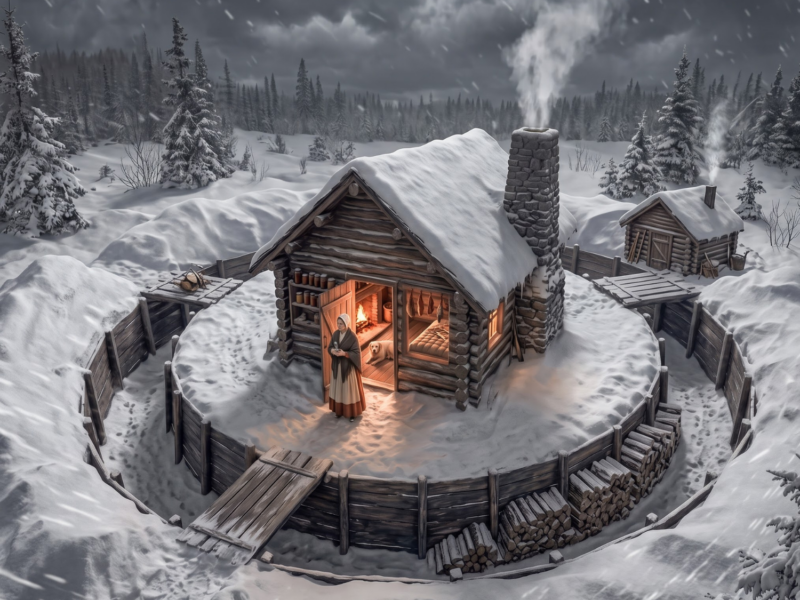
They Said Wind Can’t Be Stopped — She Dug a Trench Around Her Cabin… Then Winter Proved Them Wrong
The Scent Trap
But a hole in the ground with three horses inside it was still a death trap if the scent found its way to the surface.
The scent of a horse is a living, aggressive thing. It rises from the animal in waves—a thick mixture of sweat, manure, the warm oil deep in the hide, and the sweet, heavy fermentation of half-digested grain. On a cold night, that scent lifts straight up into the still air and spreads outward like smoke from a forest fire, reaching distances that the human nose cannot fathom. But a wolf’s nose reads it with the precision of a magnetic compass. A wolf can detect the scent of prey from nearly two miles away in the right conditions. A horse standing in a hidden vault beneath a cabin on a freezing October night might as well be lighting a signal flare.
This was the fatal problem Felicity faced on the sixteenth day. She had built the bones of the structure. Now, she had to build its lungs.
Her father had called the principle the Subterranean Scent Trap. He had explained it to her when she was twelve, using a model made of damp sand and a candle in the kitchen of their house in Cornwall. He had placed the candle inside a small tunnel made of packed sand, lit it, and shown her how the smoke rose straight up and out the top hole. Then, he had sealed the top and run a second tunnel at an angle, connecting it to the roaring fireplace across the room. When the fireplace was burning, the massive draft pulled the candle smoke horizontally through the second tunnel, and the smoke disappeared into the larger fire. The candle was still burning, but from outside the sand model, you could not see it, smell it, or know it was there.
The principle she now applied was exactly the same, scaled up to accommodate three living, breathing animals.
She engineered a primary air intake using a buried stone culvert that ran fifty feet from the cabin in a gradual downward slope, its mouth completely hidden beneath a pile of deadfall timber near the tree line. The culvert pulled fresh air through the earth, where the constant subterranean temperature warmed it before it reached the stable. The horses would breathe temperate air instead of the raw, freezing atmosphere above ground.
The exhaust system was the piece that would determine whether they lived or were torn apart.
Instead of a vertical chimney that would vent their scent straight into the sky, she constructed a horizontal flue that ran through the subsoil at a slight upward angle, connecting directly to the back of her cabin’s existing hearth. The flue was lined with flat stones and sealed with a thick mixture of clay and ash that she had hardened with repeated applications of boiling water.
When her evening fire was burning, the powerful natural draft of the chimney would pull air through the hidden flue, drawing the warm, scent-laden air from the stable into the fireplace. There, the potent smell of horse sweat and manure would be instantly incinerated by the flames, or buried completely beneath the heavy, pungent smoke of burning oak and pine. The horses would be invisible to predators because they would essentially be exhaling through the cabin’s own respiratory system.
Air moves from high pressure to low pressure, and scent follows heat. As long as Felicity kept a fire burning in the hearth, the draft would pull the stable’s atmosphere through the scrubbing flame, and the three animals below her floor would vanish from the olfactory map of the territory.
She spent two grueling days building the flue, and another day testing it by burning pungent sage bundles in the vault and checking the chimney output from outside. The smoke that rose from her chimney smelled of sage and oak. Nothing more. She tested it again with actual horse manure, shoveling fresh droppings into the stable and sealing the floorboards tight. She walked outside, circled the cabin, and stood downwind for twenty minutes.
Nothing. The system was functionally perfect.
On the eighteenth day, she began cutting the spiral ramp that would allow the horses to enter the vault from outside the cabin. She carved it from a hidden thicket of brush thirty yards behind the property, tunneling inward at a gradual downward angle until it met the basement level. The floor of the tunnel was lined with six inches of packed sand and pine needles to deaden the sharp sound of iron-shod hooves. The ramp had to be steep enough to remain concealed from anyone approaching the cabin, but gentle enough that a skittish horse could navigate it without panic.
She was cutting the final section—the junction point where the ramp met the main chamber—when the earth gave way beneath her.
It was not a total collapse. It was a slump. A section of clay wall roughly four feet wide sheared off its base and slid inward with a terrifying, wet shhhuck, burying her to the waist in a cold, heavy embrace of soil.
The lantern tipped, shattered, and went out.
The darkness was immediate and total. It was a physical weight against her eyeballs. Felicity did not scream. Screaming would have accomplished absolutely nothing and wasted precious oxygen. She reached down into the blackness and began digging herself out with her bare hands, clawing like a trapped animal at the clay that pinned her legs, working by feel in a blackness so complete she could not tell whether her eyes were open or closed. The clay was dense and wet. It packed violently under her fingernails and ground like glass against the blisters on her palms. Every handful she removed seemed to be replaced by another heavy handful settling from above.
Two hours.
That was how long it took. Two hours of blind, methodical, agonizing digging, moving the earth away from her body one fistful at a time until she could finally pull her numb legs free and crawl, weeping silently, to the base of the ladder. She climbed into the cabin, relit a spare lantern with shaking hands, and lay on the floor for a long time, staring at the ceiling and listening to the ragged rasp of her own breathing.
Her hands were bleeding freely. Three fingernails were torn off. Her back was a single, searing column of pain from the base of her skull to her tailbone. But the raw terror was not about the pain. The fear was about the recognition.
She had been buried in the earth the exact same way her father had been buried in the earth. And if the slump had been six inches deeper, or two feet wider, she would have died in the same suffocating darkness that had taken him.
She forced herself to sit up. She lowered the lantern through the opening and looked at the vault below.
The slump had occurred at the junction of the new tunnel, where she had been cutting into an area of slightly wetter clay. The main chamber was entirely untouched. The massive limestone arches she and Willard had built were exactly as they had been the night he placed the last stone. Not a crack. Not a shift. Not a single grain of limestone out of geometric position.
The friction lock had held under the violent stress of the slump, absorbing the lateral pressure exactly the way it was engineered to do. The way Ogden had designed it to do forty years before in a mine on the other side of the Atlantic.
Something fundamental changed in Felicity at that exact moment. She had been building this vault on the strength of her father’s memory, constructing it from lessons she had received as a child and carried through grief, widowhood, and three years of solitary survival. But now, lying on the floor of her cabin with blood on her hands and the grit of clay in her teeth, she was no longer building from memory.
She was building from proof.
The arches had been tested by failure, and they had passed. The structure was not theoretical. It was real, it was indestructible, and it was hers.









