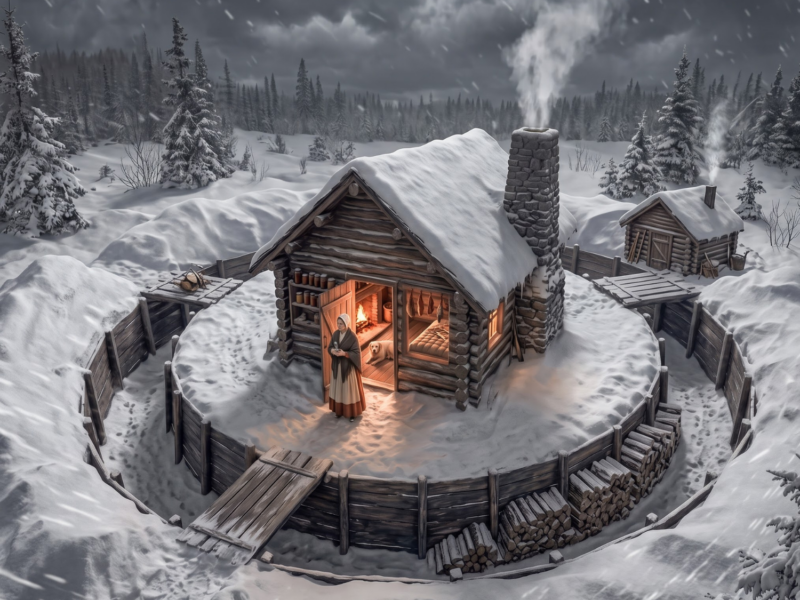
They Said Wind Can’t Be Stopped — She Dug a Trench Around Her Cabin… Then Winter Proved Them Wrong
The Cornish Legacy
Her strategy was a masterpiece of paranoia and precision. She dug from four in the morning until noon, working entirely beneath the floor of her own home where no one could see or hear the rhythmic bite of the pickaxe. In the afternoons, when the thick autumn fog rolled in from the creek and visibility dropped to thirty yards, she loaded the excavated dirt into a modified wheelbarrow and hauled it to the creek behind the property. She spread it thin along the bank, where the rushing water would dissolve it and carry it downstream, leaving no mounds of evidence.
In the evenings, she braced the newly exposed earthen walls with limestone, fitting each piece by hand.
Her neighbors saw exactly what she wanted them to see: A woman who was not hauling timber from the mill. A woman who had no stacks of lumber, no sound of hammering, no rising skeleton of a barn. They saw only a defeated widow who appeared to be obsessively cleaning her house and moving small, meaningless piles of dirt to the creek. The community quietly assumed she had given up—that she was tidying her affairs before the deadline arrived and Renshaw came to collect what the law now said was his.
They did not realize that the dirt she carried away was the volume of a hidden sanctuary taking shape beneath their very feet.
The physical toll of the work was absolute. By the tenth day, Felicity’s palms were a grotesque map of burst blisters and new calluses—yellow and hard, layered over each other like the rings of a felled tree. She ate her meager meals standing up, because sitting down meant she might not have the strength to stand up again. She slept in two-hour intervals, because sleeping longer meant losing daylight, and daylight under the fog was the only safe window for hauling dirt to the creek.
Her body became a ledger of the work, each muscle recording the debt in a currency of soreness and strain that compounded daily. She lost weight she could not afford to lose. Her dresses hung looser. Her face sharpened dramatically at the cheekbones and the jaw. When she caught her reflection in the water barrel, she saw a woman she barely recognized—someone older, thinner, and harder than the person who had stood on the porch just days ago.
But the vault was growing. Every bucket of earth she removed was a bucket of space she gained. The space was becoming something real, something with walls and dimensions and the beginnings of a ceiling that would have to hold the weight of her entire world above it.
On the afternoon of the seventh day, Felicity was dumping a heavy load of dirt at the creek in the fog when a rough voice came from behind her.
She spun around, her hand going instinctively to the heavy iron shovel in the wheelbarrow, and found Willard Ainsworth sitting on a boulder ten feet away. He had a bottle of cheap whiskey, half-empty, resting against his thigh, and he was watching her with an expression that was neither surprised nor curious. It was knowing.
Willard was sixty years old and looked seventy. He had been a silver miner before the drink took his steadiness, and now he lived in a squalid shack on the edge of town, doing odd jobs for men who needed a strong back and did not care whose it was. His clothes were worn to the color of dust. His hands shook violently when he was not holding something. But his eyes were sharp, and they were fixed on the stones Felicity had been carrying.
He did not ask what she was doing. Instead, he took a breath and said, “You are setting those stones with a friction lock. The flat faces inward, the rough faces out. Ogden taught you that.”
Felicity felt all the blood leave her face.
In seven days of agonizing secret work, she had been flawless. She had timed her trips. She had watched the road. She had scrubbed every trace of clay from her floors before dark. And now, a drunk she barely knew was sitting by her creek, reading her subterranean construction technique like a handwritten signature.
Willard saw her terror. He took a slow drink from the bottle, capped it, and set it down in the grass beside him.
“I owe Renshaw forty dollars for whiskey,” Willard said, his voice grating like two stones rubbed together. “If he finds out I helped you, he will call the debt, and I will lose my shack. I will freeze in the street.” He looked at her, his eyes shining. “But I owe Ogden more than forty dollars. Ogden carried me out of the silver mine when the ceiling came down in 1860. He put me on his back and walked three hundred yards in the pitch dark with rock falling around him, and he never once put me down.”
Felicity did not move. Her mind was a whirlwind of calculation. She had not anticipated this. She had planned for hostility, for indifference, for the slow, grinding pressure of a community that wanted her to fail. She had not planned for an ally who was also a massive liability.
Willard told her he had been there the day Ogden died in the section built by the other crew. The section with the green timber and the corners that had been cut. He said Ogden died because he trusted someone who built wrong.
“You will not die, Felicity,” Willard said softly. “Because you are building right.”
It was the first time since Ward’s death that someone had looked at Felicity and seen not a grieving widow, but an engineer.
Willard did not promise to help her long-term. He was too physically and mentally fragile for that, and they both knew it. He promised one specific thing: He would come for one night. One night only, secretly, to help her set the massive limestone arches for the ceiling of the vault. It was the one part of the construction that absolutely required two people—the crucial phase where the heavy keystone had to be held in place while the supporting stones were locked into geometric position.
In exchange, Felicity would never tell a living soul he had been there.
She agreed. They did not shake hands. The agreement was sealed by something far older and stronger than a handshake. It was sealed by the memory of a man who had carried a drunk miner out of a collapsing tunnel thirty years ago, and the unspoken understanding that some debts of blood do not expire.









