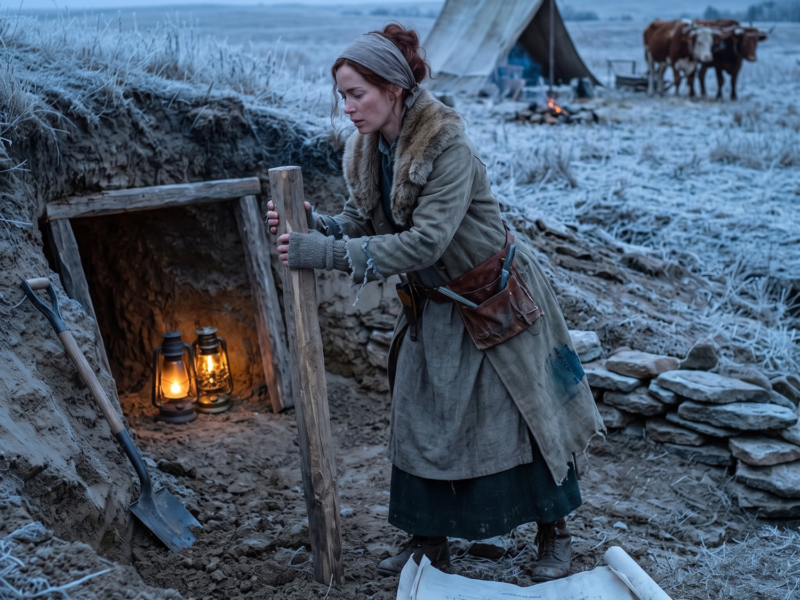
Widowed And Evicted Before Winter, She Spent Her Last $8 On A Root Cellar—It Never Froze All Winter
Widowed And Evicted Before Winter, She Spent Her L…
Widowed And Evicted Before Winter, She Spent Her Last $8 On A Root Cellar—It Never Froze All Winter
.
.
The morning they came to read Della Hartwell off her own porch was cold enough to turn a breath into a ghost.
It was the 19th of October, 1887. The first hard frost of the season had already swept across the Dakota Territory, turning the sprawling, desolate prairie of Antelope Creek to a shimmering sea of silver. Every stalk of bluestem grass between the one-room cabin and the creek snapped underfoot like spun glass as Ezra Pruitt’s men dismounted their heavy-breathing horses.
Della had known this morning would come. The note had come due, a quiet, ticking clock that had started the spring before her husband drowned.
Owen had signed the paper back when the ford ran high and brown with snowmelt. He had borrowed a mule and a wagonload of seed wheat from Pruitt, intending to double their yield. Three miles down the swollen creek, on an ordinary, unremarkable Tuesday, the current had taken him. There was no grand tragedy to the moment, no reason a person could hold onto afterward. The wagon wheel slipped, the mule panicked, the water pulled, and Owen was gone.
Pruitt, the local lender, had been patient through the burying. He had been patient through the worst of the brutal winter that followed. But patience on the frontier kept its own strict ledgers, and that morning, the last line in the ledger was drawn in red ink.
The men who came to enforce the eviction were not cruel. They did not shout or break her things. They were only thorough. By the time the weak autumn sun finally cleared the low, flat-topped buttes in the east, the bottomland and the snug little cabin that came with it belonged to a wheat man named Calhoun. He had paid Owen’s debt outright in hard currency, buying the foreclosure from Pruitt.
Della’s entire life was now stacked in the bed of a single, borrowed cart.
There was a scarred wooden trunk holding their clothing. A butter churn. A slatted crate of crockery carefully wrapped in week-old newspapers. A heavy feather bed, folded twice to save space. A small, sturdy child’s chair that Owen had pegged together by lamplight—no taller than a milking stool—which Della had tucked safely into an empty flour sack because she could not bear to leave it exposed to the elements in the back of the cart.
And tucked deepest of all, wrapped in burlap, was the small bundle of seed potatoes she had been saving all autumn, their pale eyes waiting in the dark.
Ezra Pruitt himself rode out to settle the last of it. He sat his chestnut horse at the edge of the yard, his hat in his gloved hands, looking exactly like a man who fervently wished the morning were already over.
“There is,” Pruitt told her, clearing his throat, “no reason you have to leave the claim entirely, Mrs. Hartwell.”
Della looked up at him, her hands resting on the rough wood of the cart.
“The far corner of the upper quarter is yours, if you want it,” Pruitt said, gesturing vaguely toward the north. “Free and clear. Calhoun has no use for it. It’s forty stony acres on a north fold of the land. There’s a seep that comes out of the hillside and turns everything below it to a bog. Cattle bawl and sink in it, and no sod house will ever stay dry there. But it’s yours.”
He offered it the way a man offers a broken tool he is glad to be rid of—a scrap thrown to ease his own conscience.
Della counted what was left to her without letting her face show the brutal arithmetic. She had forty acres of rock and mud. A brown, fiercely loyal shepherd dog named Scout, who slept across the doorway wherever that doorway happened to be. A milk cow named Nell, gone dry now but carrying a calf for the spring. A four-year-old daughter named Pearl, standing quietly in the cart with her mittened hands folded in her lap, exactly the way her mother stood. And eight dollars and forty cents, knotted tightly into the corner of a linen handkerchief in her pocket.
Far to the west, high above the buttes, the sky had gone the flat, heavy gray of an old silver coin. The wind blowing off it smelled sharply of snow that had not yet decided to fall. Winter was up there, brooding. It was working its way down the high ground a little earlier every day.
Della did not weep in front of Pruitt. She did not argue the fairness of a man dying over a borrowed mule. And she did not beg him to find some softer, warmer arrangement in town, though Pruitt half expected one or the other and had visibly braced his shoulders for both.
She only thanked him for the corner parcel in a voice as level and unbroken as the prairie horizon. She turned to the horse hitched to the cart, clicked her tongue, and drove toward the seeped fold of ground that everyone in Larkspur agreed was good for nothing at all.
Pearl watched her mother’s face the whole way. Finding nothing alarming there, no cracks in the foundation, the child settled against the wooden trunk and fell peacefully asleep to the rocking of the wheels.
That steadiness was worth more to Della than any number of tears would have been. She knew it, and she spent that steadiness carefully.









