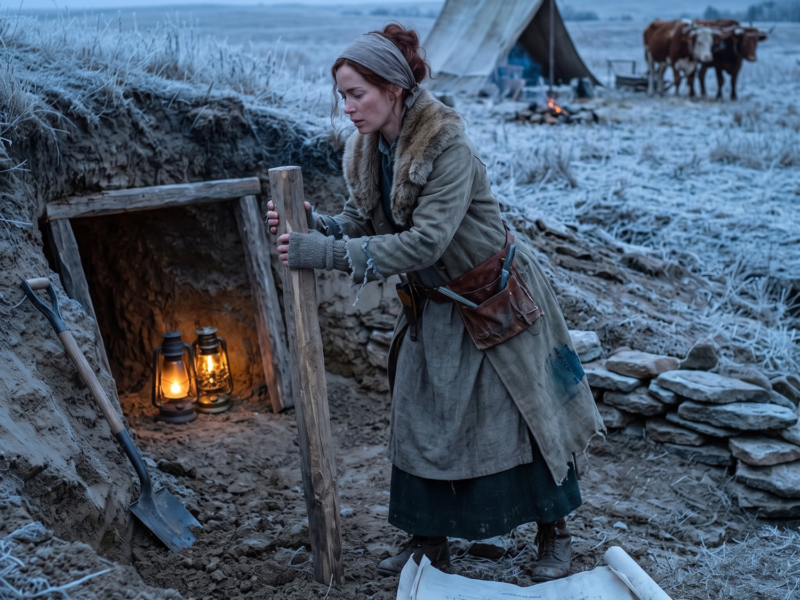
Widowed And Evicted Before Winter, She Spent Her Last $8 On A Root Cellar—It Never Froze All Winter
The Fever and the Bohemians
On the second night of the howling blizzard, terror finally breached the dugout.
Pearl took a sudden, violent fever. The child woke in the dark, crying out, her small forehead burning hot to the touch, her breathing shallow and ragged. Della held her daughter tightly through the agonizing small hours of the morning, pressing a cool, wet cloth to her brow, her heart hammering with a fear far colder than the storm outside.
What saved them both from the absolute worst of that panic was the reliable warmth of the dugout and the abundance of sound food.
The dugout stayed remarkably snug, insulated by the earthen bank against the screaming wind. There was rich milk to drink; Della had been keeping a neighbor’s surplus crock in her cellar, where the stable temperature kept it sweet and liquid instead of freezing and separating. There was ground meal for a nourishing gruel, and rich broth to be made from salted meat. A child who is kept warm and given hot, nutritious food has a far, far better chance of fighting off a winter fever than a child who is shivering in a drafty cabin with an empty belly.
By the gray, filtered light of the third morning, Pearl’s fever finally broke. She fell into a deep, healing sleep. Della sat perfectly still beside her, watching the rise and fall of her chest. She had not slept a wink in thirty-six hours, and she was glad past words to be exhausted in that particular, victorious way.
It was that same third morning, with the shrieking wind finally beginning to drop to a low moan, that the Vesley family appeared on the creek road, half dead.
Anton Vesley was a proud Bohemian immigrant who had brought his exhausted wife, Marie, and their two small children to the territory only the summer before. He was full of hope, full of desperate energy, and entirely short on the kind of hard, brutal local knowledge that only took years of suffering to earn.
His wooden shed had miraculously survived the wind, but a massive snowdrift had buried its only ventilation gap. The resulting dampness had seeped into his firewood and his food stores alike. His potatoes were frozen rocks. His fires would barely catch, smoking weakly, and his cabin had become as cold inside as the ambient air outside it.
Worse, his youngest child—an infant girl not three months old—had gone quiet and a terrifying, ashen gray. It was the way a baby goes when the mother’s milk dries up from stress and malnutrition, the ambient water is frozen, the mother’s own strength is failing, and there is absolutely no warmth anywhere to be found.
Anton had wrapped his family in blankets and dragged them through the receding drifts, looking for a chimney with smoke.
Della saw the whole tragedy in a single glance as they stumbled toward her dugout. She recognized the hollow, terrified look in their eyes because she had stood close enough to that exact same edge herself the day Owen died.
She did not offer the Vesley family charity.
Della had been on the receiving end of the town’s pity once or twice in the months since she became a widow, and she knew exactly how it tasted. She knew that a handout given to a proud, desperate man can wound his soul worse than the physical cold ever could.
Instead, she opened her door and told Anton Vesley that she needed his help. Which was, in its own way, true enough.
“I have more cellar than one woman can rightly tend to,” Della told him, her voice brisk and businesslike as she ushered them into the warmth. “And I need careful, exact records kept of how the place holds through the rest of this winter. I need temperatures and frost depths recorded twice a day, and I need a strong second pair of hands.”
She looked at Anton, giving him a job, giving him back his agency. “Your older boy could mind the temperature readings. Your wife could help me store and turn the root vegetables so they don’t spoil. And in exchange for your labor, I’ll share milk, hot food, and the warmth of this dugout until you can dig a sound cellar of your own on your claim come spring.”
No one in the small, warm room said the word charity. No one needed to.
Marie Vesley clutched her quiet baby. She understood exactly what was being offered, and exactly why Della was phrasing it the way she was. Marie’s eyes filled with hot tears. She looked at Della and said only, in her very careful, broken English, that she and her son would keep the very best, most accurate records in the entire territory.
The infant girl warmed slowly through that day in the snug dugout. She was fed on warm milk kept liquid by a spring that everyone had once laughed at, and nourished by broth made from food a frozen hole had not been able to touch. By evening, the baby had her pink color back, her small fists were waving, and she let out a loud, demanding cry that had real, vibrant life behind it.
Winter, Della thought as she watched Marie rock the baby, could strip a pioneer family of nearly everything they owned in a matter of hours. There was absolutely no call to let it strip them of their dignity on top of it.









