Widowed And Evicted Before Winter, She Spent Her Last $8 On A Root Cellar—It Never Froze All Winter
Digging In
She began digging on the fourth day, before the morning light was good enough to see colors. She used a borrowed spade and a heavy iron grubbing hoe, her sleeves pushed forcefully past her elbows despite the chill.
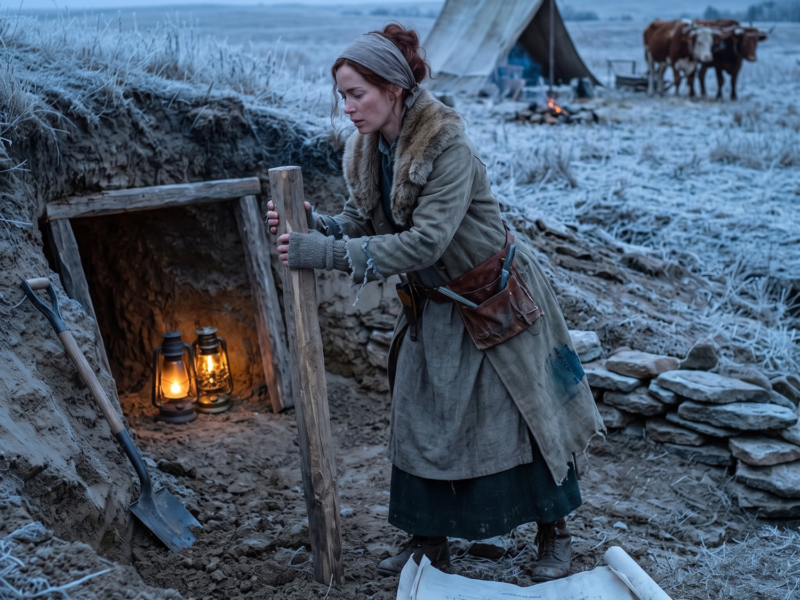
She cut aggressively into the south face of the bank, throwing the heavy, loamy soil downhill. By the second evening, her muscles screaming with exhaustion and her palms blistered raw, she had carved out a square room taller than herself, opened directly into the side of the slope. The back and sides were held securely by the firm, dense clay of the hill. She graded the dirt floor so it sloped gently down toward the natural seep.
Next came the stone. She walked her useless forty acres, gathering heavy, flat fieldstones, hauling them back one by one in the cart. She lined the lower walls and the floor channel with the stone, fitting them dry without mortar, locking one jagged edge against the next. She built it the way a person builds a wall that means to outlast her.
Along the floor, she set a shallow stone trough. She took her spade and turned a thin, steady finger of the natural spring into the trough, so that the water entered at the high, back corner of the room, ran the entire length of the stone floor, and exited out a low gap at the front. The water was never still. It was never deep enough to freeze solid. It was always moving.
The men who passed on the nearby creek road slowed their wagons to look. Most of them laughed.
A grain dealer’s son, sitting high on a buckboard, hollered down that she’d built herself a fine, spacious grave and saved the town the trouble of digging one come January. An old plowman stopped his team and asked, not entirely unkindly, whether her people back East knew she was out here digging in the dirt like a badger, and whether a telegram oughtn’t be sent to fetch her home.
A boy of about ten stood leaning against her fence line for half an hour, chewing a piece of straw, before finally announcing that his Pa said a hole that low would just fill up with snowmelt and drown her milk cow.
The remarks came floating down the cold slope and blew away on the wind. Della did not stop to answer them. She went on fitting her stones. She had learned in the long, dark months since the river took Owen that there was absolutely no answering that kind of talk with words. You only outlasted it.
Word of the strange, wet little cellar on the bog corner reached Otto Brandt before the week was out. Otto Brandt came to see it the way a stern church warden comes to inspect a local heresy.
Otto was the most prosperous, successful farmer on that entire stretch of Antelope Creek. He was a broad, careful, meticulous German immigrant who had cleared four hundred acres of virgin sod and built every structure on his place twice the size and twice as thick as it needed to be. He had spent the autumn before sinking a proper, traditional root cellar—an eight-foot-deep pit with massive walls lined with sawn oak planks hauled up from the mill in town, at a staggering price he liked to casually mention in conversation.
Otto walked his heavy boots around Della’s open dugout once, slowly. He pressed the toe of his leather boot against her dry stone work, examining the joints, and shook his large head.
“A hole that shallow,” Otto told her, his voice booming across the quiet hillside, “will freeze straight through the first hard week of December. Everyone knows it, Mrs. Hartwell. A cellar has to go down deep. Below where the frost reaches into the ground. Otherwise, it is no cellar at all, but only a cold box waiting to ruin everything a person puts in it.”
He said it plainly, not with malice, but the way a man says a thing he has paid a great deal of hard money to learn. There was no spite in his voice, which was exactly what made the warning land so heavily in Della’s chest.
Della listened politely. Then, she crouched by her stone trough and let the spring water run over the back of her bruised fingers.
“The frost doesn’t reach this water, Mr. Brandt,” she said softly. “It comes out of the ground already warm. And it doesn’t stop moving. The room won’t freeze because the water won’t let it.”
Otto Brandt looked at the little stream running clear and brave over the fieldstones. For a long moment, he said nothing at all. It was not a foolish answer, and he had come expecting nothing but foolish answers from a desperate widow with a spade.
Then he straightened his broad shoulders and pulled his hat down tight against the wind.
“Maybe,” Otto allowed, a concession dragging out of him. “Maybe. But the cold has a hundred ways into a place on this prairie. Water is only one wall against it, and winter will find the other ninety-nine.”
Whether the spring would hold, he told her, was a question the season would have to settle. And the season, he reminded her, pointing a thick finger toward the gray sky above the buttes, was already on its way down.









