Widowed And Evicted Before Winter, She Spent Her Last $8 On A Root Cellar—It Never Froze All Winter
The Vermont Memory
Most people in that unforgiving country, set down on forty acres of bog with winter coming and eight dollars to their name, would have spent the first week frantically worrying over a roof. A sod hut, a canvas tent, a lean-to against the wind—something to keep the sky off their heads.
Della spent her first week worrying over a cellar.
She had grown up far from the Dakota plains, in a sturdy stone farmhouse in Vermont, where her father kept twelve dairy cows and a springhouse cut deeply into the sloping earth behind the barn. She had carried heavy pails of milk down to that springhouse every morning of her girlhood, in the humid heat of summer and the bitter cold of winter.
And she remembered a profoundly important thing that most people on the prairie never troubled to learn.
That little stone room in Vermont never froze. Not in the worst of January. Not when the mercury thermometer on the back porch read twenty below zero and the iron nails sang and popped in the wooden walls of the house. The spring ran through a shallow trough along the stone floor, and the running water kept the ambient air inside hovering just above freezing, no matter what the violent weather did outside.
The earth held its ancient warmth, and the moving water carried it. Between the two of them, the milk stayed sweet, the ceramic crocks never cracked, and the carrots her mother buried in damp sand came up crisp and perfect at Easter.
A roof, Della reasoned as she unhitched the horse in the cold wind, kept the snow off a person. And a person could live a long while wrapped in blankets in a hole in a bank if she had to.
But a larder that froze in November was a death sentence, drawn out slow and agonizing over five months. Frozen potatoes turned to black, weeping sponge in a week. Frozen apples rotted into alcoholic mush. And worse than any of that—far, far worse—were the seed potatoes resting in the flour sack.
If the seed froze, the winter would force her to eat what little remained of it just to stay alive. And then, there would be absolutely nothing to put in the ground come spring. A homestead with nothing to plant was a homestead already dead; the losing simply hadn’t caught up to the calendar yet.
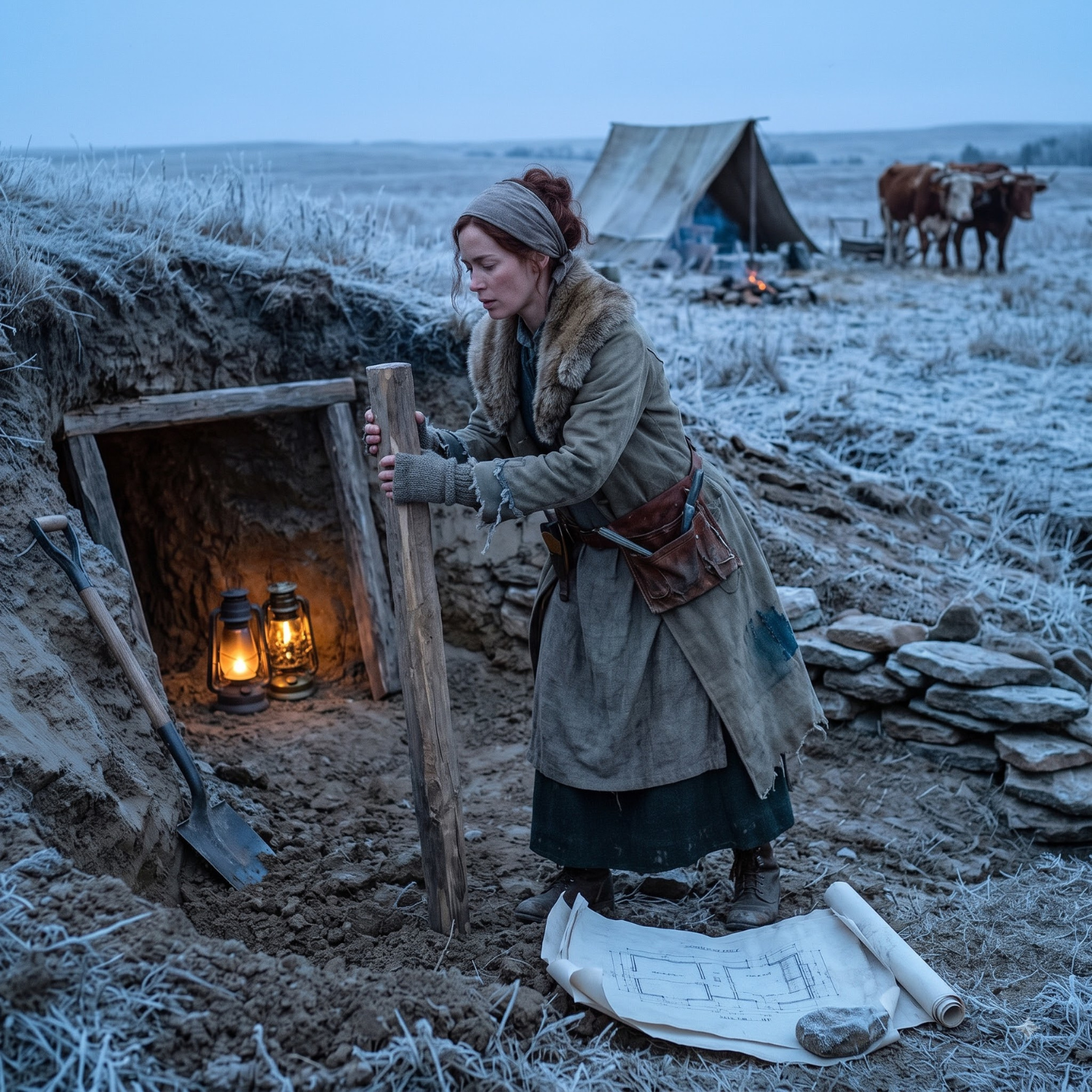
So, while the men of Larkspur shook their heads over their coffee in town, gossiping about the foolish young widow camped under a flapping canvas lean-to on the bog corner, Della walked the seeped fold of her forty acres with Scout trotting faithfully ahead. She read the ground the way her father had taught her to read it.
The flat ground below the seep was useless, exactly as Pruitt had warned. It was a treacherous sponge of mud and dead reeds. But higher up, where the seep actually came out of the hillside on a rounded shoulder of ground that faced directly south to catch the low, weak winter sun, the bank rose firm and dry above the wet.
The slope of the hill naturally shed the biting north wind, sending it howling over the crest rather than into the face of the bank. And the water came out of the earth clear, steady, and unbroken.
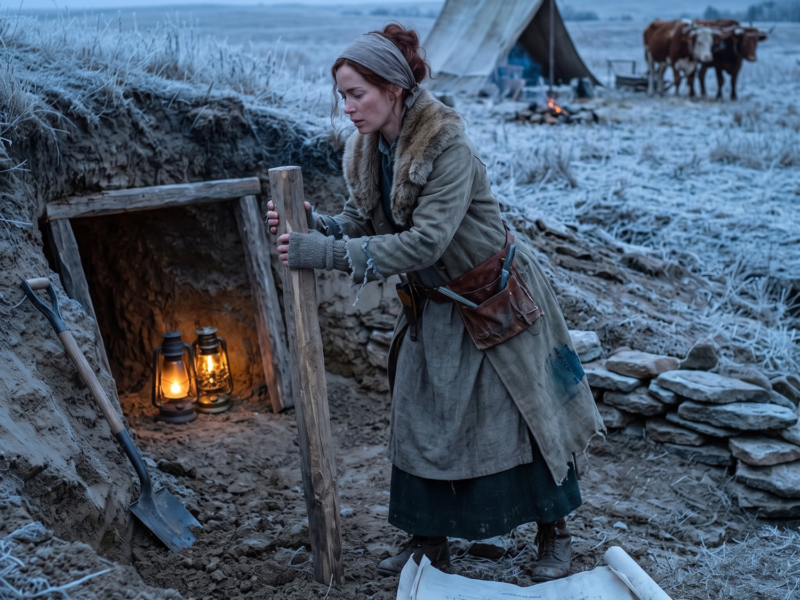
At dawn, with a thick layer of frost coating the prairie grass all around her, Della knelt and cupped the water in her bare hands. It was startlingly warm. Not warm like water from a stove kettle, but warm like a living thing the deep ground had been protecting.
The hillside had already done the better part of the work. She only had to finish what the earth had started.