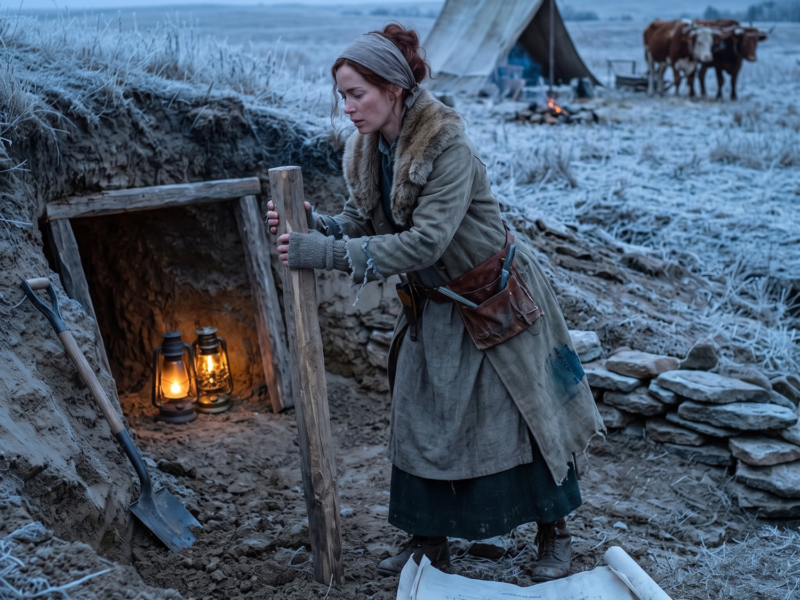
Widowed And Evicted Before Winter, She Spent Her Last $8 On A Root Cellar—It Never Froze All Winter
The Armor of Ice
The real winter announced itself on the 11th of December, and it did not announce itself with snow. It announced itself with ice.
A deceptively warm, wet wind came rushing up out of the south at dusk, bringing a heavy rain. Then, the barometer crashed. The wind swung hard and violent around to the north overnight, plunging the temperature. The driving rain froze exactly where it fell.
By morning, the world had been encased in glass. Every strand of barbed fence wire on Antelope Creek wore a heavy, glittering sleeve of ice an inch thick. The pliable willows along the water bowed low to the ground under the crushing weight. Now and again, echoing across the still, freezing air, came the sharp, terrifying rifle-crack of a massive limb giving way and crashing to the earth.
The cold dropped like a stone behind the ice storm. The mercury thermometer Otto Brandt had loaned her—half in neighborly concern, half in cynical challenge—read ten degrees above zero by noon. And it kept falling.
Della made no war on the cold. She didn’t try to fight it with massive bonfires. Every few hours, wrapped in a heavy shawl, she walked carefully down to the cellar through the glazed, crunching, glittering grass. She opened the heavy outer door, stepped into the airlock, and opened the inner door.
She stood in the dark, listening.
The spring was still running over the stones, bubbling faithfully as a clock.
She checked the tin bowls by lantern light. The one by the front step, where the airlock ended, had skinned over with the absolute thinnest film of fragile ice, and no more. The bowl by the inlet at the back was open, rippling water.
She lifted a potato from the dry sand bin. She lifted a turnip from the stacked row. She pressed her thumb hard against the flesh of each. They gave slightly, like sound, living flesh, and not like a frozen, ruined sponge.
She smiled, a small, fierce thing in the dark, and went back up the hill. She opened the ledger and wrote it down by the numbers.
December 11th. 10 above and falling. Cellar holding.
Inside the little, lamp-lit dugout built into the bank that was now their whole house, Pearl slept warmly under the thick feather bed while the storm tore itself out against the heavy earthen berm outside. Nell the cow stood placid and dry in her little lean-to attached to the dugout, chewing hay that had stayed dry. Scout lay across the interior doorway, one ear up, listening to the wind scream, completely unbothered.
Three days after the ice came, Otto Brandt rode out again. This time, he did not wait by his horse. He came walking carefully down the icy hill to the cellar without being asked.
He did not crouch and pronounce judgment. He walked the stone channel slowly. He took his thick glove off and felt the floor. He lifted a large potato out of the sand bin, turned it over in his big, careful hands, pressing his thumb into the skin. He found it perfectly firm.
For a long while, Otto said nothing. The only sound in the dim room was the small, bright, defiant running of the spring over the stones.
Then he looked at Della, his face pale. He asked her, in a low, almost defeated voice, exactly how much the whole thing had cost her to build.
“Seven dollars and fifteen cents,” Della said. She had it tracked to the penny in her ledger. Pipe, straw, and a few nails for the doors.
Otto Brandt stood holding the sound potato, looking at the dry stone walls, the moving water, and the clever vents. Something imperceptible went out of his broad shoulders.
His own cellar—the deep, magnificent one with the sawn oak walls he had paid better than forty dollars to line—had failed catastrophically. It had frozen solid in the deep freeze following the ice storm. His wife’s expensive, imported ceramic crocks of preserves had expanded and burst their seams, shattering into pieces. A massive, vital winter’s worth of put-up food had gone to colored, frozen mush in a hole he had dug exactly the way every expert in the territory agreed a cellar ought to be dug.
By every established rule he knew, his expensive cellar should have held, and her dirt hole should have failed.
He said as much, speaking half to her and half to the running water, shaking his head in disbelief. “That wooden frame on the doors shouldn’t be standing,” he muttered. “That little hole shouldn’t be keeping a thing alive in this cold.”
“It isn’t keeping it by itself, Mr. Brandt,” Della answered softly.
Her hand moved as she spoke, conducting an invisible orchestra of the elements. She pointed from the warm, deep-earth inlet, to the moving friction of the water, to the high vent breathing out the damp rot, to the south-facing bank that drank the low sun, to the thick north berm that deflected the wind.
“The hill keeps it,” Della said. “The water keeps it. The sun and the sod keep it. I didn’t fight the cold. I only got out of their way.”
Otto Brandt followed her hand from one element to the next, seeing the brutal, elegant logic of it for the first time. At the end of it, he set the potato back in the sand bin as carefully as if it were a fragile bird’s egg. He put his hat back on, pulling it low.
“I allow,” Otto said quietly, “that there are more ways to beat the cold than just going down after it with a bigger shovel.”
It was a thing a proud man did not enjoy admitting, and the admitting was worth vastly more because of the struggle it took to say it.









