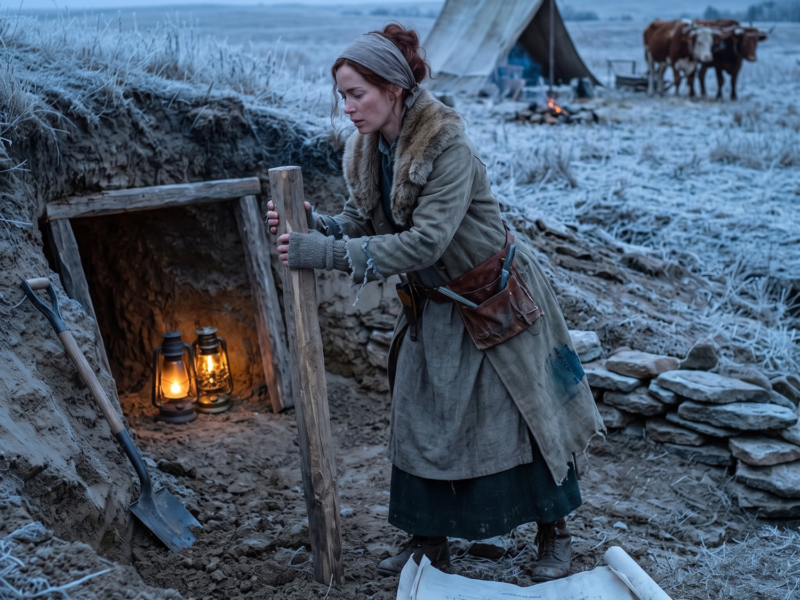
Widowed And Evicted Before Winter, She Spent Her Last $8 On A Root Cellar—It Never Froze All Winter
The Diviner's Warning
Two days after Otto Brandt’s visit, an old man named Jonah Teal rode out on a swaybacked, spotted mare to look at the cellar.
Jonah Teal did not laugh, and he did not lecture. He had dug wells, found springs, and built stock ponds across half the Dakota Territory for thirty years. He carried a willow divining rod tied to his saddle, and he understood water the way Otto Brandt understood wheat.
Jonah climbed stiffly off his horse, his joints popping. He walked the stone channel slowly, tracing the path of the water from the warm inlet at the back of the bank to the cold gap at the door. He knelt where the spring entered through the front of the earth, his faded blue eyes narrowing under his hat brim. He frowned deeply.
“The water’s fine, missy,” Jonah said, his voice like dry leaves. “The water will do just what you say it’ll do… right up until it touches the outside air. But look here.”
He laid two crooked, arthritic fingers on the exact spot where the little stream crossed from the warm, insulated earth into the open, exposed mouth of the cellar.
“Right here, where it meets the wind,” Jonah warned. “It’ll skin over with ice the very first cold snap we get. The ice will back up. The backup will freeze the inlet solid into a plug. And once the water quits running, your whole notion quits with it.”
He stood up slowly, groaning, and brushed the dirt from his knees. He looked around the damp room and added one thing more.
“Another matter,” Jonah said, tapping his cane on the stone floor. “You’ve got water, and you’ve got earth keeping it warm. That’s fine. But warm, wet air sits still and goes sour. And sour air rots a potato faster than frost ever did. You’ll want to give the bad, heavy air somewhere to go, or you’ll open this place in February to a smell that’ll turn your stomach, and a floor full of black mush.”
He was not telling her she had failed. He was telling her exactly, precisely where she would fail if she did nothing to adapt. It was the most useful, honest thing anyone had said to her since Owen died.
She thanked the old man, offering him a cup of hot coffee from her campfire before he rode away.
That night, shivering under her canvas lean-to, Della wrote both of Jonah’s warnings down in a thin, leather-bound ledger she had carried out of the cabin. It was the book she had once used to track egg money and flour purchases.
Turning to a clean, crisp page and ruling it into columns by the flickering light of a tallow dip, she wrote two words: Inlet and Stale Air. Under them, she deliberately left blank space for what she would do about each.
The first frost that truly mattered came on the last night of October, sweeping down from Canada like a scythe. It showed her exactly what Jonah Teal had promised.
She reached the cellar before dawn, the grass crunching under her boots, Scout at her heel, her breath hanging in thick white plumes in the doorway. At first glance, the room looked sound. The water ran. The earth held.
Then she saw the inlet.
A pale, thick collar of white ice had grown across the mouth of the spring where the water crossed into the open, freezing air. The ice was aggressively narrowing the stream to a mere thread, and behind it, the water had begun to pool, pull, and slow dangerously.
Near the front of the room, by the door where the heavy cold settled lowest, a creeping frost had moved across the stone floor in fine, intricate white lines. It had reached the very first row of turnips she had painstakingly laid by. When she knelt and touched them, her heart sank. They had gone soft and mushy on the side that faced the door.
Higher up in the room, near the back wall by the warm inlet, everything was sound, cool, and perfectly dry. But the front of the cellar had begun quietly, efficiently, to fail.
Della did not curse the sky. She did not tear the frozen turnips apart in a fit of despair. She knelt and laid her bare palm flat on the stone floor near the door, closing her eyes. She felt the bitter cold pressing up out of the front gap like a draft from an open window, and she understood the physics of the whole room at once.
The killing cold was coming in low, sliding heavily along the floor where the rising warm air couldn’t fight it, freezing the inlet from the outside in.
She measured the band of frost with the width of two fingers and wrote the number in her ledger. She marked exactly which row of turnips had softened and which had survived. Then, she went to work.









