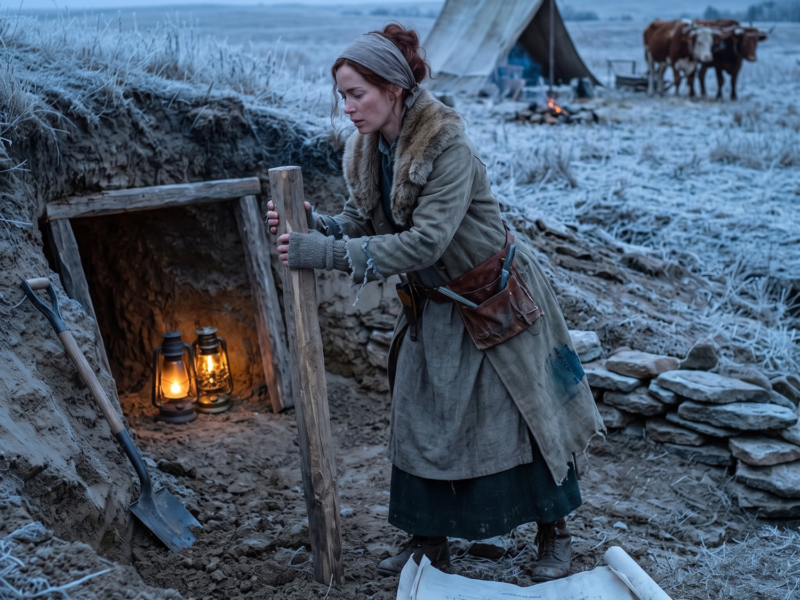
Widowed And Evicted Before Winter, She Spent Her Last $8 On A Root Cellar—It Never Froze All Winter
The Spring Awakening
Spring came late and slow to Antelope Creek, fighting the winter for every inch of ground, the way it always did.
The snow finally drew back, retreating off the south-facing slopes first. The creek rose violently, brown and churning with meltwater. Deep, grasping mud took the wagon roads, making travel impossible for a month.
But when the ground finally softened and opened up to the warming sun, Della Hartwell did the thing the whole long, terrifying winter had truly been about.
She carried the burlap flour sack down out of her cellar.
Inside it, the seed potatoes lay perfectly firm, pale, and waiting in the dark. Every single eye on the tubers was alive and sprouting. Not one of them had been lost to the frost or the rot.
She took a knife, cut them carefully, and planted them in the dark, broken ground below the seep—the exact spot where the bog water, which had ruined the land for everyone else’s cattle, turned out to make about the richest, finest potato-growing soil in the entire county.
Della was not the only farmer planting her own seed that spring, but she was dangerously close to it. The historic blizzard and the subsequent deep freeze had utterly ruined the stored seed up and down Antelope Creek. Families who had counted entirely on putting last year’s potatoes back in the ground to survive found they had nothing but foul, black mush in their shallow cellars.
Della had a massive surplus. She had more than she needed to plant her own acres.
She gave it away by the heavy bushel. She gave it to the Vesleys, so Anton could start his crop. She gave it to the young brothers from the south claim. She gave it to anyone who came up the muddy road asking. She gave it away the exact same way the side of bacon and the tallow candles had once miraculously appeared at the edge of her own camp in November. And she would not hear a single word about anyone paying her for it.
The cellars began coming up everywhere across the territory that next autumn.
People stopped digging deep, vertical pits. They banked them horizontally into the south-facing folds of their slopes. They ran their springs and well lines in through buried clay pipes deep below the frost line. They gave the heavy, damp air a high road out through the roof.
And the holes that successfully held food through the killing months stopped being a strange local curiosity and started being just the sensible, established way a person did things in that country.
Before long, the neighbors had taken to calling them “Hartwell Cellars,” named after the stubborn young widow who had built the first one on the bog corner everybody had written off as garbage.
Della never cared for the name. Whenever someone in town used it, she would shake her head, point out the window toward the hills and the running water, and say it was only earth, a spring, and a little bit of common sense—absolutely none of which she had invented.
The humble answer never satisfied anyone, and it wasn’t meant to. They had already seen the undeniable truth of it for themselves. The thing had spread across the prairie simply because it worked.









