Widowed And Evicted Before Winter, She Spent Her Last $8 On A Root Cellar—It Never Froze All Winter
The Ledger of Barter
Word of the widow’s cellar that held through the catastrophic ice storm went further and faster across the prairie than the storm itself had.
Within the fortnight, a pair of young brothers rode up from a struggling claim south of town. They stood awkwardly outside the dugout and spent an hour asking Della specific questions about the depth of the frost line, the exact angle of the inlet pipe, and how a person knew where the warm ground started on a hillside.
A large ranching family, arriving in a wagon, came with the exact same questions a few days later.
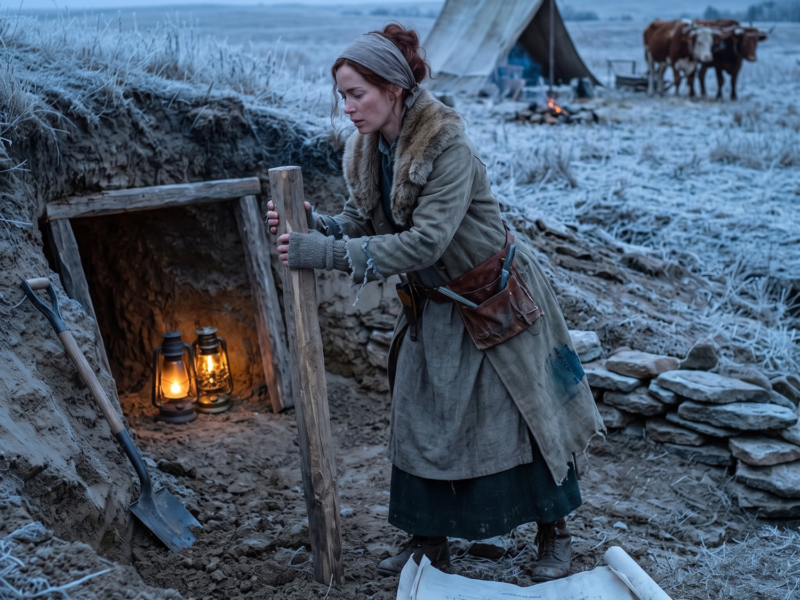
Della answered every single one of them. She didn’t hide the knowledge. She walked them down to the cellar. She showed them how to read the landscape—how to find a slope that naturally faced the winter sun and shed the north wind. She explained how to run a spring in below the frost line so it never iced at the mouth. She drew diagrams in the dirt to show why the bad air had to have a high road out, or the roots would sweat and rot in the dark.
The talks never lasted long. Most people on the frontier didn’t want philosophy; they only wanted enough practical mechanics to try it for themselves.
No money ever changed hands. Della would not have taken their coins anyway; survival was not a commodity to be sold.
But things began appearing at the edge of her camp all the same, set down quietly and without a word by anonymous hands. A heavy side of salt-cured bacon wrapped in paper. A fifty-pound sack of fine-ground cornmeal. A bundle of twenty tallow candles tied with twine.
One bitter morning, a passing rancher noticed Scout shivering outside the dugout. An hour later, a fresh bale of straw and a worn but incredibly warm, heavy horse blanket were left by the door. The rider was gone before Della could even step out to thank him.
Her wooden shelves inside the dugout filled a little at a time, almost without her noticing the accumulation, until the lean-to that had held absolutely nothing but dread in October held enough provisions to make the rest of the winter look survivable for the first time.
Then, on the 12th of January, the prairie stopped testing them and tried in earnest to kill them all.









