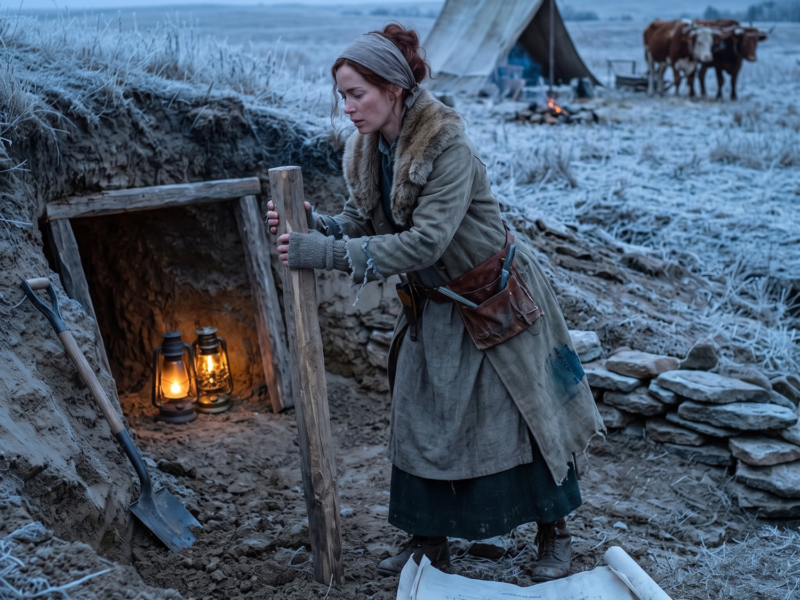
Widowed And Evicted Before Winter, She Spent Her Last $8 On A Root Cellar—It Never Froze All Winter
The Ledger
Ten years on, the landscape of Antelope Creek looked nothing like the harsh, unforgiving place that had read a terrified widow off a porch with eight dollars to her name.
Della Hartwell owned her original forty acres completely outright, and she had bought the adjoining forty acres besides from a man moving back East. The “worthless bog” had been transformed into a massive, thriving market garden that supplied fresh vegetables to half the town of Larkspur. The dry cow had multiplied into a small, pristine dairy whose rich butter took the blue ribbon at the county fair, three years running.
Pearl was fourteen years old, tall, strong, and capable. She could turn a cellar’s intake vents to adjust to the shifting weather just as well as her mother could. The infant Vesley girl, whom the spring had saved from freezing, was ten years old now, and she ran up and down the creek road on her own two strong legs every chance she got to visit Aunt Della.
More than two dozen families up and down that watershed had built some functional version of the banked spring cellar. They learned it from Della, or they learned it from someone Della had taught. The design had passed seamlessly into the ordinary, inherited knowledge of the place, the way all real, vital things eventually do—quietly, until no one remembers a time before them.
And of everything Della Hartwell had gathered to herself across those ten prosperous years—the deed to the land, the herd of cows, the money in the bank, and the sterling good name in town—there was one specific thing she valued past all the rest. It was not worth a dime to anybody but her.
It was the thin, leather-bound egg money ledger she had carried out of the cabin the morning she lost everything.
Its leather cover had gone soft, pale, and incredibly smooth with years of handling. Its sharp corners had worn round. Inside, written in her own cramped, careful hand by lantern light, were the entries from that very first, terrifying winter. Every dawn temperature. Every frost depth. And the plain, three-word verdicts written after each catastrophic storm.
When a debate came up in town about the cellars—about how cold they would truly hold, or how deep the inlet pipe actually needed to go—Della trusted the faded ink on those pages vastly more than she trusted anyone’s memory, her own included. The book remembered exactly what the brutal winter had done, and it remembered exactly how the hillside had answered it.
Some lives end in vast sums of money, and some lives end in fame. Della’s life came to rest on a foundation much quieter, and much deeper, than either.
The people of that harsh country, faced with a brutal winter coming and knowing they did not have enough to meet it, mostly went looking for more. They wanted a bigger cabin, a deeper hole, a fuller woodpile, a richer husband. They tried to fight the environment with volume.
Della had looked instead in the entirely opposite direction.
She had watched where the wind crossed the slope. She had noticed where the snow naturally let go. She had felt where the deep ground kept its ancient warmth. And she had paid close, critical attention to the small ruin that damp and frost worked on a larder long before the killing cold ever actually arrived.
Those small, quiet noticings had changed everything.
The hill, the running spring, the winter sun, the packed sod, the worn little book—none of those things had ever actually been the lesson. They were only the physical proof of it.
The true lesson was older than any cabin built on Antelope Creek, and it asked just one simple thing of a person. It asked it without mercy, and without exception.
It asked that she trouble herself to learn how the world was actually made, and then build to suit it, rather than blindly building to suit her own hopes.
The ones who learned that lesson were the ones the country finally let stay.









