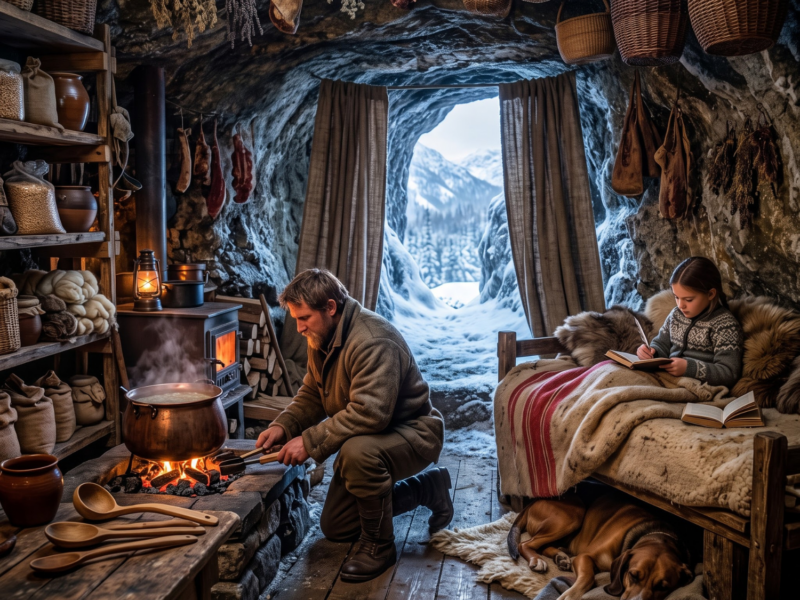
He Filled a Cave With Wool and Firewood — It Saved His Family From the Harshest Winter
He Filled a Cave With Wool and Firewood — It Saved…
He Filled a Cave With Wool and Firewood — It Saved His Family From the Harshest Winter
The wind that swept across the sprawling, unbroken high territorial plains of Wyoming in the late nineteenth century was not merely a movement of air. It was a physical entity. It was a relentless, invisible antagonist possessing both a voice and a hostile, calculating will.
It howled down from the jagged, snowcapped peaks of the Laramie Range, gathering terrible momentum as it crossed the vast, treeless expanse of sagebrush, buffalo grass, and choking alkali dust. This wind did not simply blow across the land. It scoured the earth. It battered every physical obstacle in its path, and it searched with a predatory intelligence for any microscopic weakness in the fragile, temporary structures that desperate men and women had dared to erect upon its ancient, frozen domain.
To live in this landscape during the dark months was to exist in a state of perpetual siege. The elements here were not a picturesque backdrop to human endeavor; they were an active, homicidal force intent on erasing the audacious marks of civilization.
The pioneers who came to this harsh frontier brought with them the hopes and dreams of a softer world. But fatally, they also brought the architectural habits of the forested East—a massive, generational miscalculation that would cost many of them their livelihoods, their limbs, and inevitably, their lives.
In the scattered, struggling settlement of Pine Hollow Basin, the conventional wisdom of survival was dictated by speed, desperation, and a profound, deadly misunderstanding of the environment.
The settlers built their homes from raw, green timber hauled at backbreaking expense from the distant foothills. They built their cabins entirely above the unforgiving earth, attempting to create a wooden fortress against the crushing weight of the sky. To heat these drafty wooden boxes, the men harvested massive quantities of timber during the brief, merciful summers, building towering, monolithic piles of firewood that stood beside their cabins like looming monuments to their own anxiety.
The centerpiece of every single home in Pine Hollow was a tremendous iron stove. It was a black, hungry, cast-iron beast that demanded constant, waking attention and endless feeding. The conventional wisdom of the settlement dictated that safety lay entirely in the size of the fire. The hotter the stove burned, the safer the family would be. It was a frantic philosophy of endless consumption—a desperate race to burn fuel faster than the environment could physically steal the heat away.
Yet, this common practice betrayed a profound, fatal flaw in thermodynamics.
The massive iron stoves, roaring with burning oak and pine, operated on a principle of combustion that required vast amounts of oxygen. As the fire aggressively consumed the air within the small cabin, it created a powerful, roaring updraft. The heated air, buoyant and energetic, rushed violently upward, escaping through the tin chimney, through the imperfectly sealed roof joints, and through the invisible gaps in the upper log walls.
This rapidly escaping air created a massive vacuum within the living space—a negative pressure that physically had to be equalized. To replace the air roaring up the chimney, the stove relentlessly pulled frigid, sub-zero outside air into the cabin through the floorboards, beneath the doorframes, and through the shrinking mud chinking in the lower walls.
The result was a cruel and inescapable paradox of frontier living: the hotter a family stoked their fire, the more aggressively the stove sucked freezing drafts across the floor.
A man could sit in his favorite chair, his face flushed and sweating profusely from the intense, localized radiant heat of the glowing iron, while his boots rested in a layer of air so profoundly cold that his toes would go numb. The homes became turbulent, violent zones of extreme temperature variations, completely lacking any capacity to store or stabilize the massive amounts of heat they so desperately generated.
When the fire inevitably burned low in the deep, dark hours of the night as the exhausted father slept, the thin wooden walls offered almost zero thermal mass. The accumulated heat in the air vanished into the screaming wind outside within minutes, leaving the inhabitants shivering violently beneath piles of heavy wool and stiff animal hides, desperately praying for the dawn.
Thaddius Mercer knew this cycle of suffering intimately. He had lived it. And the previous winter, it had cost him everything that mattered.
Related Articles

They Mocked the Widow’s Dirt Cellar—Then the Freeze Left Every Cabin Cold but Hers Warm
They Mocked the Widow’s Dirt Cellar—Then the Freeze Left Every Cabin Cold but Hers Warm…

A Homeless Veteran and His German Shepherd Inherited a Ridge No One Wanted — 35 Feet In, They Found
Chapter 1 / 7 A Homeless Veteran and His German Shepherd Inherit… A Homeless Veteran…

Neighbors Laughed When He Built A Cabin Inside An Old Barn—Until It Kept His Home 35 Degrees Warmer
Chapter 1 / 8 Neighbors Laughed When He Built A Cabin Inside An… Neighbors Laughed…

His Sod House Had No Woodpile in January – Until the Trains Stopped and the Town Came Begging
Chapter 1 / 10 His Sod House Had No Woodpile in January – Until t……

She Built Her Cabin Over the Woodshed and Never Burned Wet Wood Again
Chapter 1 / 8 She Built Her Cabin Over the Woodshed and Never Bu… She…

The Duke Abandoned Her on Their Wedding Day—Years Later, He Discovered What He Had Lost
Chapter 1 / 7 The Duke Abandoned Her on Their Wedding Day—Years… The Duke Abandoned…

He Wedged a Tiny A Frame Into a Crevice Before Winter and His Family Slept at 75°F While Town Hit
Chapter 1 / 7 He Wedged a Tiny A Frame Into a Crevice Before Win……

He Was Too Old to Ride—So He Bought the Ruined Ranch and Found the Room Behind the Fireplac
Chapter 1 / 5 He Was Too Old to Ride—So He Bought the Ruined Ran……

Settlers Laughed at His Underground Heat Recovery Duct — Until It Kept His Cabin 71°F Warmer
Chapter 1 / 9 Settlers Laughed at His Underground Heat Recovery… Settlers Laughed at His…

A Navy SEAL Built a Home Inside a Mountain—Then His Dog Warned Him Before the Storm
Chapter 1 / 5 A Navy SEAL Built a Home Inside a Mountain—Then Hi… A…