He Filled a Cave With Wool and Firewood — It Saved His Family From the Harshest Winter
The Verdict of the Ledger
When the massive storm finally, reluctantly loosened its deadly grip on Pine Hollow Basin, Silas Boon began actively comparing numbers with his neighbors.
The comparison did not happen in a single, dramatic town meeting. It took place over weeks, in quiet conversations beside frozen water troughs and over the counter at the trading post. They compared ledger entries, the rapidly shrinking size of wood piles, and the morning temperature readings. Simple, undeniable things.
The math was brutal.
From early November through the bitter end of January, Thaddius Mercer had burned less than a single, standard cord of mixed pinyon and juniper to heat the cave.
Silas Boon, in his well-built timber cabin, had used nearly two and a half cords just to keep his family from freezing. Several larger, draftier households in the valley had gone through more than three massive cords, keeping their stoves roaring actively almost around the clock.
The temperature records told a similar, stark story.
During the absolute worst stretch of the deep cold, when outdoor readings approached a lethal -37 degrees, the absolute lowest temperature Thaddius had recorded in the cave’s sleeping area was 45 degrees. And that figure was recorded after the fire had been completely out for six hours.
On that exact same freezing night, the thermometer in the far corner of Silas’s timber cabin hovered near 30 degrees—below freezing—despite an active, roaring fire in the stove.
The men realized that the massive difference could not be traced to any single, magic feature. It was a holistic system.
The thousands of tons of stone surrounding the cave drastically reduced the ambient temperature swings. The narrow vestibule and offset entrance severely weakened the kinetic force of incoming, heat-stealing drafts. The spaced layers of raw wool protected vital pockets of insulating, still air. The raised wooden platform physically separated the bedding from the conductive cold of the floor. Proper, deep wood storage kept the fuel perfectly dry and highly combustible. And the heat placed deep inside the shelter was forced to slowly move into the surrounding rock, turning the mountain itself into a radiator.
Just as important as the design was the maintenance. Small problems—a frozen curtain, a damp wall, a choked pipe—had been diligently discovered and immediately corrected by Thaddius before winter could enlarge them into fatal catastrophes.
One afternoon at the trading post, Caleb Roar stood by the stove and listened to the men discussing the numbers. No one exaggerated the cave’s success. No one had to; the truth was stark enough.
After a long, uncomfortable pause, Caleb packed his pipe and remarked defensively, “Well, a good cave still requires finding the right hillside to dig into.”
Silas Boon didn’t miss a single beat. He looked Caleb dead in the eye. “A good cabin also requires the right design. And we didn’t build them right.”
A few men nodded silently in agreement. The conversation moved on.
There were no grand, public apologies to Thaddius Mercer, and absolutely none were expected. This was the frontier; pride was a hard thing to swallow.
What mattered was that the nature of the debate had fundamentally shifted. Months ago, they had loudly questioned if the cave would work. Now, they quietly analyzed why it worked so perfectly.
Nature had delivered its absolute, final verdict. It was proven beyond a shadow of a doubt in the size of every wood pile, every ink mark on a ledger page, and every morning temperature reading. The wood had fought the wind, and lost. The stone had simply waited, and won.
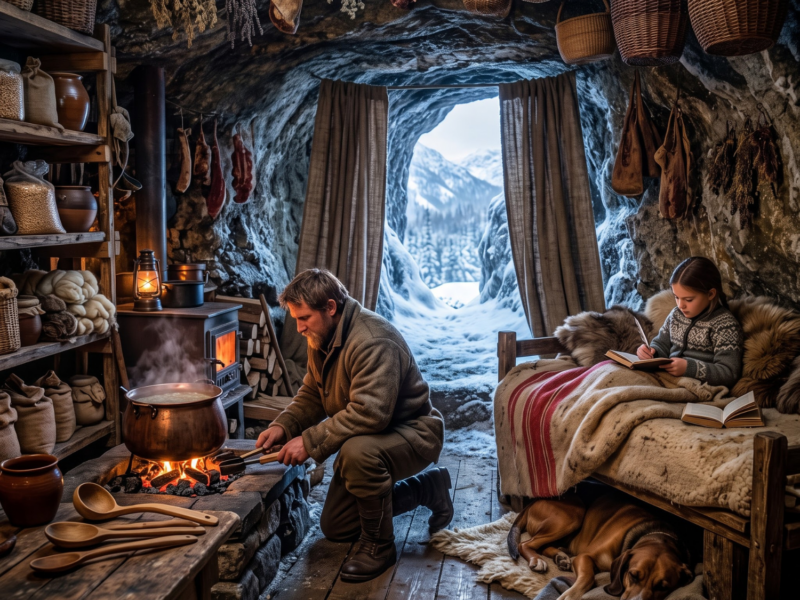
One evening, as light, powdery snow fell quietly outside the vestibule, Evelyn looked up from her book and asked Thaddius if they could stay in the cave until the basin finally thawed in the spring, rather than moving back to the cabin early.
Thaddius looked at the rough stone walls glowing in the lamplight. The violent storms hadn’t beaten it. The killing cold hadn’t beaten it. They had simply borrowed the mountain’s immense, ancient strength, and the mountain had held them safe.
“We’ll stay,” Thaddius said softly, stoking the fire, “until the mountain doesn’t need to protect us anymore.”
Evelyn smiled and returned to her book. Ranger slept soundly beneath the platform. Near the stove, Thaddius made another small charcoal mark on the stone wall, and the leather ledger received one more quiet entry.









