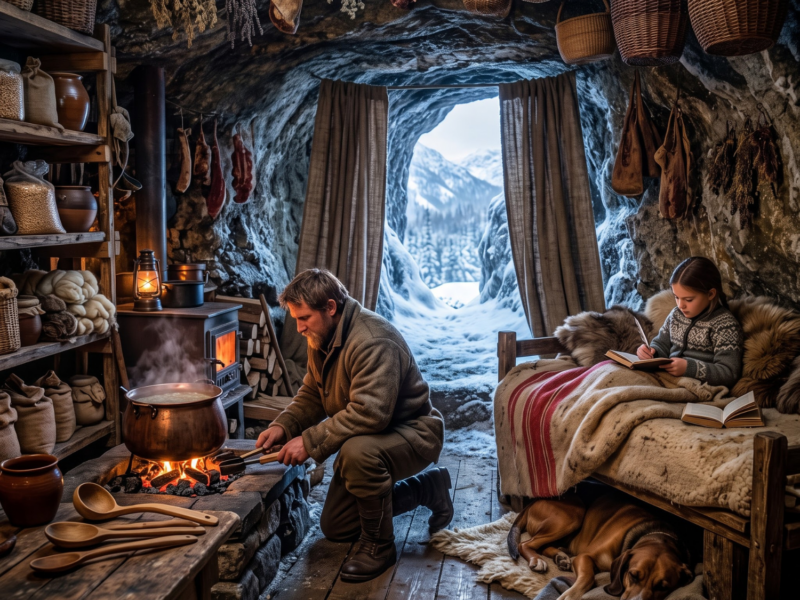
He Filled a Cave With Wool and Firewood — It Saved His Family From the Harshest Winter
The Gossip of the Basin
The first person to notice the steady, unusual stream of supplies moving up the steep slope was Silas Boon, the nearest rancher in Pine Hollow Basin.
Silas was a deeply practical man, heavily invested in the conventional wisdom of the frontier. He did not laugh when he rode past and saw Thaddius hauling greasy wool, split firewood, and sawn lumber toward a black hole in the rock. He simply stopped his horse and asked a direct question.
“Thaddius,” Silas called out, leaning on his saddle horn. “Is that cave going to be used for storing your extra firewood? Or perhaps as a deep meat cache for the winter kill?”
Thaddius stopped hauling. He wiped his brow and shook his head.
“No, Silas,” he told him plainly. “I plan to sleep up there with Evelyn when the deep cold arrives.”
Silas frowned. He looked toward Evelyn, who was carrying a small bundle of kindling. Then he looked back at the dark, yawning opening in the hillside. He pointed out two massive, potentially fatal problems immediately.
“Stone holds moisture like a sponge, Thaddius,” Silas warned, his voice grave. “You’ll wake up wet every morning. And a badly placed stovepipe in a blind cave could fill that hole with carbon monoxide and kill a family in their sleep long before the cold ever had the chance to touch them.”
“You’re right,” Thaddius agreed calmly. He did not argue. He simply picked up his load and continued walking up the hill.
A few days later, near the busy hitching rails outside the main trading post in town, Silas mentioned the strange conversation to a group of men.
Among those listening closely was Caleb Roar, a heavy-freight hauler known throughout the entire region. Caleb was not a fool. He understood brutal weather. He understood survival camps. He understood exactly what happened when a mountain winter punished careless, arrogant decisions. That was exactly why people stopped talking and listened when he spoke.
“A cave is where a desperate man hides to wait out a sudden storm,” Caleb said loudly, packing his pipe. “It isn’t where a sane man raises a child through an entire Wyoming winter.”
A few men chuckled nervously. But no one talked about riding out to stop Thaddius. No one openly called him reckless or negligent. Most of the community reached a different, quieter conclusion. They assumed that the crushing grief of losing Clara had simply clouded his judgment. Perhaps, they whispered, he simply wanted to escape the timber cabin because every single corner of it reminded him of his dead wife.
The first wave of skepticism in the basin did not arrive as hostility. It arrived as a heavy, pitying sympathy.
Later that same afternoon, Thaddius was at the trading post securing a load of supplies beside his mule when he overheard part of the men’s conversation drifting over from the rails. When Caleb loudly mentioned the child, Thaddius did not turn around. He did not defend himself or his plan.
But the leather-gloved hand holding the mule’s lead rope tightened so fiercely the knuckles popped, held for a long, vibrating moment, and then slowly relaxed again.









