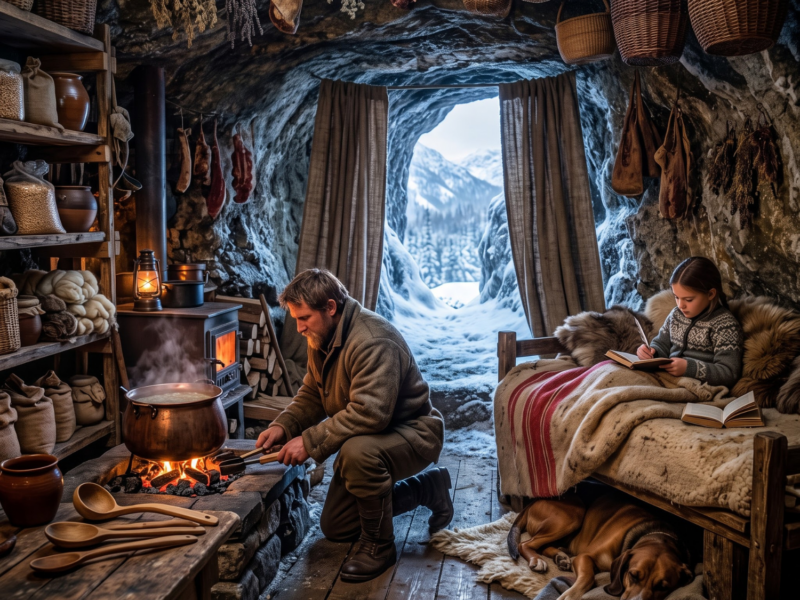
He Filled a Cave With Wool and Firewood — It Saved His Family From the Harshest Winter
The Memory of Stone
The cave first entered Thaddius Mercer’s mind as a solution in the late spring of 1888.
He had been checking the last of his winter trap lines high above Pine Hollow Basin, navigating the treacherous scree slopes, when a late, violent snowstorm rolled suddenly across the ridges. Visibility disappeared in seconds. The wind drove sharp, blinding crystals of snow horizontally through the timber.
Thaddius and his hound, Ranger, were caught exposed. Desperate for cover, they took shelter inside a shallow, black rock recess set deep into the limestone ridge and waited for the squall to pass.
More than three hours passed. Outside the cave mouth, the temperature plummeted. A thin, solid layer of ice formed rapidly across the water in his tin canteen cup.
But inside the cave, sitting in the dark, Thaddius noticed something profound. The air felt cold, yes, but it barely seemed to change. There was no wind stripping the heat from his coat. The ambient temperature was incredibly stable, insulated by the sheer, massive tonnage of the mountain surrounding them.
At the time, focused merely on outlasting the storm, he thought little about the physics of it.
But after Clara died, and he began analyzing the fatal flaws of his cabin, the memory of that stable, quiet cold returned to him.
In late August, during the blazing heat of summer, he carried a small, fragile spirit thermometer up the steep slope and placed it deep inside the darkness of the cave. That afternoon, the basin below was sweltering, sitting at a punishing 71 degrees Fahrenheit.
The thermometer at the back of the cave measured exactly 46 degrees.
Before sunrise the next morning, he returned to check it again. Outside on the ridge, the overnight temperature had fallen sharply to 34 degrees, leaving frost on the sagebrush.
Inside the cave, the thermometer still hovered flawlessly near 46 degrees.
The cave was not magically creating heat. It was simply refusing to change its temperature as quickly as the volatile world outside. The massive layers of sandstone and granite surrounded it completely on three sides and overhead. Tons of solid rock rested against the hillside, balancing the interior space with the deep, geothermal temperatures buried far beneath the surface of the earth.
Thaddius Mercer was a trapper, not a scientist. He had never heard the term thermal mass. He had never read a textbook on thermodynamics. He did not need to.
What he saw with his own eyes was a place where winter would arrive much, much more slowly. And where the heat he generated would not be instantly stolen by the wind.
He stepped to the deepest, darkest wall of the cave and pressed his bare hand flat against the rough stone. The cold there was entirely different from the biting wind outside. It was not sharp. It was not aggressive or predatory. It simply waited.
By the end of September, Thaddius Mercer had made his final, unshakeable decision.
The timber cabin would not be completely abandoned. It would still serve a practical purpose. Large, messy meals would be cooked there during the day. His heavy traps and tools would be stored there. Furs would still be cleaned, scraped, and prepared beneath its roof. Anything that required abundant natural daylight and ventilation would remain in the cabin.
But when the deep, killing cold arrived in November, he and Evelyn would sleep in the cave.
His goal was never to heat eighteen feet of solid stone the way a foolish man tried to heat a drafty summer room. He knew that was impossible. The plan was much simpler, and much more focused.
Keep the immediate shelter above freezing. Absolutely eliminate all moving drafts. Keep the bedding bone-dry. And use significantly less firewood to do it. Everything else would naturally grow from achieving those four goals.
Over several quiet evenings by the fire, he divided the massive problem of modifying the cave into five distinct parts:
-
The heavy, cold air entering through the massive entrance had to be drastically reduced and controlled.
-
Small pockets of still air had to be trapped for insulation, using raw wool.
-
Heat needed to be placed deep inside the space so the surrounding stone could absorb and reflect it, rather than losing it out the mouth.
-
Beds, human bodies, and firewood had to be physically separated from the cold, damp ground.
-
Fuel had to stay perfectly dry from the first snowfall until the spring thaw.
The solution was not a single, grand invention. It was a meticulous collection of small, calculated decisions working perfectly together.
One afternoon, while sorting supplies on the cabin porch, Evelyn stopped, looked up toward the dark ridge, and asked the question he knew was coming.
“Papa,” she said quietly, holding a bundle of twine. “Are we planning to live up there in the dirt like animals?”
Thaddius stopped working. He considered the question for a long moment, looking at his daughter’s serious, trusting face.
“No, Evie,” he told her gently. “We are not living like animals. We are simply letting the heavy hillside do the part of the work that this wooden cabin could not do for your mother.”
The answer seemed profound enough. Evelyn nodded slowly, accepting the logic, and returned to sorting pieces of raw wool into separate, neat piles.
Thaddius had specifically bartered for and gathered unwashed sheep fleeces, still heavy and greasy with natural lanolin. Years of working the snowbound, freezing trap lines had taught him a harsh, undeniable survival rule: wet cotton or damp linen was a fast death sentence. But raw wool physically shed water, and miraculously held its warmth even when completely soaked through. He had seen sheep survive blinding blizzards buried in snow drifts that froze massive cattle standing up.
To him, those dirty, greasy mats of wool weren’t just bedding. They were a flexible, impenetrable wall against the wind.
Some of the larger, cleaner panels could be stitched together into heavy, hanging curtains. Others needed patching. A few of the fleeces were too frayed and torn, and would be shredded to become dense stuffing for gaps.
The entire architectural plan existed nowhere on paper. There were no blueprints, no drawings, no precise measurements pinned to a wall. It lived entirely in Thaddius’s mind, dictated by the strict order of the heavy loads carried up the slope day after day.
Late that evening in the cabin, Evelyn was sorting through a cedar chest when she uncovered a heavy, red-striped wool blanket Clara had woven on a loom years earlier.
For several long seconds, Evelyn held the blanket quietly against her chest, her face buried in the fabric.
Thaddius stood in the doorway. He looked at the beautiful blanket, then at the dirty pile of raw wool waiting to be cut and sewn into draft curtains. He had the heavy iron scissors in his hand.
He never reached for the scissors. Instead, he walked over, took the blanket gently from her hands, folded it carefully, and set it aside on her cot.
That piece of wool would not become part of the shelter’s architecture. It would become part of Evelyn’s bed. It was the one piece of the past they would carry into the stone.









