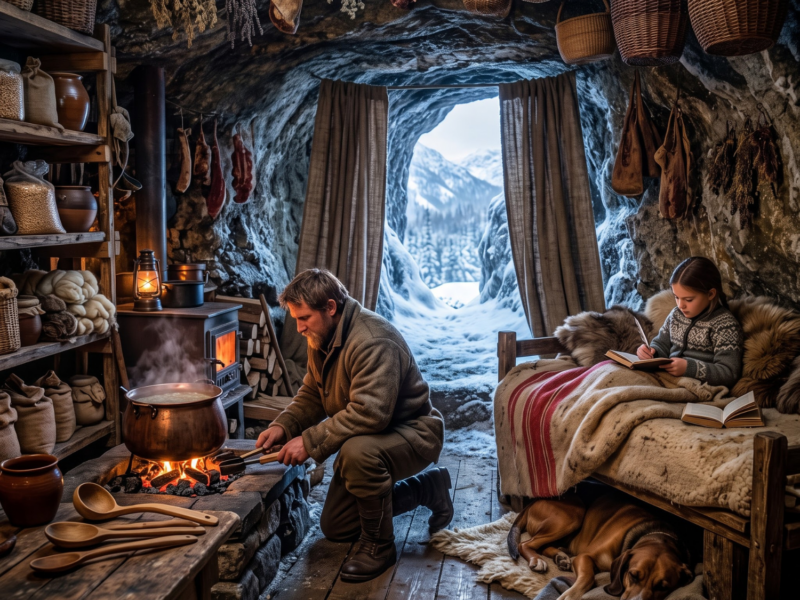
He Filled a Cave With Wool and Firewood — It Saved His Family From the Harshest Winter
The Spread of Knowledge
Spring arrived agonizingly late in Pine Hollow Basin that year.
Deep, packed snow lingered stubbornly in the shaded draws long after the lower, sun-baked ground had begun to thaw into thick mud. Travel gradually became easier between the homesteads, and with that seasonal change came something else entirely.
People started building differently.
Silas Boon moved first. The profound lesson he carried away from his visit to the cave did not become a grand speech or a public declaration at the church. It appeared instead in the form of lumber, nails, and long, sweaty afternoons of hard work.
His entire massive wood supply was physically lifted off the damp earth and stacked onto a slatted wooden platform twelve inches above the ground, to ensure airflow. Along the freezing northern wall of his timber cabin, a second, false interior wall suddenly appeared, separated from the first by a narrow, two-inch gap of dead air for insulation.
Before the threat of winter ever returned, a small, heavily insulated, offset wooden vestibule stood proudly outside Silas’s front door, forcing the cold air to physically change direction and lose its momentum before reaching the living space.
Other families across the basin made smaller, but equally vital adjustments.
One household began hanging heavy, greasy wool blankets along their windward, western wall to stop the drafts. Another family deliberately relocated their cast-iron stove away from the drafty door and closer to a newly built, massive brick masonry structure that could absorb and store the heat longer than the empty air alone.
Across the basin, little, life-saving details began spreading organically from one property to another. Nobody proudly called them “cave ideas.” They simply adopted them because they undeniably worked.
Caleb Roar never once revisited the mocking remark he had made the previous winter. The arrogant phrase about caves being “places where desperate people waited to be rescued” disappeared entirely on its own, buried by the weight of facts.
By late summer, however, the merchants at the trading post noticed something highly unusual in Caleb’s buying habits. Caleb purchased significantly more raw wool batting than he normally did. He bought large quantities of sheet metal, and several heavy bags of lime mortar.
Over the following weeks, neighbors riding past his property saw Caleb painstakingly re-chinking his entire cabin. They saw him add a secondary, heavy interior door to create an airlock. They watched him completely rebuild the roof covering protecting his precious firewood supply, ensuring it would stay bone dry.
The hard, physical work spoke clearly enough. No public apology from Caleb ever followed. And none was necessary.
When October returned to Pine Hollow, painting the chokecherry brush red once more, cabins throughout the entire basin contained architectural features that had once existed only as experiments on a rocky hillside above the town.
Air gaps. Vestibules. Raised wood storage. Massively improved weather sealing.
Knowledge had spread the way practical, life-saving knowledge often spreads on the harsh frontier: quietly, rapidly, through undeniable results, not through reputation or boasting.
As for Thaddius Mercer, he showed absolutely no interest in gloating or being proven right to the men who had mocked him.
Autumn found him right back at the cave with Evelyn.
The heavy canvas covering the vestibule, worn thin by the abrasive winter winds, was completely replaced. The hemp lashings holding the frame together were meticulously inspected, one by one. The stovepipe was dismantled, scrubbed clean of soot, and reinstalled. The stone drainage channel in the floor was cleared of any summer debris.
The intense preparation began all over again, because Thaddius knew a fundamental truth of the mountains: Winter did not care at all what had happened the year before. The past offered no protection.
One crisp afternoon in late October, Silas Boon rode his horse up the steep trail to the cave. He was carrying a massive roll of raw, unwashed wool batting tucked tightly beneath his arm.
When Silas reached the entrance, he dismounted and handed the heavy roll over to Thaddius without a word of greeting.
“I bought enough this time,” Silas said gruffly, looking at the stone. That was all he said.
Thaddius accepted the heavy roll. He considered it for a moment, feeling the greasy lanolin. Then, he took his knife and cleanly separated the roll into two perfectly equal bundles.
He handed one of the bundles back to Silas.
The rancher looked at the returned half of the wool, and then looked up at Thaddius. He smiled, a faint, understanding expression.
Neither man discussed the reason for the division. They both understood it perfectly. A man did not take what he did not need, and a neighbor did not let another neighbor face the cold unshielded.
For many long, brutal winters after that, Thaddius Mercer continued using and gently refining the cave on the hillside.
He never wrote a manual on thermodynamics, or filed a patent for his vestibule design. He left behind only a weathered, leather-bound ledger filled with numbers, a few charcoal tally marks fading on a granite wall, and a simple, enduring truth.
A brutal winter doesn’t care about land titles, arrogant opinions, or how big a fire a man can build. It yields only to the patient strength of stone, the insulation of wool, the foresight of dry wood, and the absolute necessity of careful, unblinking attention to the earth itself.









