He Filled a Cave With Wool and Firewood — It Saved His Family From the Harshest Winter
The First Assault
The first brutal assault came during the opening night of the cold wave.
The wind slammed into the mountainside with the force of a physical blow. Dry, abrasive snow piled massively against the outer vestibule and swirled violently around the entrance, desperately searching for a path inward.
The heavy outer wool curtain whipped and moved constantly in the airlock. But the inner curtain, facing the living space, barely stirred. The offset, staggered passage was doing exactly what it had been meticulously designed to do: breaking the kinetic energy of the wind and trapping the cold in the dead space.
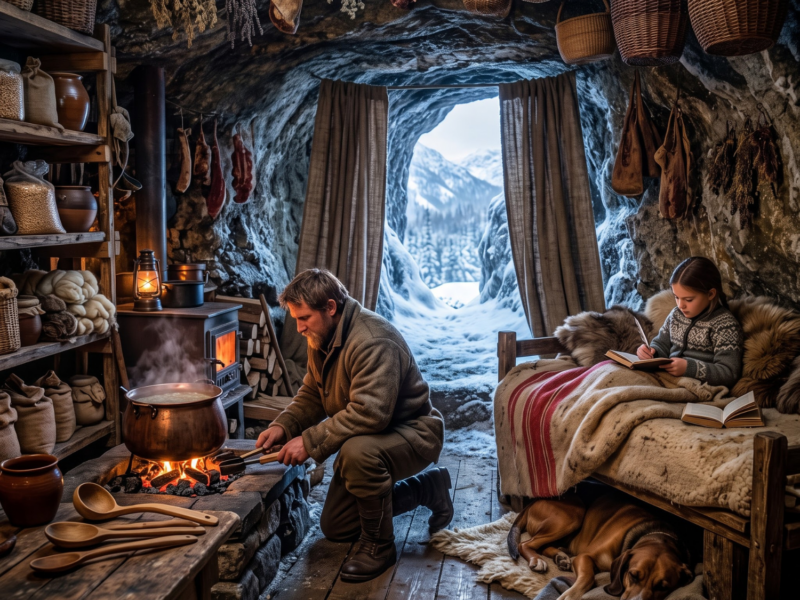
Inside the cave, Thaddius fed the small iron stove with a precise, calculated mixture of pinyon pine and juniper. The resinous pinyon ignited quickly, providing immediate, intense heat. The dense juniper burned much more slowly, leaving a deep, radiating bed of glowing red coals that would last for hours.
The heat flowed from the iron into the soapstone panels, and then outward into the massive granite shield he had built behind the stove.
Outside the cave, the temperature plunged rapidly to -24 degrees, the wind chill making it infinitely worse.
Inside the sleeping area, near the back wall, the thermometer held rock-steady near 53 degrees.
Hour after agonizing hour, the wind continued probing the structure, screaming around the rocks. The cave answered the assault by changing incredibly slowly.
Near dawn, the fire in the stove had finally collapsed into glowing coals, hidden completely beneath a thick blanket of gray ash.
Thaddius checked the thermometer. It still read 47 degrees.
On the raised platform, Evelyn slept peacefully and deeply beneath Clara’s heavy red-striped blanket. Ranger lay comfortably beneath the bed, snoring softly, with his nose tucked warmly beneath his tail. The covered water basin in the rock wall carried a thin, fragile skin of ice around its outer rim, but the bulk of the water remained perfectly liquid and drinkable.
Far below in the basin, the timber cabin told a vastly different, terrifying story.
When daylight arrived and the wind momentarily paused, Thaddius walked down the slope to inspect the old shelter.
The evidence was impossible to miss. The cold had violently entered; moisture had entered. A full water bucket he had deliberately left placed beside the inner wall had frozen completely solid, bulging the metal. Thin, stark white lines of blown powder snow had appeared beneath the heavy oak door and along several sections of the mud chinking between the logs. If they had slept there, they would have been covered in snow.
He gathered the remaining heavy sacks of dry flour and beans and carried them up the slope to the safety of the cave.
The first day did not definitively prove the cave would survive an entire, brutal winter. It proved something much smaller, but vastly more important to Thaddius.
Moving Evelyn up the mountain before the killing cold arrived had not been an overreaction. It had not been too early. It had been exactly early enough.
Later, when Thaddius returned up the slope, he found the cave utterly quiet and serene. Evelyn was still fast asleep on the platform. Ranger had placed one heavy paw protectively on the edge of her bed. Neither of them stirred as he entered, stamping the snow from his boots in the vestibule.
Without a single word, he opened the iron stove door and laid a single, thick piece of dry juniper onto the waiting, glowing coals.
The brutal cold spell did not end after a few days. It stayed. Week after agonizing week.
For more than three full weeks, daytime temperatures rarely climbed above zero. Every fresh, violent burst of wind drove the abrasive powder snow deeper and deeper into the structural weaknesses of the ordinary timber cabins in the valley.
Families down below who had felt smugly comfortable in early November began burning through their massive firewood piles far, far faster than they had ever expected or budgeted for.
Worse, the wood stacks stored outside against their exterior walls absorbed moisture from the massive, drifting snow. The logs still burned, but not well. They hissed and smoked heavily in the stoves. They produced significantly less heat. More and more wood disappeared into the hungry stoves simply to maintain the exact same, miserable, freezing temperature.
The wet, smoking wood caused thick, highly flammable creosote to accumulate rapidly inside the tin chimneys.
One log cabin on the southern edge of the basin suffered a catastrophic chimney fire in the dead of night. The terrified family managed to smother the roaring flames with buckets of snow before the wooden roof ignited, but the damaged, warped stovepipe remained dangerously in service for the rest of the winter, leaking smoke into the room.
At Silas Boon’s place, thick, white frost began forming aggressively around the interior ends of the northern wall logs. The cold was penetrating the wood deeper than usual. Silas was forced to move his children’s beds dangerously close to the red-hot stove, and he started grimly rationing their firewood by the day, rather than by the week.
Caleb Roar still possessed a larger wood supply than most settlers. Even so, the relentless winter found its opening. A powerful, hurricane-force gust violently twisted one of his heavy barn doors off its hinges. Snow drifted massively into the outer portion of his wood stack, soaking a cord of wood. His preparations had not been poor. The season was simply operating entirely beyond the parameters of ordinary human expectations.
Down in the basin, the massive wood piles shrank rapidly. People stopped checking their thermometers and started staring desperately at their calendars, wondering how long winter would last, and if they had enough fuel to make it to March.
The only exception to the terror sat high above them, hidden on the mountainside.
Inside the cave, Thaddius continued following the exact same, methodical routine. Thanks to the massive stones’ incredibly retained heat, a single, small armload of dry wood lasted four to six hours. The charcoal tally marks on the stone wall climbed upward steadily, but far, far more slowly than Thaddius had predicted in his most optimistic calculations.
One evening, Silas Boon sat in his cabin and stared at his dwindling, snow-covered wood stack out the window. Then he looked at his children, shivering violently beneath heavy wool blankets near the roaring stove.
For the first time, Silas’s thoughts drifted back to October. To the heavy loads of dry wood. To the greasy wool. To the quiet man carrying both up a steep mountainside, while everyone else in the valley mocked him and prepared for a “normal” winter.









