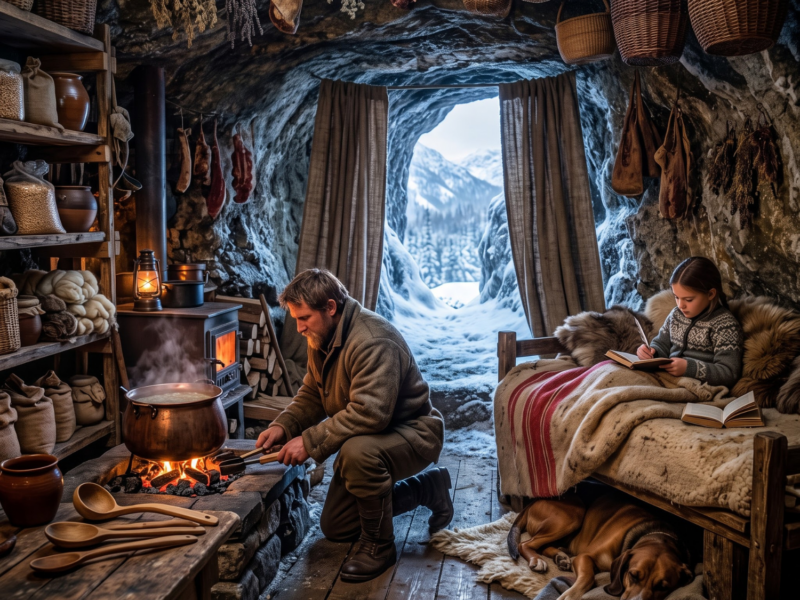
He Filled a Cave With Wool and Firewood — It Saved His Family From the Harshest Winter
Taming the Stone
Before a single wool curtain was hung, or a heavy iron stove was carried inside, Thaddius focused his intense attention on the physical cave itself. A shelter could not protect anyone if the structural integrity failed before winter truly arrived.
He started with the ceiling.
Using a long, peeled lodgepole pine pole, he systematically tapped every square foot of the sandstone overhead, listening incredibly carefully to the acoustic resonance. Solid rock answered the strike with a sharp, high-pitched ping. Loose, dangerous sections responded with a dull, hollow, vibrating note.
Anything that sounded remotely uncertain or fractured was immediately pried down with an iron bar and shattered on the floor, rather than being left hanging like a guillotine above a sleeping child.
The floor required his attention next.
The natural rock floor of the cave sloped gently toward the entrance, which was good for drainage, but two shallow, bowl-like depressions in the stone collected standing water after heavy rain.
Thaddius used a pickaxe to cut a narrow, deep drainage channel leading from the depressions straight toward the mouth of the cave. Then, he hauled up heavy canvas bags of river gravel and flat stones gathered from the hillside, completely covering the walking area and leveling the floor, elevating their boots above any potential dampness.
After the rock came the wind.
He needed to understand the invisible fluid dynamics of the air entering the space. He tied small, frayed strands of wool to sticks planted near the entrance and left them to move freely in the breeze.
He observed that most of the prevailing, brutal northern winds missed the cave opening entirely, because the mouth faced southeast. Yet, the swirling, chaotic gusts that whipped around the limestone ridge still pulled air into the cave in unexpected, turbulent directions. He noted the patterns in his ledger.
Farther inside, deep in the shadows, a thin, steady trickle of clear water seeped from a hairline crack in the stone wall. It was not much. A single tin cup could fill after several hours of dripping.
Still, Thaddius saw an opportunity. He used a chisel to enlarge a small, natural basin in the rock beneath the drip. He lined the basin with a shallow tin pan to catch the water, and expertly fitted a heavy wooden cover over the top to keep out dust. If the cave held its ambient temperature as he hoped, that tiny spring might remain unfrozen and usable even during the most severe cold snaps, saving them treacherous trips to the frozen creek below.
Meanwhile, Evelyn spent her days gathering smooth, fist-sized stones for the foundation of the future sleeping platform.
Ranger, the hound, explored every dark corner of the cave, sniffing the stone. Eventually, the dog circled twice and settled heavily near the southern wall, sighing in contentment.
Thaddius noticed this immediately. The spot Ranger had chosen was the absolute driest place inside the cave, and mathematically, it was also the most sheltered from the moving air currents he had mapped with the wool strands. Animals understood thermal comfort better than engineers.
Without saying a single word, Thaddius took a piece of charcoal and marked the spot on the wall. Evelyn proudly called it their “corner of the home.”
For the first time, Thaddius stopped looking at the rock and thinking of it as a temporary shelter. He began thinking of it, architecturally, as a room.
But the massive cave entrance was the fatal flaw. It was vastly wider than it needed to be. If left untouched, every major shift in the wind would send a fresh, freezing wave of cold air deep into the shelter, instantly stripping away any heat they managed to generate.
Thaddius had absolutely no intention of allowing that.
Using thick, peeled lodgepole pine poles he had hauled up the mountain, he built a heavy timber frame across the yawning opening. But he did not simply seal the cave behind a flat, heavy wall with a door in the middle.
Instead, he created a narrow, protruding vestibule—an airlock. It was nearly four feet long, and intentionally built low enough that a grown man had to physically duck his head to enter.
The design looked incredibly strange from the outside. It looked like a wooden box glued to a mountain. That was exactly the point.
A smaller doorway drastically reduced the sheer volume of air capable of moving in and out. The vestibule created a vital buffer zone of dead air between the violent outside world and the protected living space beyond.
More importantly, the openings did not line up. The heavy outer wooden entrance sat slightly to the right of the tunnel. The inner opening into the cave sat sharply to the left. The wind, which moves in straight lines of force, could no longer run straight through the shelter like a bullet. Its kinetic energy was broken against the wooden wall of the vestibule.
The spaces between the pine poles of the vestibule were packed incredibly tight with dry prairie grass, wet clay, and the scraps of greasy waste wool. A final layer of heavy canvas, thickly coated with a waterproof mixture of linseed oil and fine ash, completely covered the exterior, shedding snow and wind.
Evelyn carried endless armfuls of grass and wool stuffing, while Thaddius tightened the rope lashings and meticulously sealed the gaps with clay.
One afternoon, Caleb Roar rode past on the trail far below the ridge. He stopped his horse and glanced up at the strange, canvas-covered structure clinging to the rock.
“Looks like the fool is building a sheep pen on the side of a mountain,” Caleb remarked to his riding companion, spitting tobacco juice into the snow.
A few days earlier, Silas Boon might have laughed in agreement. This time, looking up at the structure, Silas didn’t laugh.
The offset, staggered entrance caught his sharp, practical attention. It looked incredibly deliberate. It looked like something built by a man who understood how wind behaved.
As evening winds swept across the hillside, howling through the pines, Thaddius placed a lit candle inside the living area of the cave and sat back to watch the flame.
Outside, the freezing gusts pushed violently through the trees. Inside, protected by the staggered airlock, the golden flame of the candle barely trembled.
Evelyn stepped through the low vestibule, pulling off her hat, and paused. Then, she smiled brilliantly.
“The wind doesn’t bite your ears in here anymore, Papa,” she said.
Thaddius only nodded, his face serious, and tightened one final knot on the doorframe.
Inside the vestibule, Thaddius hung two massive, heavy wool curtains, spacing them roughly five inches apart. The outer curtain was made from the rough, greasy wool scraps stitched together with heavy twine. The inner layer, facing the living space, was denser and softer.
Between those two curtains sat a five-inch pocket of completely still air. That trapped, dead air was the real, invisible insulation.
The first overnight test of the system looked incredibly promising.
One night in late October, the temperature outside on the ridge dropped sharply to nineteen degrees. By dawn, the ambient temperature inside the cave still remained above forty-three degrees, and absolutely no fire had been lit. The thermal mass of the stone was holding the summer heat.
But then, Thaddius noticed a critical problem.
The lower edge of the heavy outer wool curtain had frozen solid to the stone floor of the vestibule. Moisture tracked in from snowy boots, melting snow blowing in, and the warm air escaping from the interior had collected heavily in the wool fibers at the bottom. During the freezing night, the water froze solid, cementing the curtain to the rock.
It was a small problem, but a potentially fatal one. If the heavy curtain tore when yanked open, the thermal barrier failed. If it remained frozen shut, the entrance could become difficult or impossible to open from the inside when it mattered most—say, during a fire or a blizzard.
Thaddius immediately took the heavy curtain down.
He used shears to trim three inches from the bottom edge. He installed a raised, sloped wooden threshold on the floor, and used his pickaxe to cut a narrow drainage groove in the stone beneath the doorway to carry melting snow outside. Finally, a strip of soft, pliable leather was fastened along the lower edge of the wool to block the floor drafts without physically touching and freezing to the wet stone.
The following morning, the curtain remained perfectly dry and swung freely.
Evelyn looked at the newly repaired entrance, her brow furrowed. “Did the cave fail us, Papa?” she asked, worried.
Thaddius shook his head, placing a hand on her shoulder. “No, Evie,” he said. “It just told us exactly what needed fixing.”
That, he knew, was the vital difference between a mistake found safely in October, and a mistake found fatally in January.









